 Talent Summoner
How to Spot a Weak AI Shortlist Before Contacting Anyone
Use a practical pre-outreach gate to find weak evidence, unmet requirements, duplicates and unresolved unknowns in an AI candidate shortlist.
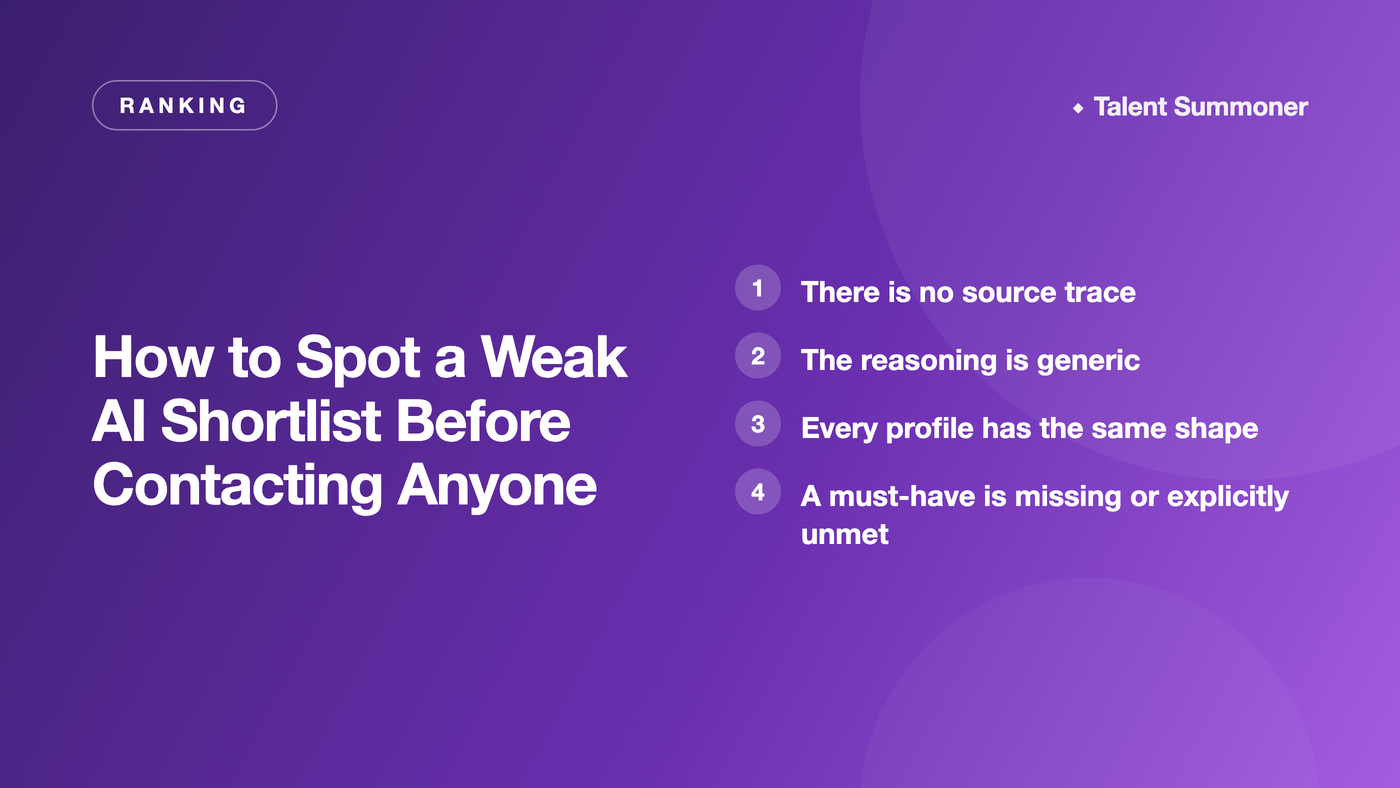
An AI shortlist can organise the first review pass, but a polished ranking may still be unready for outreach. Before contact, ask whether a reviewer can trace each important claim, relate it to the role and assign a human next action.
This is a release check, not a full ranking audit: a low rank is not a rejection, and a high rank is not permission to message. Catch output needing correction while the brief and search are easy to change.
1. There is no source trace
Stop when a result gives a conclusion without showing where it came from. Look for a relevant CV sentence, profile passage, project description or other public professional source, with date context.
"Strong technical leader" is not a trace. "Led a migration" is incomplete if the report does not show the project, scope or source wording. Copy the supporting passage beside the related requirement. If the claim cannot be traced, mark the candidate hold and do not contact them from that claim.
2. The reasoning is generic
A weak explanation could describe almost anyone in the same job family. Replace the candidate's name with another profile; if it still reads naturally, rewrite it around one concrete signal and one caveat. The wording is not proof.
3. Every profile has the same shape
If every result has the same title, technology list, employer type or career path, inspect whether the brief is over-narrow or one phrase dominates retrieval. Variation is not a quality guarantee, and uniformity is not proof that other backgrounds are absent. Stop outreach, clarify the brief or add approved adjacent routes, then rerun one controlled change. When one title or city dominates because of a minimum score, source or city filter the agent proposed, review the candidate filters before evaluation before you rewrite the brief.
4. A must-have is missing or explicitly unmet
Separate supported, unknown and contradicted. An explicit source conflict is unmet and needs a human decision. A requirement that does not appear is unknown; missing information is not proof that the candidate lacks it.
Check that the report has not turned a must-have into a nice-to-have because other signals look attractive. For an unknown, write a verification question. For a contradiction, ask the role owner whether the boundary is genuine, flexible or incorrectly written. A high rank cannot override the requirement.
5. Important unknowns are hidden
Look for missing ownership, project scope, recency, working pattern, location boundary or responsibility level. "Used Python" does not answer whether the person owned production services; "remote" does not answer whether the agreed time zone works.
Record unknowns beside the criterion. Name the question, owner and evidence that would change the disposition. A conversation may verify an open question; check a hard boundary with the role owner first.
6. Data is stale or conflicting
Compare dates and claims. A current-looking title may conflict with an older CV, project dates may overlap, or one source may describe support while another says ownership. These are signals, not automatic disqualifiers.
Pause when the conflict changes a must-have or boundary. Preserve both versions, identify the more specific or recent source and write one neutral question. Do not choose the version that makes the match look strongest.
7. The shortlist contains duplicates
Check for the same person under a different name format, profile URL, employer snapshot or source variant. Duplicates distort the list and can lead to repeated messages. Keep one canonical record and mark the duplicate as merged or removed by a human. If identity cannot be resolved, hold the row rather than guessing.
8. No human owns the next action
Do not release a shortlist that only has ranks. Each candidate needs progress, verify, hold or revise, a job-related reason and a named owner. "Contact" is not an owner: specify who checks the source, approves the message and records the response.
A practical stop/fix rule
Use stop for an explicit must-have conflict, unresolved material contradiction, untraceable claim or duplicate identity that could cause repeated contact. Use fix for generic reasoning, a repeated pattern, a hidden unknown or a missing owner. Correct the brief, evidence or workflow, then rerun or review. No flag is an automatic rejection or claim about ability.
Where Talent Summoner fits
Talent Summoner is our product for AI candidate sourcing, CV ranking and outreach you confirm before it sends. The live candidate-ranking tool, checked 19 August 2026, accepts up to 50 CVs in PDF, DOCX, MD or TXT, requires no account and creates a shareable report. Inspect evidence, resolve flags and choose whom to contact.
When the pool needs rebuilding, candidate sourcing starts from a role brief and searches LinkedIn, GitHub and other public professional sources across 200M+ profiles. It returns must-haves, nice-to-haves and plain-English reasoning; feedback can adjust later search and weighting. See pricing for options.
Bottom line
Before outreach, trace the reasons, challenge generic explanations, inspect patterns, separate unknown from unmet, resolve stale data and duplicates, and assign a human owner. Release only when open questions are visible and owned.
FAQ
Is a low-ranked candidate automatically a weak candidate?
No. Rank is a review priority, not a hiring decision. Inspect evidence and criteria before deciding whether to progress, verify or revise.
Does missing evidence mean the candidate lacks the requirement?
No. Mark the criterion unknown and create a verification question. Missing information is not proof of absence.
Should I contact someone when a must-have is unknown?
It depends. A conversation can verify an open question, but check a hard boundary with the role owner first. Record the decision and owner.
Can Talent Summoner automatically reject candidates?
No. Talent Summoner supports ranking and review; your team owns verification, outreach and decisions. It is not an ATS and does not automatically reject candidates.
Related: How to Read Evidence Behind a Candidate Match · How to Evaluate an AI-Ranked Candidate Shortlist · How to Compare Two Candidate Profiles Fairly
Talent Summoner product facts read from our live candidate sourcing, candidate ranking and pricing pages, verified 19 August 2026. We re-verify this page quarterly — tell us if something changed.