 Talent Summoner
How to Write a Technical JD That Produces Better Matches
Write a clearer technical job description with outcomes, evidence, boundaries and a candidate-friendly application route.
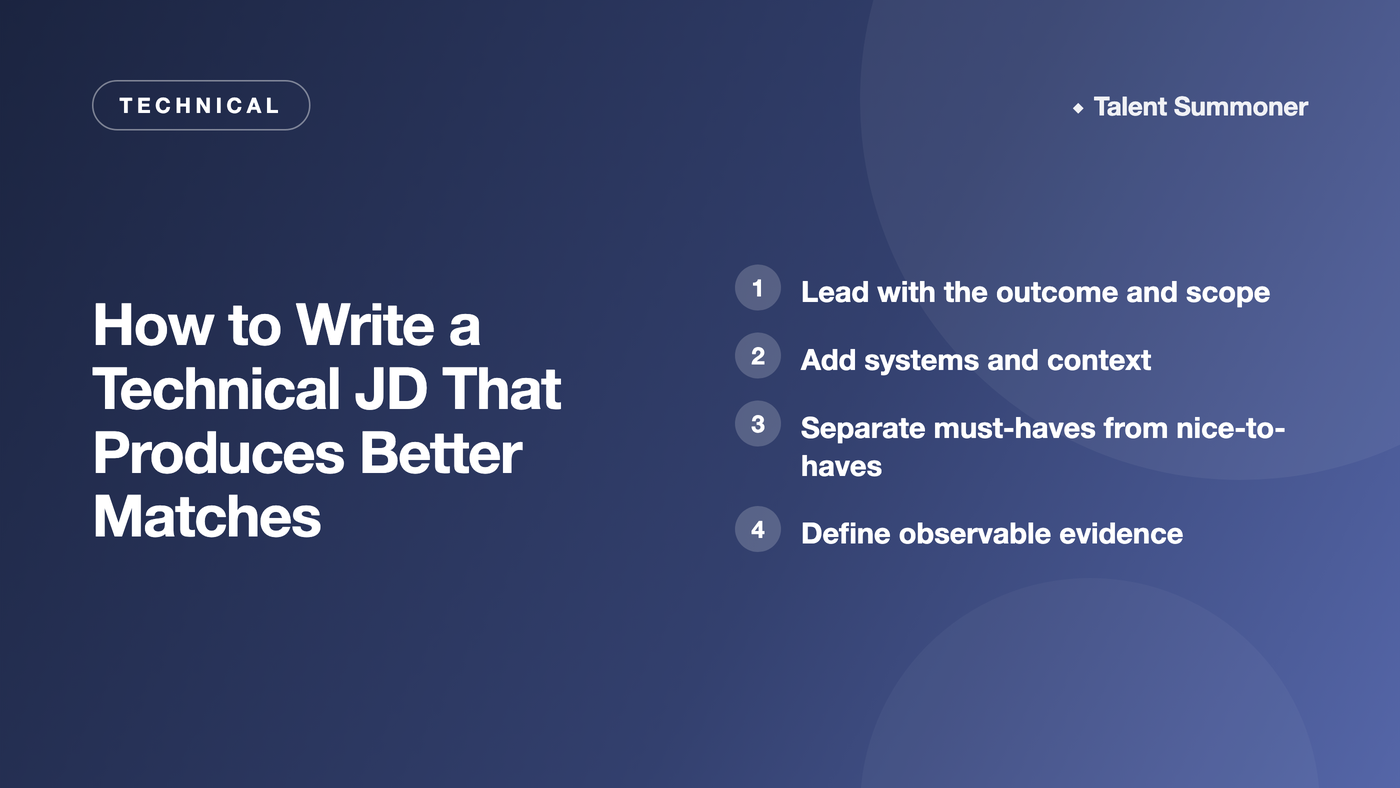
A technical job description (JD) is both a candidate-facing invitation and a search signal. "Better matches" does not mean guaranteed hires or a higher ranking. It means the role is specific enough for relevant people to recognise the work and for your team to review comparable evidence.
Write the public JD around the job, not an internal wish list. Keep founder questions and approval notes separate.
1. Lead with the outcome and scope
Open with the problem this person will solve and the outcomes they will own, without promising an exact result. For example: "Own the service that processes customer events, improve its reliability and make incident response repeatable."
Define the product or service, system boundaries, collaborators and exclusions. Explain whether the person designs, implements, operates, mentors or decides. Do not substitute "rockstar" or "senior" for that information.
2. Add systems and context
Name the technical environment where it helps a candidate judge the work: languages, data stores, cloud setting, deployment model, scale or reliability context. Explain why; "Python and PostgreSQL for a customer-facing workflow" is more useful than an unconnected tool list.
Include team shape, collaborators, on-call expectations and decisions this role can make. If a technology is learnable, say so.
3. Separate must-haves from nice-to-haves
Keep must-haves to conditions genuinely required for the approved work, such as owning production incident response or working a stated schedule. A nice-to-have might be a particular cloud provider or domain. Explain the value of each preference and do not let it disguise a requirement.
Remove inflated or proxy requirements. Unneeded years, a prestigious employer, a particular degree, "culture fit" or a long tool list can screen for familiarity instead of capability. Keep a qualification when the work or an approved constraint requires it; otherwise describe the underlying skill.
4. Define observable evidence
For every important requirement, state what a candidate might have done: owned a system, delivered a migration, made a design decision, completed a work sample or earned a qualification. Include scope and context: "designed and operated an API used by several internal teams" gives more to review than "API experience".
Allow equivalent routes through different titles, stacks or organisations. Treat missing profile or CV wording as unknown to verify, not automatic absence, and use the same evidence question for comparable applicants.
5. Publish practical boundaries
State location, remote or hybrid pattern, office days, time-zone overlap, travel, employment type and authorisation when relevant. Be direct about on-call coverage. Include compensation range, currency and variable elements when your organisation chooses to publish them or a local requirement applies. Confirm requirements with HR or legal advisers.
6. Explain the process and route in
List interview stages, who candidates will meet, any work sample, the decision sequence and a realistic contact route. Explain how to request an adjustment or alternative format for the application or assessment, with a monitored email or form. Avoid personal information that is not needed to assess the role.
Before and after: a technical JD example
Before: "We need a senior backend rockstar with 8+ years, top-tier company experience, Kubernetes, AWS, Go, Kafka, a computer science degree and exceptional communication. Fast-paced culture. Apply with your CV."
After (example): "Own the event-processing service used by our product teams: plan changes, ship Go services, operate deployments and lead incident follow-up. Work with product and security in a four-person platform team. Production-service ownership and explaining trade-offs are required; Kafka or AWS is helpful, with equivalent event-driven systems welcome. Hybrid in Hong Kong, two office days and shared weekday on-call. Process: conversation, technical discussion and paid work sample. Request an alternative format at hiring@example.com."
The second version gives candidates a useful picture while leaving room for adjacent evidence. Replace its fictional contact and conditions with approved facts.
Copyable technical JD checklist
Map the JD to Talent Summoner
Talent Summoner is our product for AI candidate sourcing, CV ranking and outreach you confirm before it sends. Its candidate-sourcing tool, checked 19 August 2026, starts with a role brief and searches LinkedIn, GitHub and other public professional sources across 200M+ profiles. It returns a ranked shortlist with must-haves, nice-to-haves and plain-English reasoning. A clear JD supplies outcomes, context, boundaries and evidence; the hiring team verifies sources and decides whom to contact.
FAQ
How long should a technical JD be?
Explain work, evidence and boundaries, but keep it scannable. Remove repeated copy.
Should every technology be a must-have?
No. Make it a must-have only when the approved work depends on it and an equivalent is not workable. Otherwise label it context or a nice-to-have and describe the underlying capability.
Do years of experience improve a technical JD?
Only when they represent a real operating need. Prefer an observable responsibility, such as owning production incidents, and state equivalents.
Can Talent Summoner guarantee better matches?
No. Talent Summoner organises sourcing and ranking around the role brief, but public evidence is incomplete; your team owns verification, outreach, interviews and the final decision.
After confirming outcomes, boundaries and evidence, start a sourcing search, review surprising matches and check pricing.
Related: How to Hire Software Engineers · How to Find Backend Engineers · How to Find AI Engineers
Talent Summoner product facts read from our live candidate sourcing, candidate ranking and pricing pages, verified 19 August 2026. We re-verify this page quarterly — tell us if something changed.