Talent Summoner
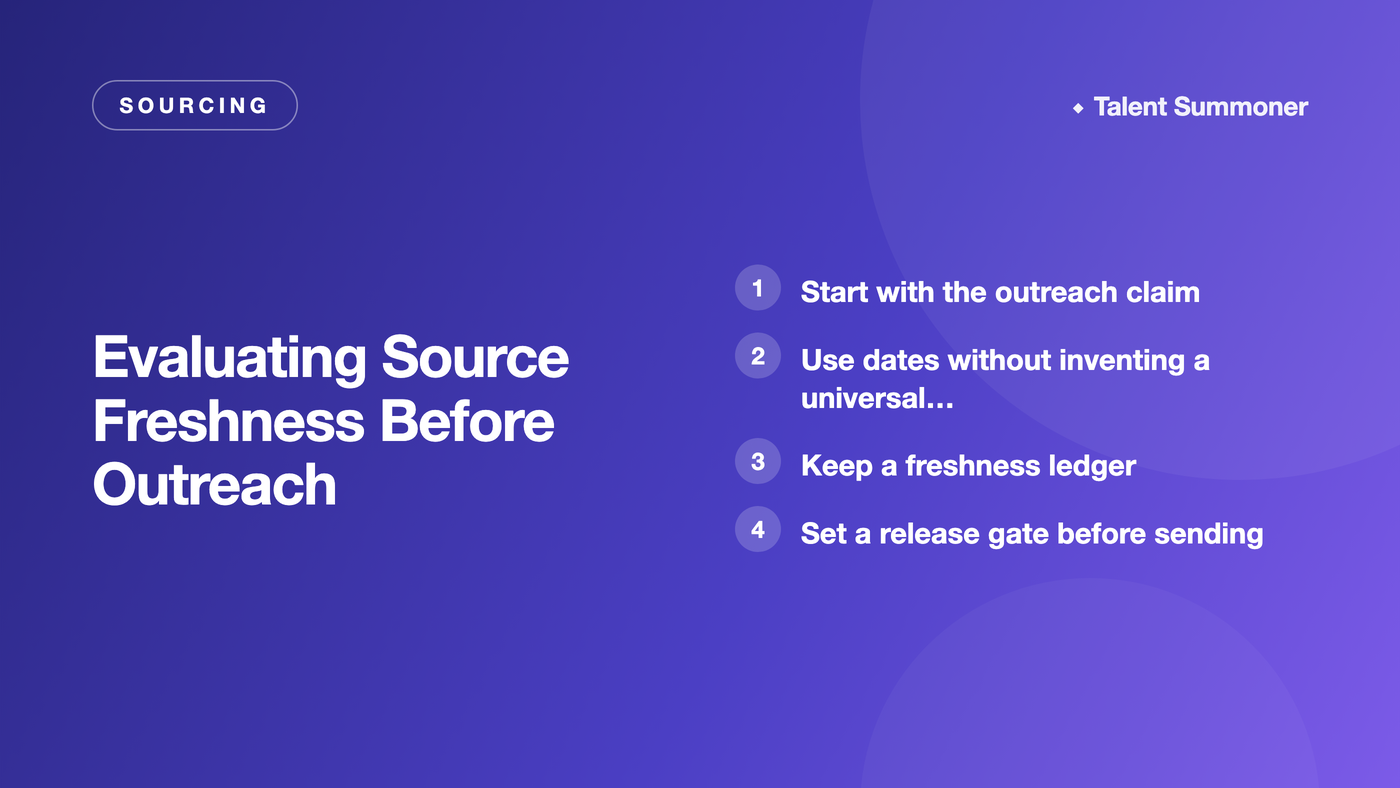
Evaluating Source Freshness Before Outreach
Use a claim-level freshness check before candidate outreach, with a simple evidence record, stop rules and human review for uncertainty.
Source freshness is not a property of a whole candidate profile. It is a judgement about whether evidence is recent enough for a particular hiring action. A job title may be useful as a discovery clue while being too old to support a message that says, “Your current work looks relevant.”
Before outreach, evaluate the evidence behind the reason for contact. Record what was observed, when, what it can support and what remains unknown.
Start with the outreach claim
Write the smallest job-related claim that the message needs, such as “this person has published work involving the role’s technical area”. Do not start with “Is this profile fresh?”
For each claim, define the action it would support and evidence that could support it:
| Outreach claim | Useful evidence | What it does not establish |
|---|---|---|
| The person has relevant recent work | A dated project, role description or publication with clear attribution | Current interest, quality or availability |
| The role may fit the stated location | A current location or work arrangement stated by the person or an authoritative source | Permission to contact or willingness to relocate |
| The person may recognise the problem space | Described responsibilities, project context or public work connected to the role | Performance, seniority or personal motivation |
Keep the message narrower than the evidence. If the source shows a past project, ask whether the person would be open to hearing about the role; do not present it as current employment.
Use dates without inventing a universal threshold
Capture the source date, record-entry date, human review date and outreach-decision date where available. A page with no visible date should be marked “date not shown”, not assigned a guessed publication date.
There is no universal freshness window. A recent conference biography may support a narrow subject claim but not a current employer claim. A dated project page may remain useful background while a location field can change quickly. Set the rule by claim and role, and document who approved it.
Use these labels as a team vocabulary:
- Current enough for this claim: the source and review date support the limited wording planned.
- Dated but usable as context: the source may guide a verification question, but the message must not call it current.
- Date not shown: consider it only if its content and provenance justify a narrow, cautious reason for contact.
- Conflicting: sources disagree about a material fact; resolve it or hold outreach.
- Insufficient: the source does not support the claim, even if the page itself is recent.
These labels describe evidence, not a person’s value. Missing updates are unknowns, not proof that relevant work stopped.
Keep a freshness ledger
Use one row per material claim, rather than one overall profile score:
Person / record ID:
Role brief version:
Outreach claim:
Source URL or record ID:
Exact source wording or excerpt:
Source date: shown / not shown
Observed or captured on:
Last human review:
Freshness label:
What this supports:
What remains unknown:
Verification question:
Decision: send / verify first / hold / do not use
Owner and review-by date:
Review the source, not only a search snippet or copied summary. Preserve its context and note duplicates, reposts or directory entries. Repeated text is not independent confirmation. If a source is inaccessible, record that limitation rather than infer its contents.
Set a release gate before sending
Use four questions at the release gate:
- Is the outreach reason tied to an approved, job-related requirement?
- Does the cited evidence support the exact wording, or does the message overstate recency?
- Are material unknowns and contradictions visible to the human sender?
- Has the team checked its contact, suppression and privacy process for this person and channel?
Choose send only when the wording is accurate and the responsible person accepts the remaining uncertainty. Choose verify first when one focused question could change the reason for contact. Choose hold when the source is conflicting, inaccessible or too weak for a respectful message. Choose do not use when the evidence is irrelevant, improperly obtained under your process or based on a sensitive inference.
The UK's Information Commissioner's Office (ICO), in guidance published 6 November 2024 and checked 2 September 2026, says organisations using AI in recruitment should consider lawful basis, transparency, fairness, accuracy monitoring and collecting only the minimum personal information required. This is general information, not legal advice; apply rules relevant to the employing entity and location.
Where Talent Summoner fits
Talent Summoner is our product for role-based candidate discovery. Its candidate-sourcing workflow, checked 2 September 2026, starts from a role brief and searches LinkedIn, GitHub and other public professional sources across 200M+ profiles, returning a ranked shortlist with must-haves, nice-to-haves and plain-English reasoning. Use it to prioritise records for review; it does not establish that a profile is current or choose whether to contact someone.
When the input is an existing CV set, candidate ranking is the separate workflow for organising supplied CVs against a job description. It does not refresh public profiles or maintain contact history. Talent Summoner does not send automated outreach or manage an ATS pipeline. Review pricing for current Role options after approving the search and review capacity.
How recent should a candidate source be before outreach?
There is no universal number of days. Set a claim-specific rule, record source and review dates, and change the message or verify the fact when evidence is dated or unclear.
Does a current job title prove that a candidate is available?
No. A title can support a discovery clue, but it does not establish interest, availability, performance or permission to contact. Treat those as separate questions.
What should I do when a profile has no date?
Mark “date not shown”, preserve the source and narrow the claim. If the evidence cannot justify a respectful, job-related reason for contact, hold the record or ask an approved owner to verify it.
Can Talent Summoner check source freshness for me?
No. Our product helps discover and rank public-source results. A human still reviews the source, records uncertainty, checks the organisation’s contact process and decides whether and how to send outreach.
Take one approved role brief and audit the evidence behind one proposed message. Record the freshness label, verification question and owner before deciding send, verify, hold or do not use. Then start a focused candidate-sourcing search, or use candidate ranking for an existing CV set, and keep the outreach decision with its evidence record.