 Talent Summoner
Reasonable Adjustments for Interviews: What to Ask and Change
A guide for hiring managers in Great Britain: what to ask after an interview adjustment request, what to change and keep, plus a reply to copy.
 By Derek Chau · Published · in Hiring Process
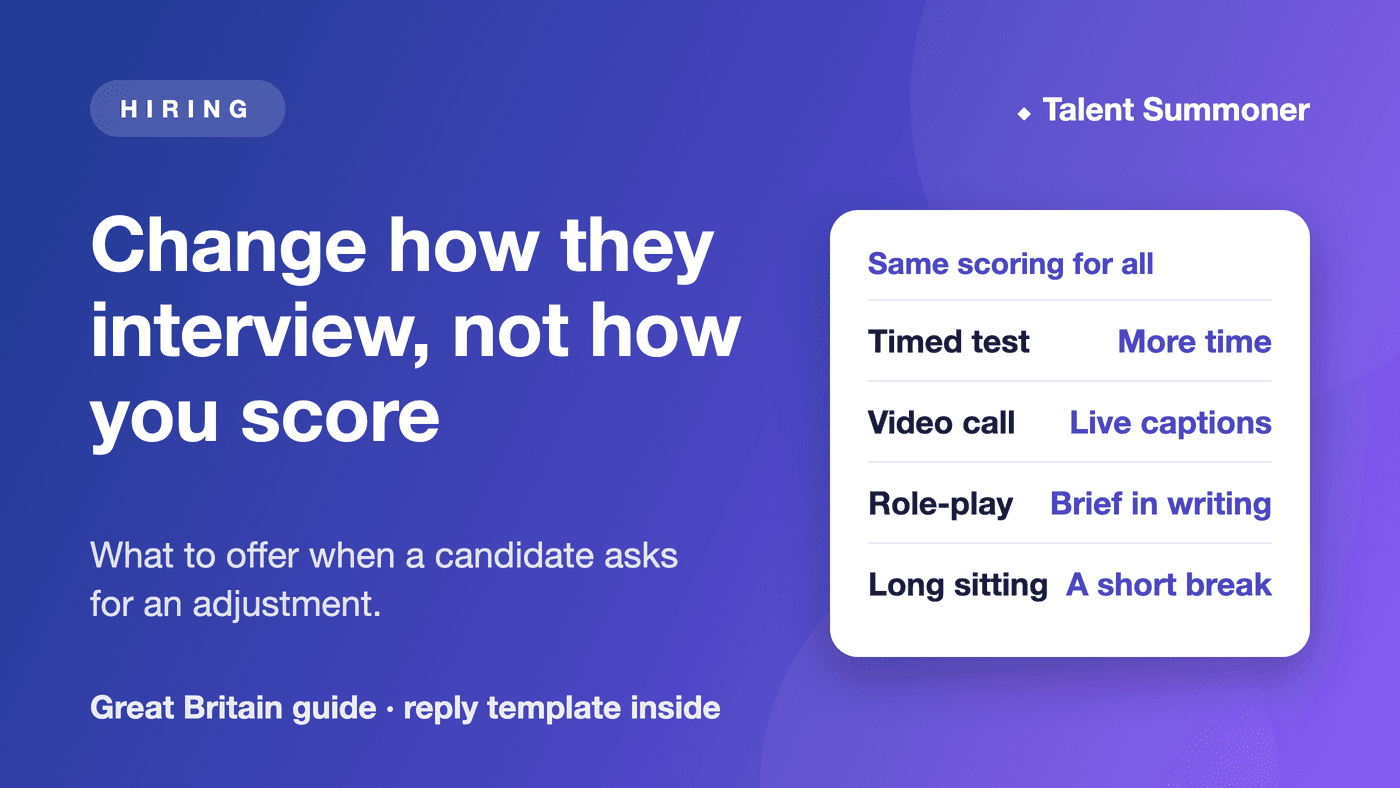
When a candidate asks for a reasonable adjustment to an interview because of a disability or health condition, ask what would remove the barrier, change how the interview is delivered, and keep scoring what the job truly requires. A request tells you how someone needs to take part, not how well they will do the job.
We build Talent Summoner, which turns one role description into a ranked shortlist; your first Role is free, with no card needed. It works before the interview, so this guide stands on its own.
This guide is for hiring managers in England, Scotland and Wales, and it is not legal advice. Northern Ireland has separate disability law, and the legal points here do not carry over to it or to other countries.
What can I change without changing how I score?
Change the way a candidate takes part, and keep measuring what the job truly needs. What you must do depends on the person.
More time, a sign language interpreter and an accessible room are Acas examples. Live captions, a written scenario and a break are common options.
| Interview element | Adjustment | What stays the same |
|---|---|---|
| Timed written test | More time to read and write | Same questions, same marking guide |
| Video interview | Live captions or a sign language interpreter | Same questions, same order |
| Interview room | A room the candidate can reach and enter | Same panel, same scoring sheet |
| Live role-play | The scenario sent in writing beforehand | Same scenario, same criteria |
| One long sitting | A scheduled break | Same total content |
What do I do when a candidate asks for an adjustment?
Follow the same five steps every time, so nobody gets a different process.
- Thank them and ask what would help. Ask about the barrier, not the condition.
- Check the change against your criteria. If it would alter what you measure, ask whether the job truly needs that criterion, because the duty can cover a criterion itself (Equality Act s.20).
- Confirm the arrangement in the format the candidate asked for.
- Tell the panel the arrangement, not the reason.
- Score every answer against the same criteria as everyone else.
Add one line to every interview invitation: "Please tell us if you need any reasonable adjustments so you can attend."
When someone asks, here is a reply you can adapt:
Hi [Name], thank you for telling us. Could you let us know what would make the interview work best for you, and how you would like us to confirm the arrangements? Once we have your answer we will write back with the final format, the time and who you will meet.What do employers in Great Britain have to do?
These points come from Acas pages checked on 2 November 2026 and the Equality Act, which covers England, Scotland and Wales. The reasonable adjustments page was last updated on 30 January 2025, and the interviewing page on 30 June 2026.
- Under the Equality Act 2010, employers must make reasonable adjustments for disabled job applicants. The duty applies when the employer knows, or could reasonably be expected to know, that the person is disabled.
- Acas says that by law you must ask anyone coming to an interview to tell you if they need reasonable adjustments so they can attend.
- Before an offer, you must not ask about an applicant's health, with narrow exceptions. One covers whether adjustments are needed for an interview or other assessment (section 60).
- The employer is responsible for paying for reasonable adjustments.
- You do not have to change the basic nature of the job.
Acas says to talk with the person and not make assumptions about what will help.
What does this look like for a customer success interview?
Fictional example: Sam runs hiring at a 12-person software company. The customer success interview is 45 minutes on video, with a live role-play and a screen-share exercise.
Priya, a candidate, asks for captions, the role-play brief in writing, and a short break. Sam asks what would help most, offers a quick call to confirm, and never asks about a diagnosis.
Priya also asks about the screen-share exercise.
Sam turns on live captions, emails the scenario the day before, and adds a five-minute break at the halfway point. The screen-share exercise tested nothing the job needs, so Sam swaps it for a spoken walkthrough of the same problem.
The panel hears the arrangements, not the reason. Every candidate is scored on the same three criteria: explaining clearly, prioritising, and handling an upset customer.
Afterwards Sam asks the panel whether the format got in the way of any answer. If it did, Sam asks one follow-up question instead of marking that answer down.
When is this approach wrong for you?
Use something else in these cases:
- You hire outside Great Britain, including Northern Ireland. The law differs and this guide does not cover it.
- The request would change what the job requires. Call the Acas helpline before you decide, since the duty has limits.
- You need a legal answer for a specific person. Ask the Acas helpline or an employment lawyer.
Where does Talent Summoner fit?
Talent Summoner works before any interview. Its candidate sourcing searches LinkedIn, GitHub and other public sources from a role description, and candidate ranking scores up to 50 uploaded CVs against a job description (both checked 2 November 2026).
Each tool explains its scores, and you decide who gets an interview. Talent Summoner does not send LinkedIn InMail or sync with an ATS today, and the adjustment process in this guide stays with you.
We re-check the product and source facts on this page every quarter.
FAQ
Does an adjustment request mean a candidate will perform worse?
No. A request describes how someone needs to take part, so score their answers against the same criteria as everyone else.
What should I ask a candidate who requests an adjustment?
Ask what would remove the barrier and how they want the arrangements confirmed. Acas says employers should talk with the person and not make assumptions.
Who pays for an interview adjustment in Great Britain?
Acas says the employer is responsible for paying for reasonable adjustments. It also says a small employer might not be able to afford as much as a large one.
Do I have to ask candidates if they need adjustments?
In Great Britain, Acas says you must ask anyone coming to an interview to tell you if they need reasonable adjustments so they can attend.