Talent Summoner
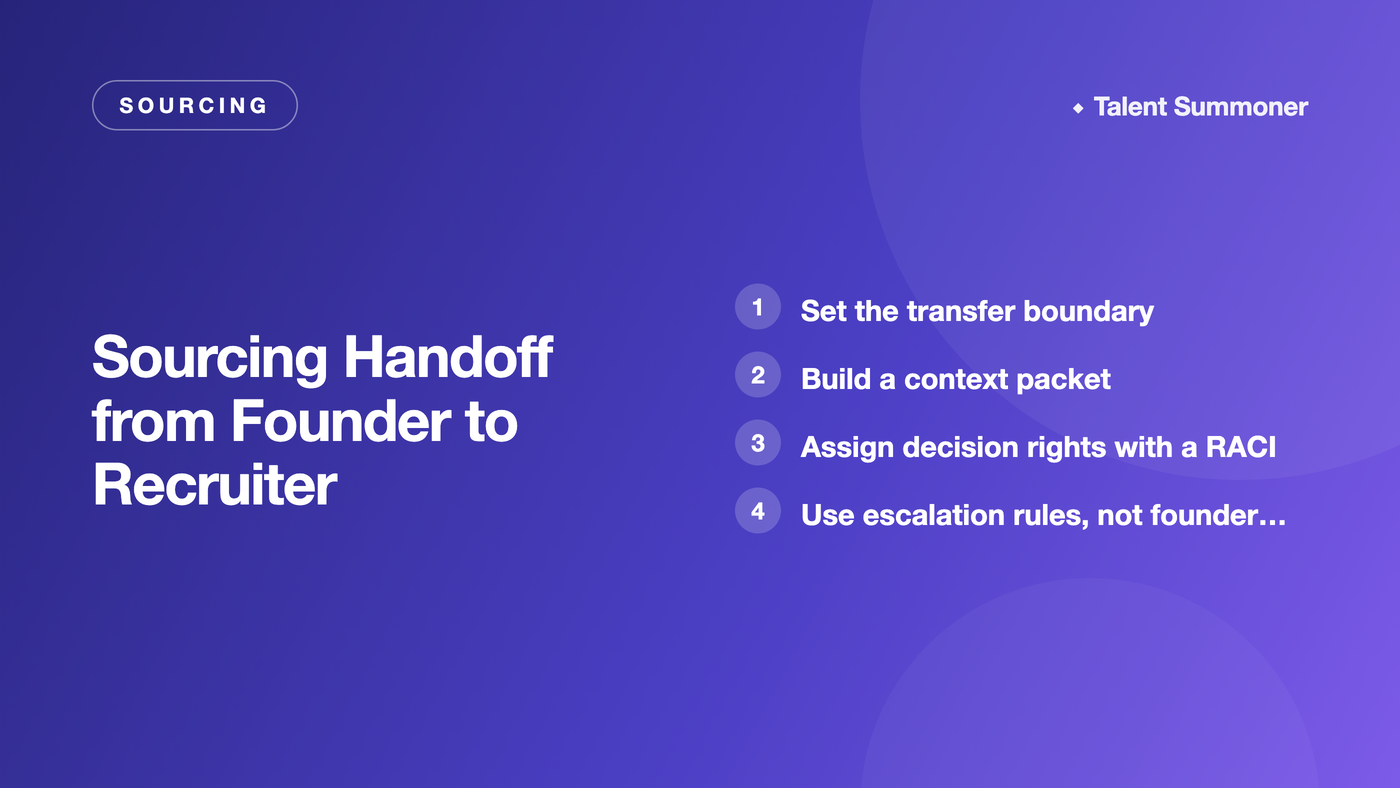
Sourcing Handoff from Founder to Recruiter
Transfer a founder-led sourcing effort to recruiter ownership with a context packet, decision rights, evidence handoff and first-week acceptance checks.
A founder often starts sourcing because they hold context: why the role matters, which trade-off is acceptable and why a person looked promising. The handoff must transfer that context, evidence and authority to act.
Treat the transfer as an operating agreement for one role. It should tell the recruiter what is fixed, what can change, what each record means and who resolves an exception. The founder can remain the final hiring decision-maker while the recruiter owns sourcing and its day-to-day record.
Set the transfer boundary
Write the boundary before the recruiter starts. Include the role version, handoff date, founder's remaining decisions and recruiter's first action. State whether inherited candidates may be contacted, the approved communication route and the authoritative record. An inherited record or public source is not contact permission; verify the current basis before contacting and record that decision. Keep permission, compensation, working pattern and role changes out of informal conversation.
The founder should explain the reasoning behind the brief, not ask the recruiter to preserve every preference. Separate a firm requirement from a hypothesis. If an assumption is no longer useful, raise it for a decision rather than silently rewriting it.
Build a context packet
Keep the packet in the team's existing recruiting record. A versioned, access-controlled document linked to candidate records is enough. Include:
| Packet item | Minimum content | Acceptance test |
|---|---|---|
| Role decision | Outcome, responsibilities, approved constraints, must-haves, preferences and version date | Recruiter can describe what is in and out of scope without a private explanation |
| Founder context | Why the role opened, trade-offs already considered, assumptions and unresolved choices | Each assumption is labelled as a decision, question or hypothesis |
| Sourcing record | Sources and search wording tried, dates, useful observations and routes intentionally not used | Recruiter can avoid repeating work and can explain what the record does not cover |
| Candidate ledger | Source URL or reference, date, job-related signal, interpretation, unknowns, status, contact history and next owner | Every inherited record has a traceable next action or a recorded hold |
| Open decisions | Issue, options, decision owner and the point at which it blocks action | The recruiter knows where to escalate instead of guessing |
| Access instructions | Permitted viewers, approved use, retention or deletion instructions and the system of record | The receiving team confirms access and handling expectations |
The candidate ledger is the core evidence handoff. Rewrite "excellent fit" into an observable record: "the public role description names ownership of API reliability; scope and recency remain unknown; recruiter to verify in an approved conversation." This preserves the lead without turning an impression into a fact. Missing information remains unknown, not a reason to close someone.
The Information Commissioner's Office (ICO) guidance on AI-assisted recruitment, published 6 November 2024 and checked 2 September 2026, advises organisations to document responsibilities and processing instructions, limit unnecessary personal information and explain how information is used. These controls are useful even when the packet is manual. This is general information, not legal advice; apply the rules for the employing entity, location and process. The NIST AI Risk Management Framework is voluntary guidance, not a certification or hiring standard.
Assign decision rights with a RACI
RACI means Responsible (does the work), Accountable (owns the decision), Consulted and Informed. Use one accountable owner per activity. This is an illustrative example for a founder, recruiter, functional reviewer and operations or HR partner; adapt it.
| Activity | Founder / role owner | Recruiter | Functional reviewer | Operations / HR |
|---|---|---|---|---|
| Confirm the role brief and trade-offs | A/R | C | C | C |
| Run approved sourcing and maintain records | I | A/R | I | I |
| Decide whether a profile is in scope | I | A/R | C | I |
| Change a must-have, location, work pattern or compensation boundary | A | R | C | C |
| Resolve a specialist evidence question | I | R | A | I |
| Handle access, contact restrictions or retention questions | I | R | I | A |
| Make the final hiring decision | A | C | R | I |
The recruiter is not responsible for employment approval or final selection. The matrix prevents the founder from remaining the hidden approver for routine sourcing. Record changes with the packet version.
Use escalation rules, not founder interruptions
The recruiter should act independently inside the approved boundary. Escalate if an action would change the role, promise terms, use a new category of personal information, bypass a contact restriction or rely on a material claim that cannot be checked. Also escalate conflicts in the record, an unowned candidate question or an unavailable decision owner.
For an escalation, record the trigger, affected candidate or role field, options, temporary state and accountable decision-maker. Pause only the affected action; do not erase the earlier record. A routine unknown can become a recruiter-owned verification question. A material boundary change belongs with the founder and relevant operations, HR or legal owner.
First-week acceptance checklist
Use this checklist at the end of the first week after transfer:
- The packet has a version, handoff date, system of record and named owners.
- The recruiter can restate the role boundary, current assumptions and approved contact route without relying on the founder's memory.
- Every inherited candidate has a source, date, job-related reason for inclusion, unknowns, status and next owner.
- The RACI identifies one accountable owner for routine sourcing, material brief changes, access questions and final selection.
- The recruiter has made at least one in-scope record decision and documented the reasoning in the shared system.
- Open escalations name the decision-maker and the next review point; no blocking question is sitting only in chat.
- The founder is receiving exceptions and decisions, rather than redoing routine profile review.
The handoff is accepted when the recruiter can run the agreed work and another reviewer can reconstruct each candidate decision. A meeting or forwarded list is not acceptance.
Where Talent Summoner fits
Talent Summoner is our candidate sourcing and ranking product. Its candidate-sourcing workflow starts with a role description, searches LinkedIn, GitHub and other public professional sources, and returns ranked results against must-haves and nice-to-haves with plain-English reasoning. Use that output in the packet; your team records the source, interpretation, unknowns, owner and decision.
If the founder already has CVs, the candidate-ranking tool can create a ranked, shareable report from supplied material. It does not manage an ATS pipeline, send outreach, verify every claim or make the hiring decision. Review pricing for current Role options, then keep the handoff record in your system.
Next step
Before the next founder-led search changes hands, create the packet, complete the illustrative RACI and ask the incoming recruiter to acknowledge the checklist. Once accepted, start the candidate-sourcing workflow and attach its reviewable output to the shared role record.
What should be in a founder-to-recruiter sourcing handoff?
Include the role boundary, founder assumptions, tried routes, candidate evidence and unknowns, contact history, open decisions, access instructions and named owners. Version and date it.
Does the recruiter own the final hiring decision after the handoff?
Not necessarily. In the illustrative RACI, the recruiter owns routine sourcing and records while the founder remains accountable for material brief changes and final selection. Set the actual rights explicitly.
What should the recruiter do when founder notes and evidence disagree?
Keep source observation and founder interpretation separate, mark the conflict and escalate it to the accountable owner. Do not convert an impression into a fact or delete the original note.
Can Talent Summoner manage the founder-to-recruiter handoff?
No. Talent Summoner is our sourcing and ranking product. It can provide ranked sourcing results or a report from supplied CVs, but your team owns the record, outreach, verification, interviews and decisions.