 Talent Summoner
A Founder's Hiring Workflow for One Open Role
A practical founder hiring process for one open role, with stage owners, decision gates and clear hand-offs from approval to close.
 By Kevin Wong · Published · Updated · in Hiring Process
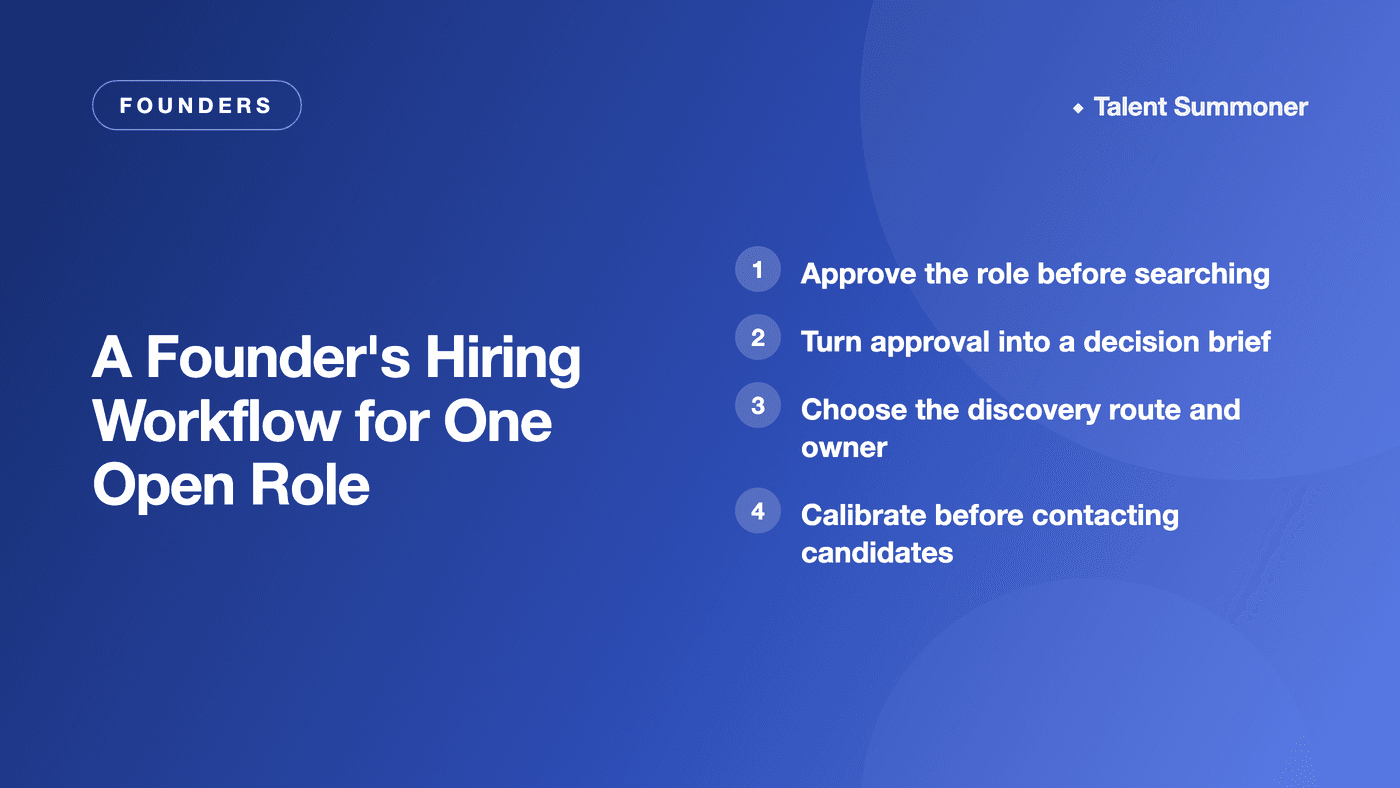
One open role needs an explicit process, even when a founder is recruiter, hiring manager and final approver. Without hand-offs, decisions disappear and an offer can arrive before anyone knows who owns the next step.
Use one sequence: approve the need, define the decision, discover and review candidates, assess consistently, decide, offer and close. Give every stage one accountable owner and a gate. A gate is a decision to move forward, pause or change direction; it is not a promise about hiring speed.
1. Approve the role before searching
The founder or budget owner approves why the role exists, its work, manager, working arrangement and pause conditions. If scope, budget or management is unresolved, stop here. A vague request for "someone good" is not an approved role.
2. Turn approval into a decision brief
The hiring manager owns the brief, with the founder as reviewer. Describe the outcome, must-haves, preferences, working constraints and acceptable adjacent backgrounds. Add an evidence question to each must-have. A missing signal is not proof that a person lacks a capability.
Ask a credible reviewer to challenge the outcome and requirements. Record the brief version and who can change it. The release gate is shared understanding, not merely a completed job description.
3. Choose the discovery route and owner
The founder or delegated search owner chooses applications, referrals, communities, direct research or a suitable combination. Keep pool evidence separate: an application shows what someone submitted; a public profile may show a project but not availability or interest.
Talent Summoner is our product for AI candidate sourcing, CV ranking and outreach you confirm before it sends. As verified on 3 October 2026, candidate sourcing starts from a role brief and returns public-source discovery material for human review. For collected CVs, candidate ranking is a separate workflow. Sourcing discovers possibilities outside an existing pool; ranking organises material the team already has.
4. Delegate review without losing authority
Break the work into evidence preparation, evidence labelling, triage and decision. A delegated reviewer can prepare excerpts, label a criterion as supported, adjacent, unknown or contradicted, and surface a question. The role owner retains brief changes and progression decisions unless authority is expressly assigned.
Give the reviewer the brief version, criteria, permitted material, source format, labels and escalation rule. Use two passes: the reviewer returns source-backed notes; the decision owner checks contradictions and unknowns, samples supported labels and records the next action. Escalate when the brief changes, sources conflict materially or an inference is unrelated to the role.
5. Calibrate and assess consistently
The search owner prepares the review set; the hiring manager owns calibration. Inspect strong, borderline and unexpected records. Ask what supports each must-have, what remains unknown and whether results reflect the brief. A ranking orders attention; it does not prove ability, interest or suitability.
For two interviewers, allocate criteria before conversations and require independent notes. Each note should capture an observable answer, example or unanswered question against the assigned criterion. At the debrief, compare evidence rather than impressions. Agreement does not repair a missing must-have; preserve disagreements and assign a focused comparable check.
6. Decide, approve the offer and close
The founder owns the final decision, with the hiring manager accountable for the recommendation. Compare finalists against the same requirements and evidence. Record why the selected person meets the role need and what remains to be confirmed before an offer.
Prepare an offer packet with the role and brief version, candidate decision record, proposed terms, approvers, open conditions, sender and response route. The authorised terms owner confirms the details within their authority. When a candidate counters, record the request, negotiation range, owner and response date. Do not improvise a changed level, scope or condition in candidate communication.
The close gate records the next owner for onboarding or the next approved sourcing step. Talent Summoner does not manage applications, candidate communication, interviews, offer status or final hiring decisions. Use current pricing only for the current sourcing options.
7. Capture learning before the next role
Run a short review after a completed, paused or closed search. Reconstruct approval, discovery, review, conversations and decision in order. Separate observations from interpretations, then choose one repair.
| Prompt | Evidence to inspect | Possible repair |
|---|---|---|
| Where did the role change? | Brief versions and approval record | Improve the release gate |
| Where did work wait? | Queue, hand-off and review dates | Bound discovery or name a reviewer |
| What did the founder repeat? | Calendar and decision notes | Delegate preparation or clarify authority |
| What could not be verified? | Evidence and exception record | Add an evidence question or a stop rule |
Give the repair an owner, review date and retirement condition. Do not turn one hire or one stalled search into a universal benchmark.
When the role pauses, preserve the brief version, work queue, open questions and restart condition. A restart should begin with a current owner and a specific next action, not with an assumption that old evidence or prior interest is still current.
What are the stages in a founder hiring process?
Approve, brief, discover, calibrate, assess, decide, offer and close. Each stage needs an owner and a gate.
Who should own one open role?
The founder normally owns budget approval and the final decision. A hiring manager can own the brief and assessment; a search owner can handle discovery. Name one owner for every next action.
What parts of candidate review can be delegated?
Evidence preparation, labelling and triage are clear delegation units. Keep role changes and progression decisions with a named authority unless that authority is explicitly delegated.
Where does Talent Summoner fit?
It supports candidate sourcing and CV ranking. The team owns the ATS record, outreach, interviews, offer, workflow and final decision.
Create one role record with the approval owner, hiring manager, brief reviewer and next gate. Once it is approved, begin a focused candidate-sourcing search.