Talent Summoner
Candidate Discovery Using Portfolio Evidence
A practical review checklist for using portfolio evidence in candidate discovery, finding failure signals and choosing the next human check.
A referral arrives with a polished portfolio. An outbound profile links to a half-finished repository. The team has one hiring manager and little time, so the easy mistake is to treat the polished artifact as proof and the quiet one as a weak candidate.
Portfolio evidence is more useful as a troubleshooting input. Inspect what the artifact lets you verify, name the failure signal when it does not answer the question, then choose one fair next action. This keeps referrals and outbound discovery on the same review standard without pretending that every candidate has the same public work.
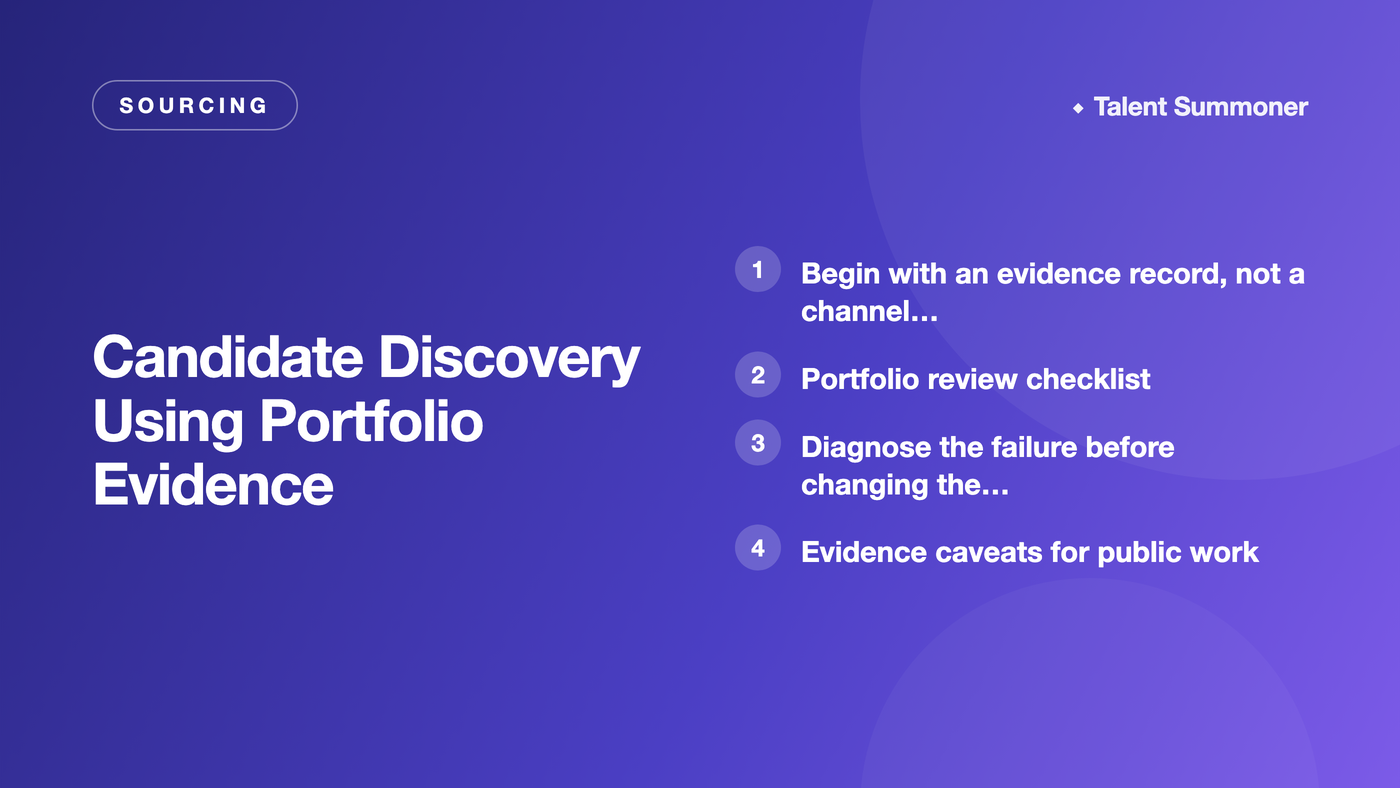
Begin with an evidence record, not a channel preference
Create one record for each portfolio item before discussing the candidate's rank:
Candidate / source route (referral or outbound):
Portfolio URL or approved source / capture date:
Artifact type and job-related reason to inspect:
What the page or file visibly establishes:
Candidate's contribution stated or unknown:
Failure signal / unresolved question:
Next action / owner / date:
The source route is context, not a quality score. A referral is a lead from a person; it is not independent verification. An outbound profile is also a lead. Apply the same evidence questions to both, and record the page and date so a second reviewer can retrace the decision.
Portfolio review checklist
Use this table while looking at the artifact. The final column is deliberately an action, not a verdict.
| Check | Evidence to inspect | Failure signal | Next corrective action |
|---|---|---|---|
| Identity and contribution | Author, role, project context and the candidate's own description | A client logo, team repository or gallery appears without personal ownership | Ask the candidate or referrer what they personally owned; keep the item unknown until answered |
| Problem and constraints | User, business problem, technical constraint or design trade-off | Screenshots or a feature list show the result but not the problem it addressed | Ask for a short context-and-decision explanation, using the same prompt for comparable candidates |
| Process and decisions | Alternatives considered, rejected options, tests, iterations or rationale | A polished final state has no trace of decisions or learning | Request a walkthrough or use a relevant work sample; do not infer depth from visual polish |
| Outcome and scope | Stated result, measurement method, project size and the candidate's part | "Improved" or "scaled" appears with no scope, baseline or attribution | Record the outcome as unverified and ask which change the candidate made and how it was assessed |
| Recency and access | Date, version, working link and permission to inspect | A dead link, old version, login wall or confidential-looking material blocks review | Ask for an accessible, approved alternative or remove the artifact from this criterion; do not guess what is behind it |
| Role relevance | The artifact's work is related to the open role | An impressive item is unrelated to the responsibilities being hired for | Mark it as context only and return to evidence that answers the role's actual questions |
This is not a request for a portfolio from every person. Some work is confidential, collaborative or never published. A missing portfolio is an unknown evidence state, not evidence that the candidate has no relevant experience.
Diagnose the failure before changing the search
When an artifact is weak, identify the failure type before broadening a query or favouring a referral. An attribution gap means the work is visible but ownership is unclear; ask one ownership question. A context gap means the artefact shows an output but not the problem or constraints; ask for a short case explanation. A recency gap means the material may be stale; ask for a current example or treat it as historical context. An access gap means the source cannot be reviewed lawfully or practically; use an approved alternative.
If the artifact is attractive but generic, ask about one decision and one trade-off rather than awarding extra credit for presentation. If it is technically detailed but unrelated to the role, leave it as context and inspect another item. If a referral says "excellent designer" but supplies no inspectable work, record the endorsement as a lead and use the same verification route you would use for an outbound profile.
Make one corrective change at a time. Keep the criterion fixed while asking a focused question, or keep the question fixed while checking an approved alternative source. A useful disposition is progress, verify, hold or close, with a job-related reason and a named owner. "Close" should reflect an explicit role boundary or unresolved material contradiction, not a preference for attractive portfolios.
Evidence caveats for public work
Public artefacts are selected and partial. GitHub says a profile showcases work, contributions and information a person chooses to share publicly, and that profile elements can be hidden. Its contribution reference also explains that only contributions meeting specific conditions appear in the graph. A quiet profile or a low activity graph therefore cannot establish that someone lacks the capability, and activity alone cannot establish authorship, production scope or current ability. Use it to choose a question, not to manufacture a biography.
Do not copy code, screenshots or text into a hiring record merely because it is public. Check the repository licence and any applicable organisational policy; GitHub's licensing guidance explains that public visibility is not an unrestricted reuse right. Retain only the minimum job-related detail needed for the review. The UK's Information Commissioner's Office recruitment-AI guidance, dated 6 November 2024, highlights data minimisation, transparency and monitoring fairness, accuracy and bias when organisations use AI in recruitment. This is general information, not legal advice.
Where Talent Summoner fits
Talent Summoner is our product for role-based candidate discovery. Its current candidate-sourcing workflow starts with a role brief, searches LinkedIn, GitHub and other public sources across 200M+ profiles, and returns ranked candidates against must-haves and nice-to-haves with plain-English reasoning. Use a portfolio link surfaced there as a prompt for this checklist. The result does not verify authorship, availability, interest or job performance, and your team still owns contact, interviews and the hiring decision.
When a referral has already supplied CVs, candidate ranking is the related workflow for organising that existing material. It does not turn a CV into portfolio proof. Keep the artifact record and human follow-up beside the product output, rather than treating a rank as a corrective action.
Next step
Choose one referral and one outbound profile for the same role. Complete the record for one portfolio item from each, label the first failure signal and assign one owner to the next check. Then start a focused candidate-sourcing search or review the supplied pool with candidate ranking.
Does a portfolio prove a candidate can do the job?
No. It can provide work context and a question to investigate. Ownership, scope, recency, outcomes and relevance may still need a human check.
Should candidates without a public portfolio be rejected?
No. Public work is selective, and some work is confidential or collaborative. Mark the missing item unknown and use a comparable verification question or work sample where appropriate.
Is a referral stronger evidence than outbound discovery?
Not by itself. A referral can explain why someone is worth contacting, but the endorsement does not verify the portfolio or the candidate's contribution. Apply the same evidence record to both routes.
What should I do when a portfolio link is broken?
Record the link and date, mark the item inaccessible, and ask for an approved alternative if the evidence is material. Do not infer a capability from a missing page or copy material that should not be shared.
Does Talent Summoner verify portfolio authorship?
No. Our product can help discover and rank profiles against a role brief. Humans inspect the source, ask about contribution and context, verify material claims and make the hiring decision.