Talent Summoner
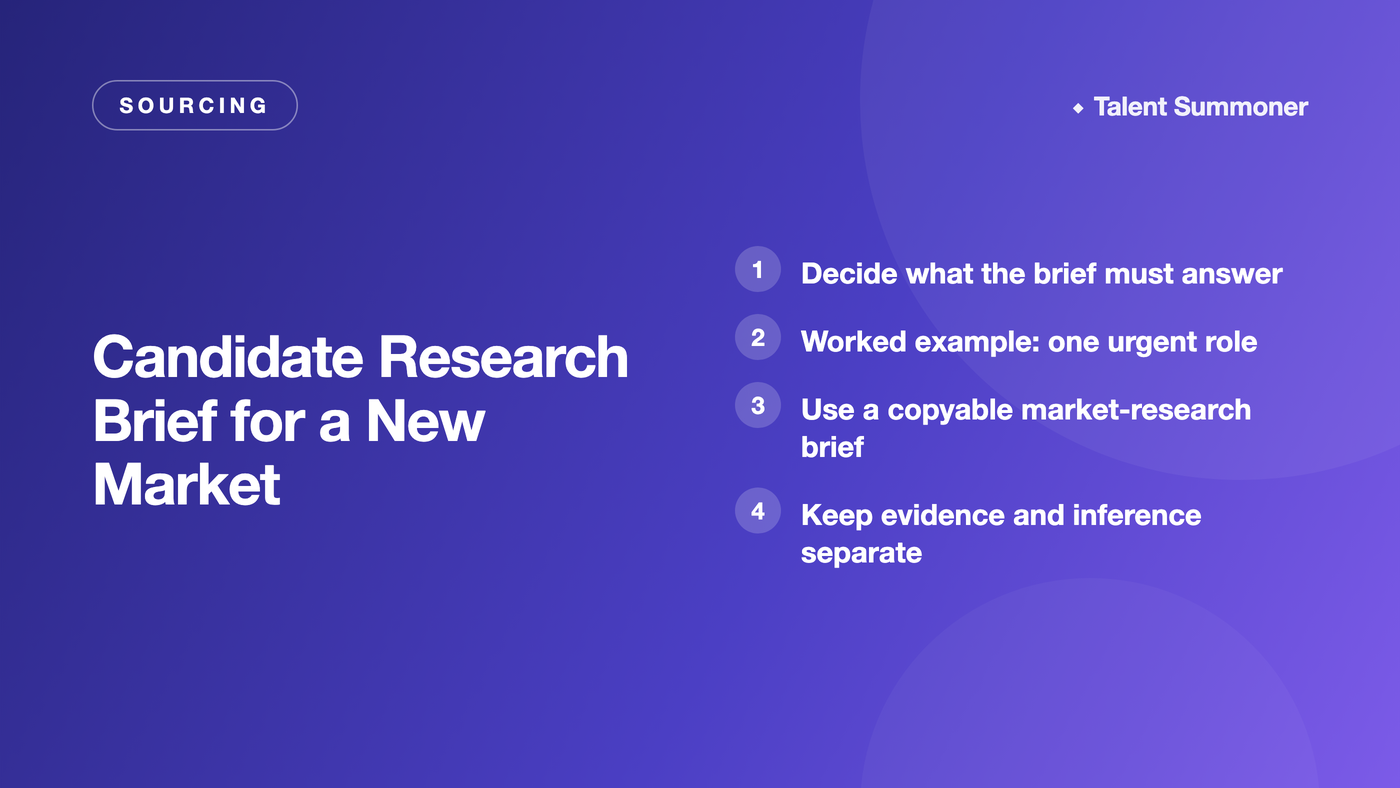
Candidate Research Brief for a New Market
Create a candidate research brief before entering a new market, with testable assumptions, evidence limits, one owner and a clear stop condition.
Your startup has one urgent role, but the familiar search area is not producing a clear path. The founder is considering a new market without knowing whether the role language, working boundary or public evidence will translate. Starting immediately can turn an untested hunch into a long list of names.
A candidate research brief makes the pre-search decision explicit. It records the market assumptions, acceptable evidence, decision owner and stop condition. It is not a market-size report, promise of candidate supply or hiring forecast.
Decide what the brief must answer
Write one decision question, not a general wish to learn more. For example: Should the founder open an approved candidate search for this role in Market B? The answer can be go, revise the role or market boundary, defer the question, or close it for now.
The brief should answer four things before anyone searches names:
- What work must the hire own?
- Which market boundary is actually being considered?
- Which assumptions could change the decision?
- Who can approve the next action?
Keep the question narrower than "Is there talent in Market B?" A public search cannot establish a whole market's size. It can test whether the approved role has interpretable, job-related evidence in approved sources.
Worked example: one urgent role
This is an example, not a market benchmark. A founder needs one senior backend engineer to own API reliability before a customer launch. The home-market search has not answered whether the same role can be researched in Market B. The founder owns the decision; a research operator may collect evidence but cannot change the question.
| Brief field | Example entry | Boundary |
|---|---|---|
| Role outcome | Own the design, operation and improvement of the customer API | A title is not evidence of ownership |
| Market boundary | Market B, with the company-approved working pattern | Do not infer work location from an employer's headquarters |
| Assumption 1 | Equivalent work may use different titles | Title variation is a search hypothesis, not proof of fit |
| Assumption 2 | Public professional sources may show relevant work context | A profile is partial and may leave material facts unknown |
| Assumption 3 | The founder can review job-related evidence promptly | Review capacity is an owner dependency, not candidate supply |
| Evidence record | Source, URL, review date, observed signal and unknown | Do not turn missing information into a negative finding |
| Stop condition | Every assumption is marked supported, conflicting or unknown, and the founder can choose the next action | No invented profile, salary or response threshold |
The output is a decision record, not a pile of profiles. If the working boundary is still a guess, return to the role owner before expanding the search.
Use a copyable market-research brief
Paste this into the role record before opening a new market:
Decision question:
Role outcome:
Market boundary and approved working pattern:
Assumptions to test:
Evidence allowed and source date:
Evidence that is out of scope:
Decision owner:
Research operator:
Stop condition:
Decision: go, revise, defer or close
Decision date and next owner:
For each assumption, state what would support or weaken it. A useful entry might say, "A role-related project description uses a different title but describes the required API ownership; verify scope with the candidate." It should not say, "This market has many strong engineers" unless a dated, relevant methodology supports that claim.
Keep evidence and inference separate
Use a small evidence vocabulary: observed for a dated public statement, candidate-stated for information the person provides, internal constraint for an approved company condition, and unknown when the record cannot answer the question. Keep the original source beside the note.
Do not use the total number of profiles returned by a tool as a local market estimate. Do not infer availability, interest, seniority or work authorisation from a profile. Do not treat an empty result as proof that a market has no suitable people. Those are different questions that need a human-owned verification route or a different source.
If an assumption conflicts with evidence, record the conflict instead of averaging it away. The founder can decide whether to change the role, change the boundary, ask a follow-up question or stop researching this market.
Name the owner and stop before scope drifts
The founder remains accountable because this is one urgent role. The research operator owns accurate records, source dates and scope. A subject reviewer can challenge whether an observation is job-related, but does not become an unapproved decision-maker.
Stop before searching when the decision question, market boundary or evidence rule is not approved. Stop the research pass when each assumption has a status and the founder can choose go, revise, defer or close. Also stop if the next action would require an unsupported market claim rather than a narrower evidence question. A clear unknown is a valid result, not a reason to browse indefinitely.
Where Talent Summoner fits
Talent Summoner is our product for role-based candidate sourcing. Its current candidate-sourcing page, checked 2 September 2026, describes searching a role brief across LinkedIn, GitHub and other public sources across 200M+ profiles, with ranked results against must-haves and nice-to-haves and plain-English reasoning. That coverage statement is not a local market estimate. Use it after the brief sets the boundary, and have the team inspect evidence and decide what requires verification.
If the founder already has CVs from the approved market, the separate candidate-ranking tool is for comparing that supplied set. Neither workflow answers whether the market assumption is true or makes the hiring decision. NIST's AI Risk Management Framework is voluntary guidance; its risk-management framing is a useful reminder to keep assumptions, evidence and human ownership visible.
FAQ
What is a candidate research brief for a new market?
It is a pre-search decision record for one role. It defines the market question, assumptions, evidence limits, owner and stop condition; it does not claim market size or supply.
What evidence should the brief include?
Record dated, job-related observations with the source and what remains unknown. Separate public observations, candidate-stated information and internal constraints from inference.
How do I know when to stop market research?
Stop when each assumption has a status and the decision owner can choose go, revise, defer or close. No universal profile or response threshold proves a market is ready.
Does Talent Summoner measure a local talent market?
No. Its public sourcing description refers to broad profile coverage and ranked role matches. Your team defines the boundary, inspects evidence and makes the market and hiring decisions.
Should the founder or a recruiter own the brief?
The person accountable for the role decision should approve it. A researcher or recruiter can collect evidence and challenge wording, but material changes need that owner.
Complete the brief for one role, ask the founder to approve the boundary, and record the stop condition. Then start a focused candidate-sourcing search only if the decision is go. If it is revise or defer, keep the evidence record with the next owner.