Talent Summoner
Candidate Sourcing Funnel Stages for Lean Teams
A founder's guide to candidate sourcing funnel stages, with the right input, owner, decision and stop condition for one urgent role.
Your co-founder says the team needs one senior backend engineer urgently. There is no recruiter, and every hour spent browsing profiles displaces product work. The useful question is when this search should move forward, broaden, pause or hand off.
A candidate sourcing funnel makes those decisions visible. This guide is a control sheet for one live role: each stage has an owner, a handoff input, a decision and a stop condition. It is not a generic sourcing workflow, a promise of volume or a hiring-speed forecast.
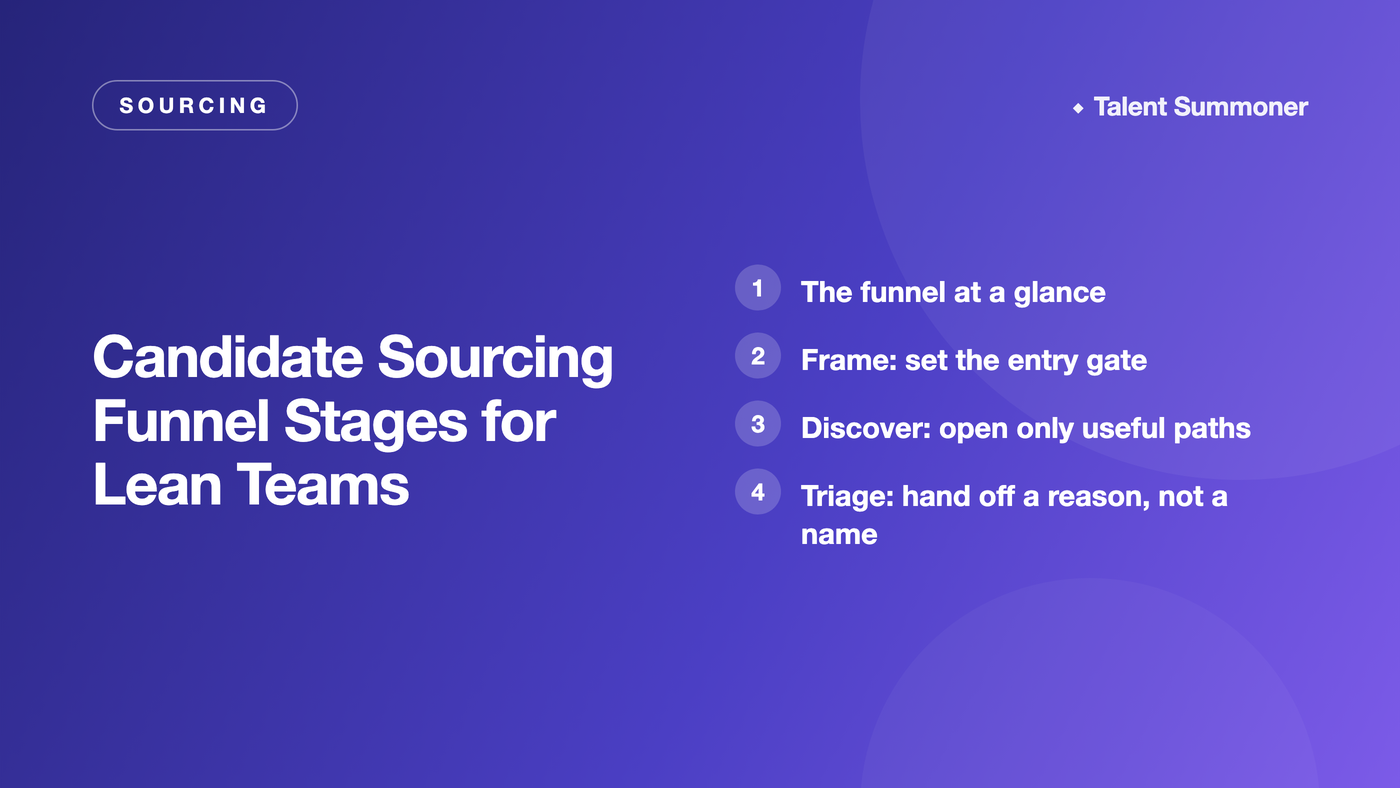
The funnel at a glance
| Stage | Input | Owner | Decision | Stop condition |
|---|---|---|---|---|
| 1. Frame | Job description, outcome and constraints | Founder or role owner | Is the role specific enough to search? | An approved brief names the outcome, must-haves and evidence to inspect |
| 2. Discover | Approved brief and search scope | Search operator | Which paths are worth opening? | A reviewable set contains plausible and adjacent profiles, or the search is repeating itself |
| 3. Triage | Profiles and visible evidence | Founder plus subject reviewer | Progress, verify, hold or close? | Every reviewed profile has a reason and a next action |
| 4. Calibrate | Review reasons and unknowns | Role owner | What single rule needs changing? | One correction has been tested, or the team has a clear reason to pause |
| 5. Handoff | Approved shortlist and questions | Outreach owner | Who merits a human conversation? | The owner can contact, verify or hold without reopening the whole search |
The same person may own several stages on a lean team. The point is to name the responsibility, not to create extra bureaucracy.
1. Frame: set the entry gate
The founder or role owner supplies the entry input: the urgent business outcome, the constraints and the evidence the team will inspect. Separate three kinds of input:
- Must-haves: conditions that genuinely change whether the person can do the work.
- Nice-to-haves: useful signals that should not become rejection rules.
- Boundaries: real location, working pattern, authorisation, compensation or start-date constraints.
For each must-have, write one evidence question and include acceptable adjacent backgrounds. A familiar job title is not evidence by itself.
The founder or role owner approves the brief. Stop framing when another person can explain what counts as supported, adjacent or unknown. If the team cannot agree, pause and resolve the role before adding search channels.
2. Discover: open only useful paths
The search operator receives the approved brief and opens only paths that could reveal its required evidence: public profiles, portfolios, technical work or referrals, depending on the role. Return the search scope and assumptions with the candidate set; do not hand off a list without its context.
Treat the first pass as a learning pass. Record title variants, adjacent backgrounds, evidence gaps and assumptions. Continue when a must-have or approved adjacent route has not been tested. Broaden one variable at a time so the next owner can see what changed.
Stop when new results repeat weak evidence, or when the set is reviewable by the named owner. There is no universal pool size; a smaller set with reasons and unknowns beats an unexamined list.
3. Triage: hand off a reason, not a name
The founder and, where needed, a subject reviewer receive the candidate set and inspect visible evidence. For every profile, ask:
- Which must-have has direct or adjacent evidence?
- What is unknown and how could a person verify it?
- Why should this profile receive attention now?
Use a consistent disposition: progress, verify, hold or close, with a reason tied to the entry gate. Do not convert silence in a public profile into proof that a capability is absent. Keep the source and review date with the note so the next owner can retrace it.
If the founder already has a pile of CVs, Candidate Ranking is the relevant starting point: the current tool accepts CVs in PDF, DOCX, MD or TXT format and returns a shareable report. It ranks supplied material; it does not replace verification or the hiring decision.
4. Calibrate: change one gate rule
The role owner turns triage into one written correction to the funnel gate, such as "treat implementation leadership as adjacent evidence" or "remove this nice-to-have from the first pass". Avoid changing several criteria at once; the team then cannot learn which assumption caused the result.
Run a second pass when a correction could answer a real evidence gap. Pause when results keep failing for the same reason, the brief is a moving target, or specialist expertise is missing. Bring in a subject reviewer or rewrite the outcome before expanding the funnel.
If you use Talent Summoner, our candidate-sourcing workflow, checked on 2 September 2026, starts from a role description, searches LinkedIn, GitHub and other public sources across 200M+ profiles, and returns ranked candidates with must-haves, nice-to-haves and plain-English reasoning. It is a discovery aid, not an ATS or automatic rejection system; your team checks evidence, contacts candidates, interviews and chooses the hire.
5. Handoff: release a reviewable next action
The outreach owner receives the shortlist, evidence, unresolved questions and reason for contact. This is the funnel's release decision, not a score handoff. Verify facts that matter to the invitation and do not infer personal or sensitive attributes from a public profile. A high rank is not proof of interest, availability or ability.
Stop sourcing when the owner can contact, verify or hold without reopening the whole search. If nobody can make that decision, return to the brief or evidence review. More profiles are not the next step.
The UK's Information Commissioner's Office asks organisations considering AI recruitment tools to address lawful basis, transparency, data minimisation and fairness monitoring. NIST's AI Risk Management Framework is voluntary guidance for managing AI risks. This is general information, not legal advice; apply the rules that govern your organisation and candidates.
A practical next step for the urgent role
Write the outcome, three must-haves, two acceptable adjacent routes and one evidence question for each must-have. Name each stage owner and stop condition, then start one candidate sourcing search. If the result cannot be reviewed with a reason, fix the brief before widening the search.
FAQ
What are the main candidate sourcing funnel stages?
Frame, discover, triage, calibrate and hand off. Each stage has an owner and a stop condition.
When should a lean team stop sourcing?
Stop when the owner can contact, verify, hold or close from the evidence collected. Pause if the brief is unclear or new results repeat weak evidence.
Is a larger candidate pool always better?
No. Stop at a reviewable set with reasons, unknowns and next actions. No universal pool size proves a search is complete.
Should AI decide who gets hired?
No. Sourcing or ranking orders attention. People check evidence, communicate with candidates, assess interviews and make the final decision.
Where does Talent Summoner fit in this funnel?
Talent Summoner is our product for role-based sourcing and ranking. Its current sourcing workflow starts from a role brief and returns a reasoned shortlist. It does not replace verification, outreach, interviews or the hiring decision, and it is not an ATS.