Talent Summoner
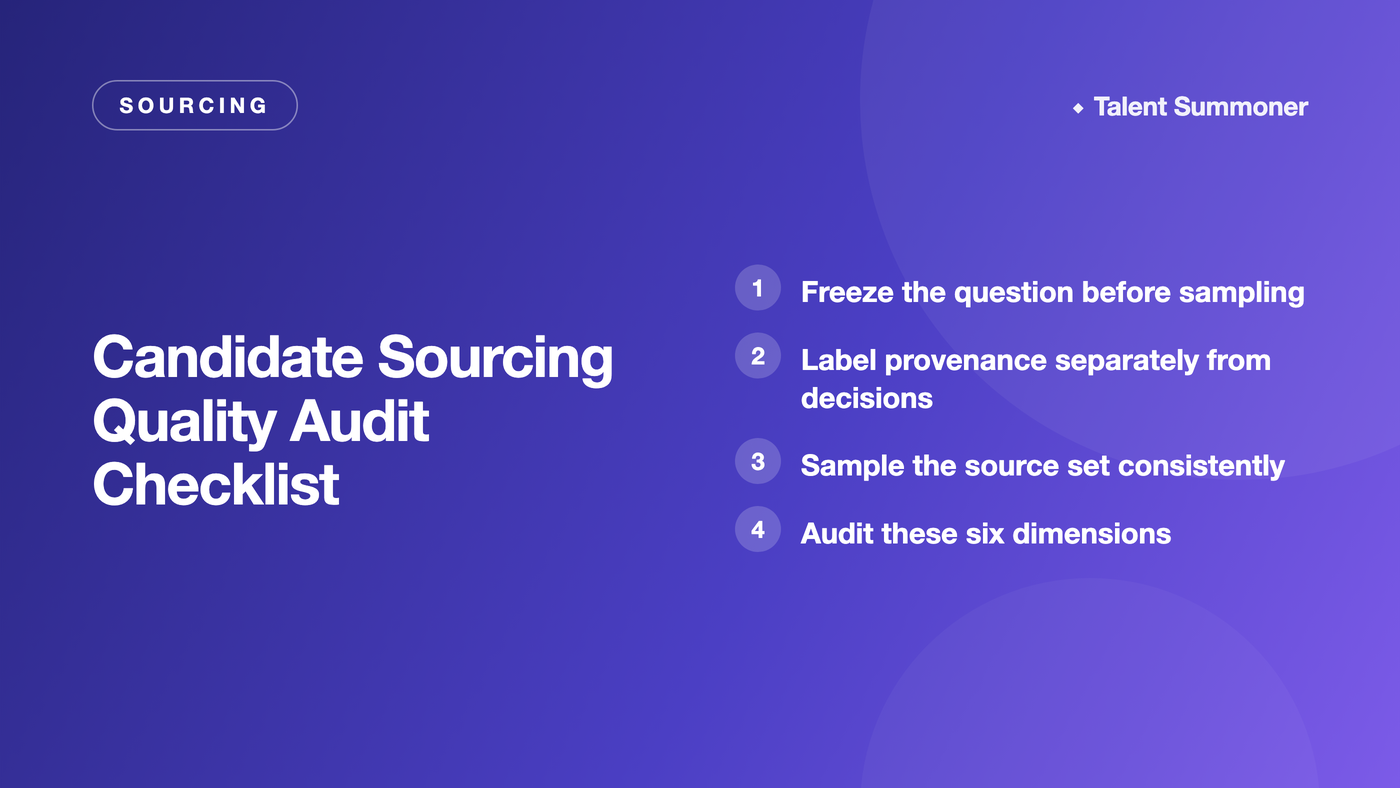
Candidate Sourcing Quality Audit Checklist
Copy an audit that separates sourcing assumptions from evidence, samples records consistently, assigns owners and sets a new-market go/no-go.
A new market can produce convincing profiles while its search method still rests on untested assumptions. A candidate sourcing quality audit asks whether a source set is traceable, relevant and ready for the next decision. It does not grade a person's worth or predict hiring success.
Run it after initial discovery and before a shortlist reaches a hiring manager or anyone chooses outreach. Scope one role, approved brief, market definition and search period. The population is records returned by named sources and queries, not the whole market.
Freeze the question before sampling
Record the role brief version, decision owner, market boundary, channels, query variants, dates and purpose. Separate must-haves, preferences and operating constraints. For each criterion, define evidence that could support it.
Then list assumptions beside the observation that would test each one:
| Assumption | Observable check | If the check is missing |
|---|---|---|
| A title maps to the role's work | Responsibilities or project context are visible in the source | Mark the criterion unknown or adjacent |
| A profile reflects current status | A current role or dated source supports the reading | Record recency as unknown |
| A project claim belongs to this person | The source identifies the person and their contribution | Check attribution before using the claim |
| A channel covers the new market | Search scope, variants and exclusions are recorded | Describe the coverage gap; do not infer absence |
Do not add a requirement to explain a preferred result. If the brief changes, create a new version and audit the new question separately.
Label provenance separately from decisions
Keep a provenance label separate from the team's action. This stops a source observation becoming an automatic rejection rule.
| Provenance label | What it means | Safe interpretation |
|---|---|---|
| Direct | The source explicitly connects the person to relevant work | A useful lead; scope, authorship or recency may still need checking |
| Contextual | An employer, team, event or publication page associates the person with work | Context for a question, not proof of personal ownership |
| Derivative | A snippet, repost, directory or duplicate repeats information | Do not count repeated text as independent support |
| Unknown | The available material does not answer the criterion | Write the missing fact and a focused verification question |
| Conflicting | Reliable sources disagree on identity, date, scope or status | Preserve both traces and pause the affected decision |
Keep source wording, URL or record ID, source date if shown and capture date beside the label. A label describes support for one criterion, not a candidate score. The candidate-sourcing page describes the product workflow; this guide audits the whole source set and its controls.
Sample the source set consistently
Before opening records, define strata such as source, channel, query variant, location interpretation and disposition. Take a fixed sample from each relevant stratum, including duplicate-looking, inaccessible and surprising results.
For every sampled record:
- Preserve the source, date and search context.
- Compare the same approved criteria in the same order and record provenance, unknowns, contradictions and the next question.
- Note exclusions, including duplicates or unavailable pages.
- Ask a second reviewer to recheck a subset when the result could change whether the search continues.
The sample reveals broken queries, derivative sources, identity errors and unowned gaps; it is not an estimate of candidate quality, market size or coverage. If it reveals a blind spot, change one approved variable, record it and sample again.
Audit these six dimensions
| Dimension | Audit question | Minimum record |
|---|---|---|
| Brief integrity | Does each inclusion decision map to the approved role question? | Brief version, criterion and job-related reason |
| Provenance | Can another reviewer open the source behind a material claim? | Source, exact URL or ID, wording and dates |
| Attribution | Is the source connected to the intended person and contribution? | Identity check, ownership wording and duplicate note |
| Context and recency | Does the source establish the relevant work setting and time? | Project or role context, dates and explicit unknowns |
| Coverage | What channels, variants and exclusions shaped this set? | Search log, strata, sample rule and blind spots |
| Record control | Who may review, correct, restrict or delete the record? | Named owner, permitted viewers and review date |
The UK's Information Commissioner's Office recruitment guidance, published 6 November 2024, highlights questions about impact assessment, lawful basis, responsibilities, fairness and accuracy monitoring, transparency and minimum necessary data. Apply requirements for the organisation and location; this is general information, not legal advice. NIST's AI Risk Management Framework is voluntary guidance for structuring risk ownership and evaluation, not a hiring certification.
Copyable audit record
Use one record for the audited source set, then attach the sampled evidence log.
CANDIDATE SOURCING QUALITY AUDIT
Role / market / purpose / brief version:
Population definition / search period:
Sources, channels and query variants checked:
Sample strata / sample rule / exclusions:
Audit owner / decision owner / second reviewer:

Dimension:
Evidence or source trace:
Provenance label: direct / contextual / derivative / unknown / conflicting
Assumption tested:
Unknown or contradiction:
Corrective action / owner / due date:

Decision: continue / repair and retest / pause
Decision reason and approved change:
Access, correction and retention review:
Practical audit checklist
- Freeze the role brief, market definition, search period and decision owner.
- Define the population, strata, sample rule and exclusions before reviewing records.
- Preserve each sampled source, URL or ID, source date and capture date.
- Label provenance separately from interpretation, unknowns and contradictions.
- Check identity, attribution, context, recency and duplicate records.
- Record channel coverage and blind spots without claiming an exhaustive market.
- Name owners for verification, correction, access and retention review.
- Record continue, repair and retest, or pause with a job-related process reason.
Make the go/no-go decision
Continue when the brief is approved, material claims are traceable, relevant strata are sampled, assumptions are visible and material gaps have owners. This means the method is usable for the current question, not permission to contact every record.
Choose repair and retest when the source trail is incomplete, one query or channel dominates, repeated claims are derivative, or a criterion is inferred from a title or proxy. Correct the brief, source log or sampling rule and audit a new sample.
Pause when the purpose or access boundary is unapproved, identities cannot be traced, the sample is mostly unavailable or copied material, a material requirement depends on a sensitive or irrelevant proxy, or nobody owns verification and record control. This is a process decision, not a judgement that a person cannot do the work.
Where Talent Summoner fits
Talent Summoner is our product for role-based candidate discovery. Candidate sourcing, checked 2 September 2026, starts from a role brief, searches LinkedIn, GitHub and other public professional sources across 200M+ profiles, and returns a ranked shortlist with must-haves, nice-to-haves and plain-English reasoning. Treat it as discovery input: audit the sample and inspect the source; a human owns the decision.
For existing CVs, candidate ranking, checked 2 September 2026, organises the pool. Talent Summoner does not verify public claims, establish interest or availability, manage an application pipeline or automatically reject candidates. Humans own source checks, contact, interviews, corrections and the final decision.
What is a candidate sourcing quality audit?
It checks the brief, provenance, attribution, context, coverage, sampling and ownership behind a sourcing result. It tests whether the process is decision-ready, not whether a person is a good hire.
How many profiles should a sourcing audit sample?
There is no universal number. Choose a fixed rule covering relevant sources, query variants and edge cases, record exclusions and use a second reviewer for material decisions. Do not present it as a market-size or quality benchmark.
Should an unknown or derivative source automatically close a record?
No. Unknown means the source did not answer the question; derivative means it should not be counted as independent support. Assign a verification question or hold the record, and close only for an approved, job-related process reason.
Can Talent Summoner run this audit for me?
No. Our product supports role-based discovery and ranking, but humans inspect source context, check material claims, control records and decide whether the search continues.
Start with one approved role brief, define the population and sample rule, and assign the audit owner before reviewing names. Then start a focused candidate sourcing search, or use candidate ranking when the input is an existing CV set, and keep the go/no-go reason with the evidence.