Talent Summoner
Candidate Outreach Sequence for a Hard-to-Fill Role
A decision guide for sequencing respectful outreach to passive candidates, with clear inputs, human owners, verification boundaries and stop conditions.

A hard-to-fill role does not justify sending more messages to more people. It calls for a sequence that makes each invitation understandable, proportionate and easy to stop. This guide is for a recruiter contacting a passive candidate at the learn stage: deciding what must be ready, who owns each decision and when to stop.
As a supporting resource, it can merge into an outreach hub or remain a role-level decision aid. It is not a bulk-outreach template or response-rate forecast. A passive candidate may be visible in a public source without being available, interested or willing to use a channel. Keep those questions open until the person answers.
Gather the inputs before contact
Prepare one versioned record for the role and one reviewable record for each proposed contact. The minimum inputs are:
- Approved role brief: the outcome, genuine must-haves, useful preferences, reporting context, location, working pattern and any approved compensation information.
- Evidence note: one or two current, job-related source statements, their URLs, review date and each source's limitation. A title or employer name is a lead, not proof of ownership or ability.
- Contact decision: the proposed channel, the approved contact basis under your organisation's policy, prior contact, duplicate check and any do-not-contact or opt-out instruction.
- Message purpose: what the recipient will learn and the single optional next step, such as receiving the role overview or choosing a short introduction.
- Owners and records: the human sender, role approver, reply owner, suppression or opt-out owner and the system where status and corrections will be recorded.
If a material role condition is still being negotiated, pause the sequence. Do not turn an unapproved promise into a selling point.
Run the sequence as gates
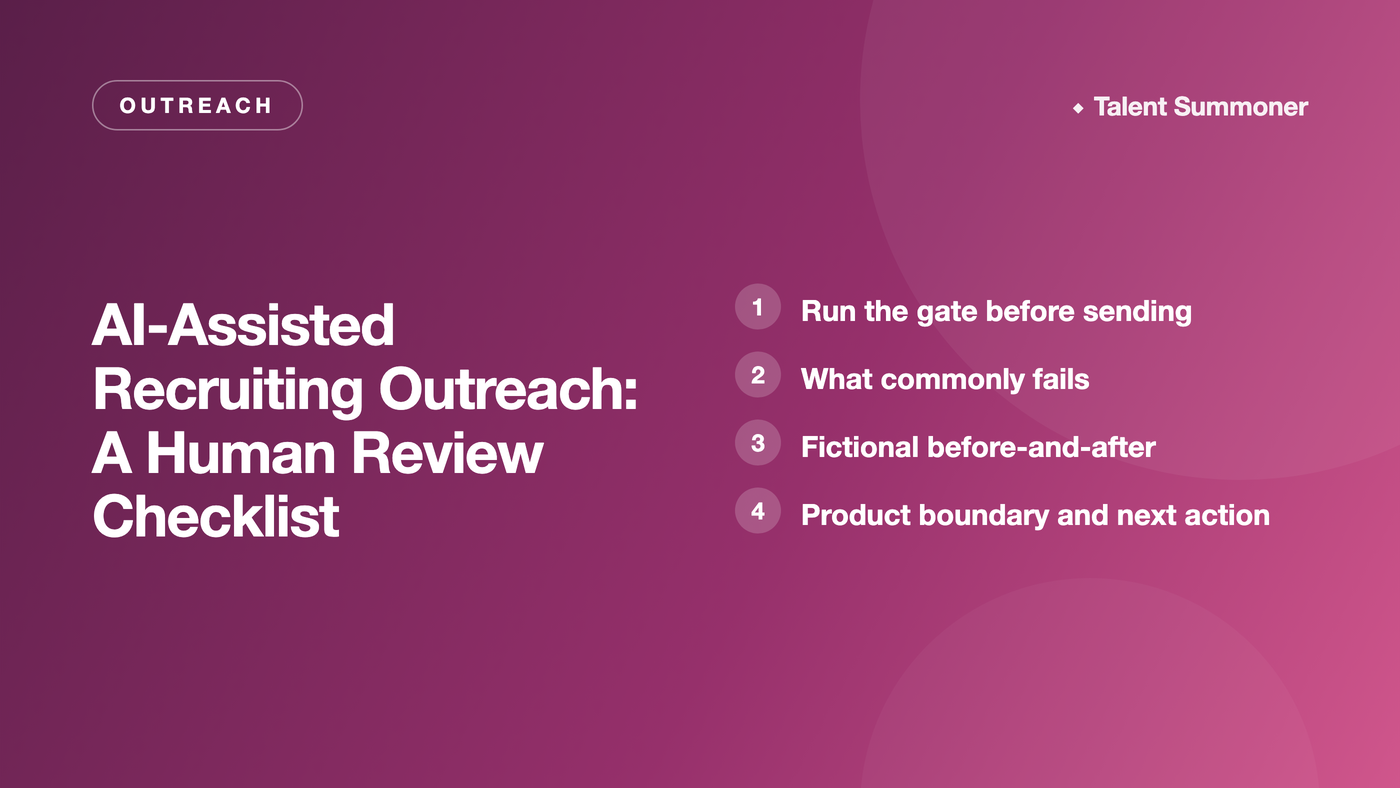
Use this order. Each gate has an owner and stop condition; a fluent message is never a reason to skip one.
| Gate | Human decision | Stop condition |
|---|---|---|
| The recruiter and role owner agree why this person may be relevant to one requirement. | No traceable evidence, or relevance depends on a sensitive, personal or guessed fact. |
| The recruiter checks identity, duplicate history, prior messages, suppression and the approved channel and basis. | Identity, contact basis, channel or opt-out status is unresolved. |
| The sender writes a short invitation that identifies the organisation, source-based reason, role context, known conditions and uncertainty. | The draft invents ownership, familiarity, urgency, availability, interest, compensation or a guaranteed outcome. |
| The named sender sends one optional invitation and records the version, date and channel. | No human sender or reply owner is available, or the role has materially changed since review. |
| The reply owner records interested, clarifying question, decline, no response or opt-out and routes the next action. | The person declines, requests no further contact, or the team cannot answer a material question truthfully. |
| The role owner approves one useful follow-up only when policy permits and the message adds information. | The approved review point arrives, the role closes, or another message would add pressure rather than context. |
The table controls decisions, not a message count. Silence is not consent, rejection or proof of unsuitability. Record it and close or suppress under the approved process.
Write for a person who is not looking
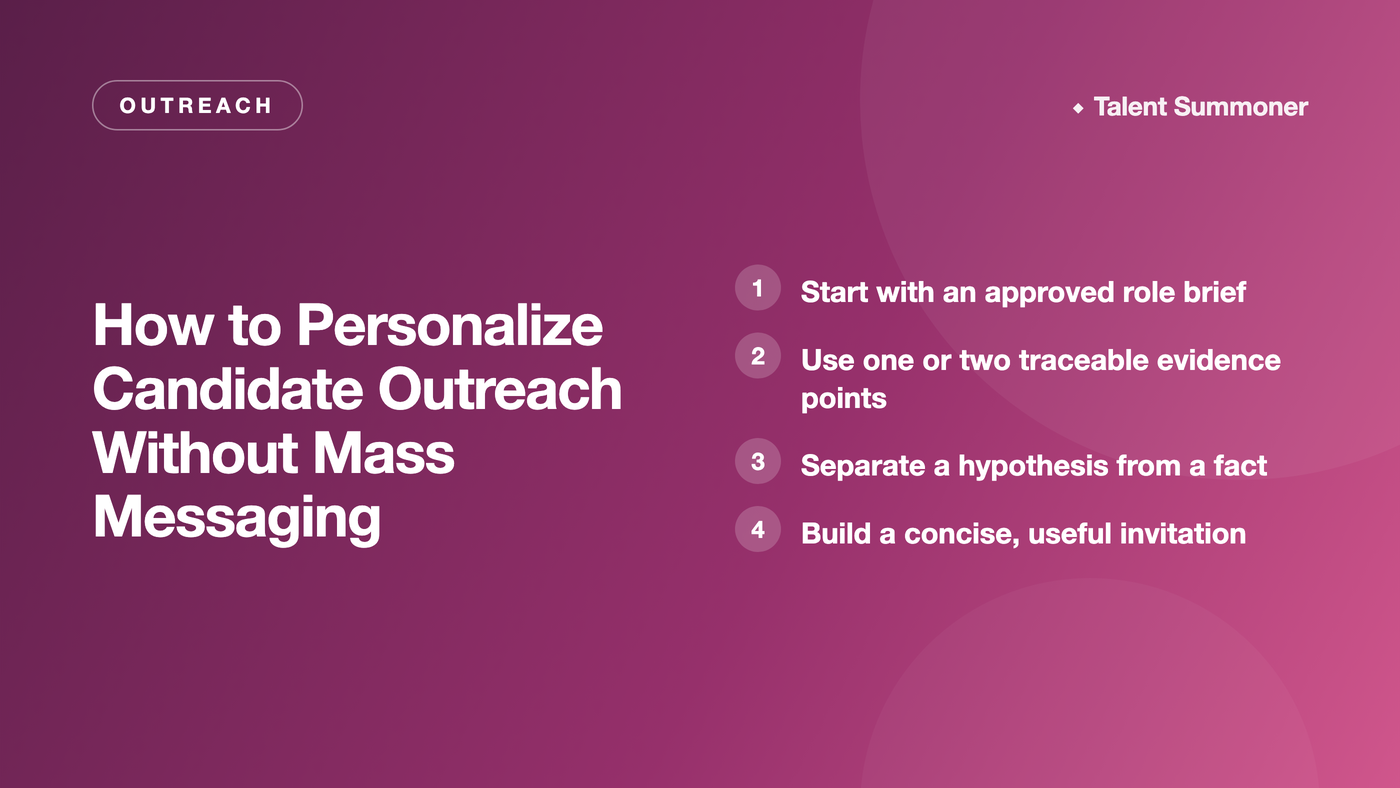
The first note should help the recipient make a small decision. Name yourself and the organisation, state the role's actual outcome and refer only to verified evidence. Use language such as "I noticed" or "this may relate to" rather than claiming the person led a project when the source does not say so. Include approved location, working pattern or compensation details when they affect the decision; label unresolved details clearly.
End with a low-pressure question and easy decline. Approve only when the sender, evidence, role conditions and optional next step are clear; otherwise hold. Before sending, a human checks facts, links, channel, contact basis and suppression. Never disguise generated copy as personal conversation or switch channels because of silence.
Set verification boundaries
Public professional evidence helps answer "why might this be relevant?" It does not answer current scope, identity certainty, availability, interest, work authorisation, compensation expectations or permission to contact. Ask the smallest job-related question, let the candidate correct the record and do not infer from missing profile details or lack of response.
If an AI tool helps discover or rank profiles, keep its output as research input. The UK's Information Commissioner's Office guidance on AI-assisted recruitment says organisations using AI in recruitment should consider a lawful basis, clear responsibilities, transparency, fairness and accuracy monitoring, and collecting only the minimum personal information needed. Its 6 November 2024 guidance is general information, not legal advice; apply the rules for the organisation, channel and location.
Know when the sequence is wrong
Stop before sending when the brief is unsettled, the source is stale or untraceable, the message needs a sensitive detail, or no one owns replies and opt-outs. Stop after a decline or explicit request for no further contact. Stop when the role closes, material conditions change or the only next step is another generic nudge. Escalate privacy, fairness, identity or employment-authorisation questions to the responsible owner.
Where Talent Summoner fits
Talent Summoner is our product for upstream candidate discovery and ranking. Its candidate-sourcing workflow, checked on 4 September 2026, starts with a role description and searches LinkedIn, GitHub and other public sources across 200M+ profiles, returning ranked results with must-haves, nice-to-haves and plain-English reasoning. Use that output as research input, then verify evidence and make the contact decision yourself. It does not prove interest, availability, consent or suitability.
When a team already has CVs, candidate ranking can compare supplied files with a job description and produce a reasoned report. That is separate from public-source discovery. Talent Summoner does not manage an ATS or candidate pipeline, automatically reject candidates or send automated outreach. Humans review messages, choose the channel and basis, send, handle replies and opt-outs, and make the hiring decision.
How many messages belong in a candidate outreach sequence?
No universal number applies. Set a policy limit, make each follow-up useful and stop at review point, decline, opt-out or closure. Silence is not permission.
Is a public profile enough reason to contact a passive candidate?
It can provide a job-related discovery signal, but it does not prove current interest, availability, identity certainty or permission to use every channel. Verify the source and contact process, then make the invitation optional.
Who owns verification and replies?
Name a recruiter or other human owner for source and identity checks, a role owner for material role facts and a reply owner for questions, declines and opt-outs. Record each handoff and stop when an owner is missing.
Can Talent Summoner automate this sequence?
No. Our product supports upstream sourcing and separate ranking of supplied CVs. Your team controls verification, outreach, reply handling, suppression and the hiring decision; Talent Summoner is not an automated outreach sender or ATS.
For the next role, version the brief, evidence note and contact decision; name one sender and one stop condition. Then start a focused candidate-sourcing search; if you already have CVs to review, use candidate ranking as the separate upstream input.