 Talent Summoner
How to Personalize Candidate Outreach Without Mass Messaging
A practical, human-reviewed workflow for relevant candidate outreach using public professional evidence without mass messaging.
 By Derek Chau · Published · Updated · in Candidate Outreach
Personalised candidate outreach is not a first name added to a template. It is a reasoned invitation based on a real role, limited job-related evidence and honest uncertainty. Help someone decide whether a conversation is worth having.
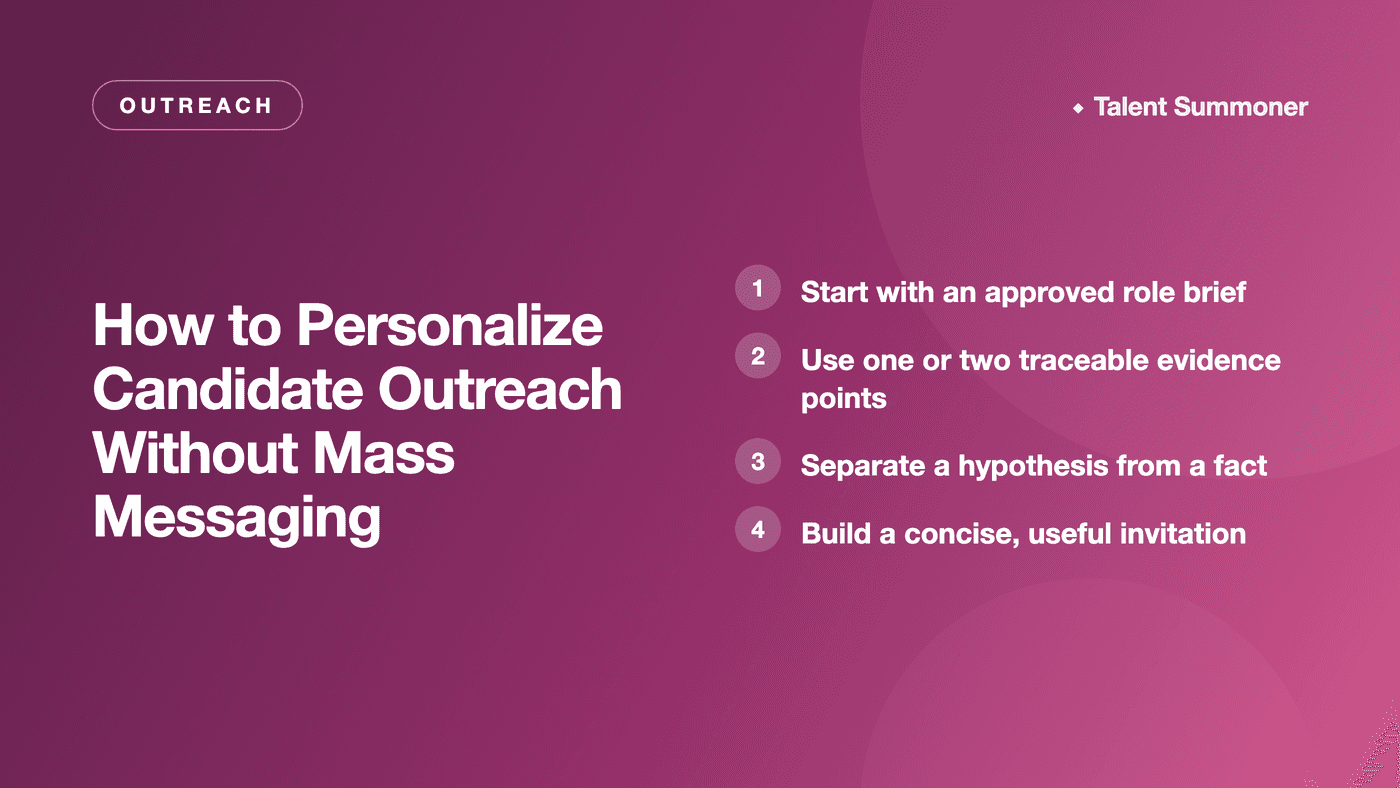
Start with an approved role brief
Before looking at profiles, agree the role brief with the hiring owner. Record the outcome, must-haves, preferences, location or working pattern, evidence for each requirement and who may approve changes. An approved brief explains why the role exists and what work is relevant.
Do not personalise from an unapproved wish list. If level, work arrangement or responsibilities are unsettled, pause contact first.
Use one or two traceable evidence points
For each possible contact, choose one or two public professional signals that connect to the brief. Record the exact URL, page title, review date and visible claim. Examples include a role description, project page, technical article or conference biography.
Keep evidence job-related and proportionate. A public profile can be incomplete or stale. It may suggest relevance, but does not show availability, interest, identity certainty or permission to contact someone through every channel. Never use sensitive or protected information, personal-life details, photos or guesses about motivations.
Separate a hypothesis from a fact
Write the relevance hypothesis first: "This public project may overlap with the platform reliability work in our role." List what is verified and what is not. A project page may show association, but not ownership, scope, results or interest in moving. Say "I noticed" or "I wondered whether" rather than "you led" when the source does not say that.
Build a concise, useful invitation
A human-reviewed message can follow five parts:
- Identify yourself and the organisation.
- Name the relevant public work and source accurately.
- Explain the role context and candidate benefit, such as scope, team, location or working pattern.
- State the relevance hypothesis and an important unknown.
- Ask whether they want details and make declining or opting out easy.
Copyable message framework
Hi [Name] - I am [your name] from [organisation]. I noticed [specific public professional evidence] while looking for experience related to [role outcome]. We are working on [brief role context, location or working pattern]. It may be relevant because [careful relevance hypothesis], although I have not verified [important unknown]. Would you be open to a short overview? No problem if not, and please say if you would rather not hear from us.Fictional example
The following is fictional, not a real candidate quote or profile:
Hi Maya - I am Lin from Northstar Labs. I noticed the public case study describing an event-processing service you worked on while looking for experience related to our platform engineer role. We are building reliability tooling for a small team in Singapore. That work may overlap, but I have not verified your current scope or interest. Would you be open to a short overview? No problem if not, and please say if you would rather not hear from us.
It names a signal without pretending to know the person's priorities. Public visibility is not consent; the recipient can correct the assumption, decline or request no further contact.
Review contact before sending
Manual review should check the brief, evidence links, hypothesis, wording and candidate benefit. Check the contact basis under team policy and applicable channel and location rules. This is general information, not legal advice; requirements differ by channel and location.
Before sending, search the suppression or do-not-contact record, check for a conversation or duplicate, confirm the address or profile, and record the source and review date. A ranking is not a reason by itself; explain the invitation and unknowns.
Own follow-up and status
The team, not a template, owns the follow-up limit. Decide who monitors replies, what counts as a decline or opt-out and when to suppress. Do not set a universal cadence or treat silence as permission. Stop when asked.
Record status such as drafted, reviewed, sent, replied, declined, opted out, suppressed, duplicate or closed. Add role version, sender, channel, date, evidence links, message version, response and next action. No reply is not proof of poor fit, and a positive reply is not a hiring decision.
Where Talent Summoner fits
Talent Summoner searches approved public professional sources and ranks and explains results from a role brief. It can draft outreach and send it through your connected Gmail, Outlook or LinkedIn account after you review and confirm each message; it does not send automated or mass outreach, manage an ATS or pipeline, or contact anyone without your review. Humans verify evidence, write, review and send messages, handle replies and opt-outs, conduct interviews, make decisions and maintain records. See candidate sourcing, candidate ranking and pricing.
When personalisation is the wrong fit
Do not personalise when the brief is unsettled, the only signal is a title or employer, the source cannot be traced, the contact basis is unclear, or the message exposes private or sensitive detail. It is also wrong when nobody can review messages, monitor replies, honour opt-outs or keep status current. Pause or use a human recruiter.
FAQ
Does a public profile mean I have consent to contact someone?
No. Public professional information can provide a discovery signal, but does not prove consent, availability or interest. Check applicable channel and location rules, make the invitation optional and honour an opt-out.
Should an AI tool write and send the message?
A tool may organise evidence or produce a draft, but a human should verify the profile, review wording, choose the channel, send it and handle replies. Talent Summoner does not send automated outreach or manage an ATS or pipeline.
What should happen after no response?
Follow your team's limit, not a universal cadence. Record the outcome, do not treat silence as rejection or permission, and suppress the person when asked.
Next step
Choose one approved role brief, write two evidence questions and review one possible contact against them. Then start a focused candidate-sourcing search, keeping verification and outreach decisions with a named human owner.
Related: Candidate Outreach After the Shortlist: What to Say · Boolean Search Limitations for Technical Recruiting · AI Sourcing vs Boolean Search for Founders
Talent Summoner product facts read from our live candidate sourcing, candidate ranking and pricing pages, verified 3 October 2026. We re-verify this page quarterly — tell us if something changed.