 Talent Summoner
Headhunter vs Recruiter: Which One Should You Pay? (2026)
A headhunter approaches people who are not looking; a recruiter mostly works people who are. See who pays each, how they are paid and when to use which.
 By Derek Chau · Published · in Agencies & Costs
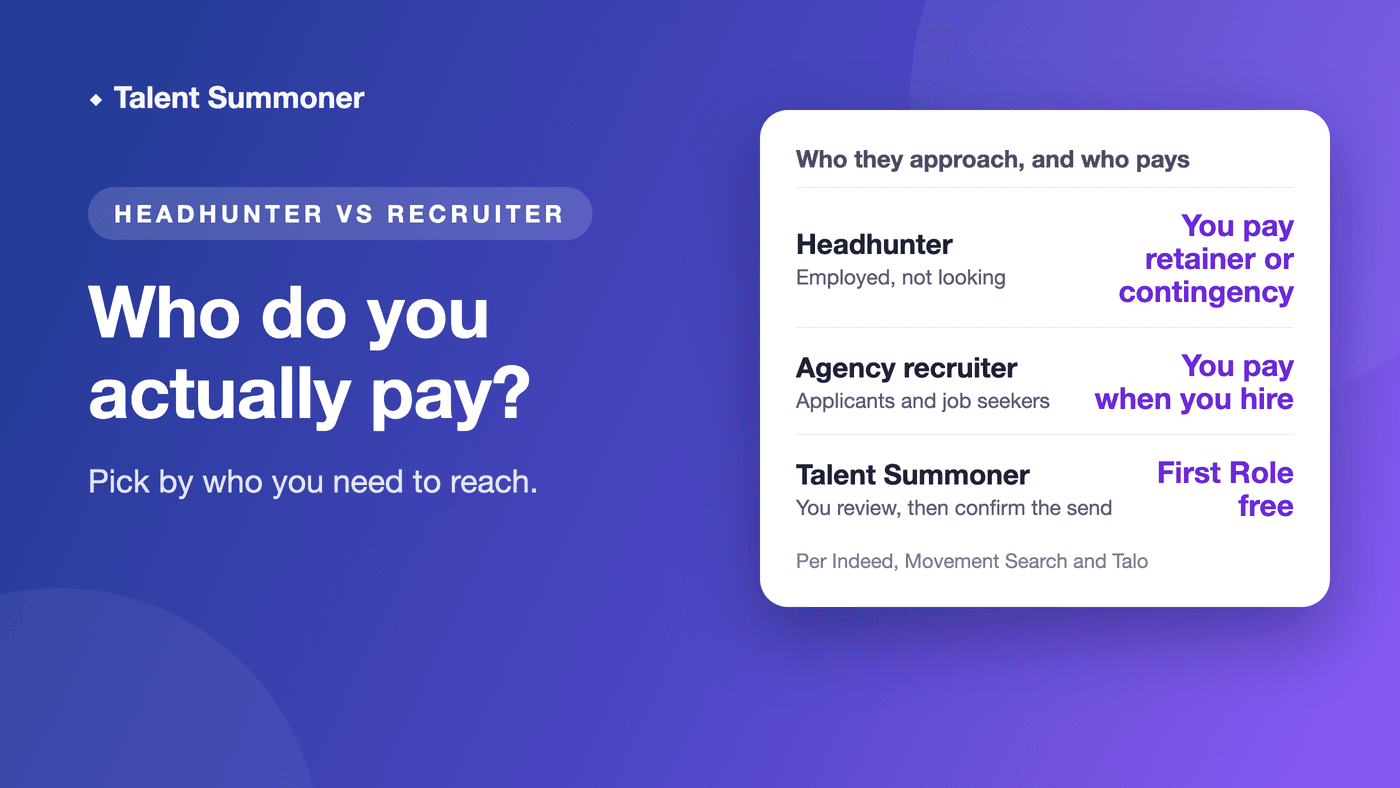
A headhunter is hired by you to approach people who are not looking for a job. A recruiter, in-house or at an agency, mostly works with people who are looking or who apply.
We build Talent Summoner, which searches public profiles and returns a ranked shortlist with the reasoning for each person. Your first Role is free, with no card.
Hiring a senior or confidential role? Read on, because a headhunter may be worth it.
Filling a role people already apply for? You probably need neither.
Headhunter vs recruiter at a glance
The two words overlap. The table shows the usual difference, from Indeed's career guide and the firms named below, read on 4 November 2026.
| Who | Who pays them | How they are paid | Who they approach | Use when |
|---|---|---|---|---|
| Headhunter (executive search) | You, the hiring company | Retainer, part paid before the hire, or contingency, paid after | Employed people who are not job hunting | Senior, hard-to-find or confidential roles |
| Agency recruiter | You, the hiring company | Usually contingency: paid only when you hire their candidate | People who are looking, via job posts, resume databases and applications | A role that draws applicants, and you have no time to screen |
| In-house recruiter | Their employer, which is you | A salary, sometimes with bonuses | Applicants, plus some outreach | You hire often enough to keep one busy |
| Talent Summoner | You | First Role free, then per Role or monthly | Nobody until you review each message and confirm the send | You can run the calls and need names |
Sources: Indeed, Movement Search, Talo and Pin. Movement, Pin and Talent Summoner sell recruiting services or sourcing, and Talo matches companies with recruiters, so weigh their pages accordingly.
The candidate never pays. Talo says the hiring company covers the fee and that companies do not expect candidates to pay it.
Three questions that pick one for you
Ask these in order and stop at the first yes.
- Is the person you want senior or hard to find, employed and not looking? Use a headhunter. Movement describes this as cold-calling top performers and building trust with people who were not planning a move.
- Must the search stay quiet? Use a headhunter. Talo says retained search firms provide confidential outreach.
- Does the role draw applicants? Use a recruiter, or post it yourself. Movement says recruiters add real value when a role attracts a healthy number of applicants.
If all three answers are no, you may only need a list of names. That is a sourcing job, and you can do it yourself.
What each one costs
Most reported fees are a percentage of the hire's pay, and some firms charge a flat fee. On a US$210,000 first-year package, the reported 20% to 35% comes to about US$42,000 to US$73,500, by our arithmetic.
- Headhunter fees covers retained, contingency and flat structures on a worked salary.
- Contingency recruiting covers how the agency fee works, with the math on a real salary.
What a headhunter does that a tool cannot
A headhunter persuades. Movement says the work is building trust with people who never planned a move.
Indeed adds that headhunters often vet candidates against the job description.
Talent Summoner does not replace that. It ranks people against your must-haves, but it does not interview, phone-screen or close, or make a headhunter's confidential approach.
Where Talent Summoner fits
Talent Summoner searches LinkedIn, GitHub and other public sources, then ranks each person against your must-haves with plain-English reasoning. It drafts a message for each person, and you review each message and confirm the send from your own Gmail, Outlook or LinkedIn.
Your first Role is free, then US$29 per Role, US$79 for three, US$59 a month for 10 Roles or US$299 a month for Unlimited (up to 4 people, US$59 per extra person). That suits a mid-level role where someone on your team can own the replies and the interviews.
Trade-offs, stated plainly: no InMail, no always-on pipeline and no ATS integration today. Messages go out under your name, so it is not a confidential approach.
When a headhunter is the wrong choice
A headhunter is a poor fit in three cases:
- You hire the same role several times a year, so a fee each time adds up.
- You already have names and need help choosing.
- The role is junior and applicants are plentiful. See when a recruitment agency is worth the fee.
FAQ
Is a headhunter better than a recruiter?
Neither is better; they do different jobs. A headhunter suits senior, hard-to-find or confidential roles, and a recruiter suits roles that draw applicants.
Who pays a headhunter, the company or the candidate?
The hiring company pays, according to Talo. Candidates are not expected to pay a headhunter or executive search fee.
Is a headhunter the same as an executive recruiter?
Often, yes. Indeed says headhunting is sometimes called an executive search, and that companies usually hire headhunters for top positions such as CEOs.
How are headhunters and recruiters paid?
Indeed says headhunters are usually paid on retainer or on contingency. Agency recruiters are typically paid only when a placement is made, according to Movement Search, and in-house recruiters earn a salary.
Can I find passive candidates without a headhunter?
Yes, for many roles. A sourcing tool or your own search can find employed people, but you still do the outreach and persuasion yourself.
Before you pay a fee, run one Talent Summoner search free and compare the shortlist with what an agency would send.
Descriptions of headhunters and recruiters come from the sites named, read on 4 November 2026. Talent Summoner prices come from our public pricing page on the same date, and an intro offer for a second Role may appear at checkout. We re-verify this page quarterly - tell us if something changed.