Talent Summoner
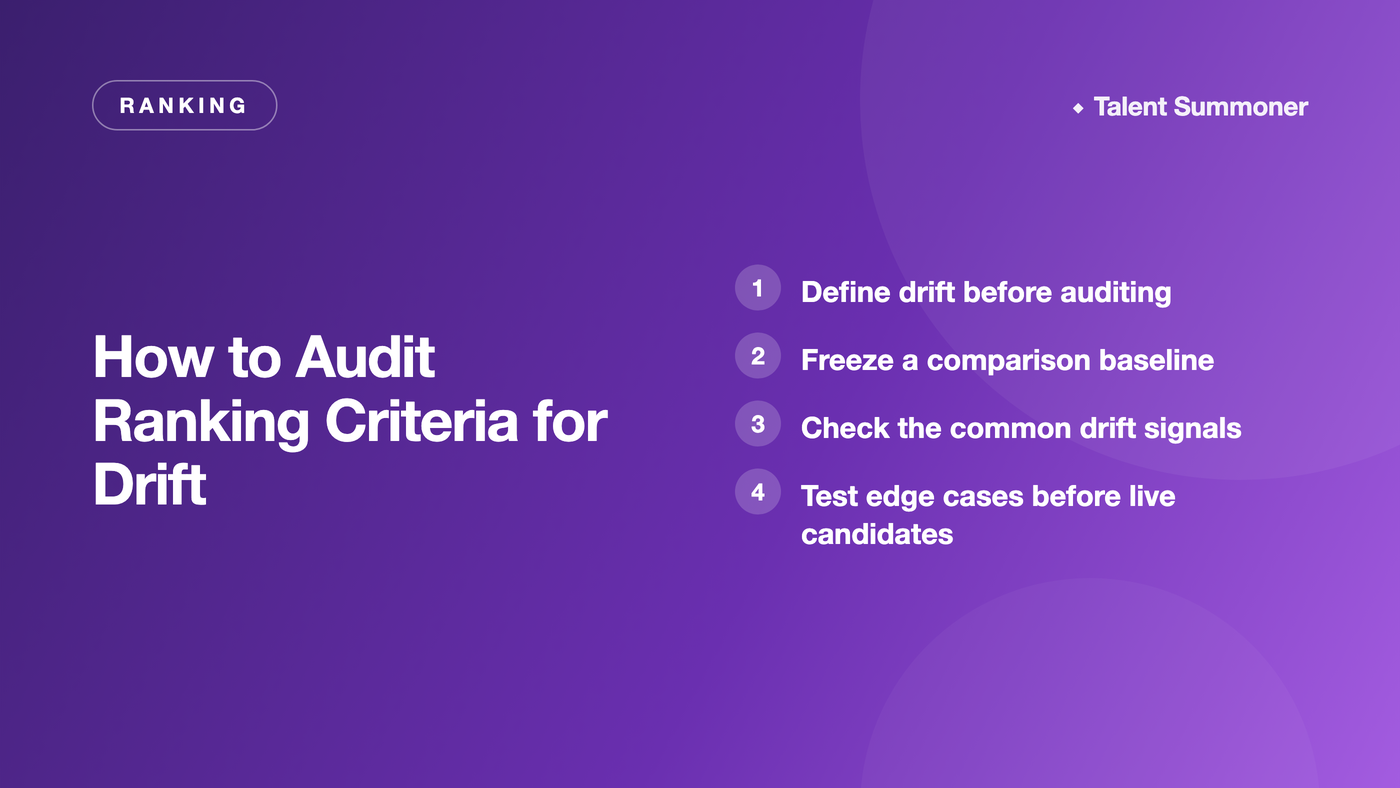
How to Audit Ranking Criteria for Drift
A practical runbook for finding silent changes in ranking criteria, testing edge cases and assigning an owner before acting on a shortlist.
Ranking criteria drift happens when the rule used to compare candidates changes without a deliberate, recorded decision. A must-have becomes a preference, a familiar title starts receiving extra credit, an unknown is treated as a negative, or reviewers use different meanings for the same requirement.
For a team testing ranking edge cases, the aim is not to prove that a ranking is accurate. It is to find where the approved role brief, evidence standard or weighting has quietly moved. This operator runbook uses synthetic fixtures and versioned records so the team can decide whether to retain, revise, pause or escalate the criteria before acting on a live shortlist.
Define drift before auditing
Start by writing what is allowed to change. A ranking baseline should identify the role, brief version, approval date, decision owner, material criteria and their class: must-have, nice-to-have or genuine operating boundary. Add the evidence standard for each criterion, acceptable equivalent experience, any approved weighting and the status labels reviewers may use.
Drift is a change to that definition or its application, not simply a different candidate order. A new candidate set or an approved role change can legitimately produce a different order. The audit question is whether the change was intentional, job-related, versioned and applied to comparable candidates.
Do not repair a suspicious result by editing one candidate's note. Preserve the original baseline, the input records and the reason for every change. If the role has genuinely changed, create a new brief version and decide whether earlier reviews need to be rerun.
Freeze a comparison baseline
Create a compact baseline record before looking at the test output. Capture the exact criterion wording, its class, the evidence that would count, the evidence that remains unknown and the next action for an unresolved item. Record the approver. If your process uses weights or thresholds, record their purpose and limits rather than relying on memory.
Use the same fixtures and source snapshot for each comparison where practical. Label fixtures as synthetic; they test the rule and are not candidate evidence. Keep a change log with four fields: observed behaviour, suspected change, approved correction and rerun result.
Check the common drift signals
Audit one dimension at a time. The following table is a starting set of checks, not a universal scoring formula.
| Drift signal | Synthetic check | Evidence of a problem | Immediate action |
|---|---|---|---|
| A preference behaves like a gate | Hold the must-haves constant and vary one nice-to-have | The preference displaces a candidate with stronger required evidence without an approved reason | Pause and ask the role owner to confirm priority |
| Title wording receives extra credit | Use equivalent work under different job titles | A title changes the interpretation while the described work does not | Revise the criterion to observable work |
| Unknown becomes negative | Remove one material fact while keeping other evidence identical | Missing detail is treated as failed evidence rather than unknown | Restore the unknown state and assign verification |
| Adjacent experience disappears | Use a documented, relevant neighbouring context | The rule cannot represent an approved transferable route | Clarify the acceptable bridge or retain a deliberate boundary |
| Criteria overlap | Run one fixture that satisfies two similar requirements | The same evidence is counted twice without an approved purpose | Merge, separate or explain the criteria |
| Definition changes between reviewers | Give the same fixture to independent reviewers | Labels differ because the evidence standard is unclear | Calibrate the definition before comparing names |
The point is to inspect the rule's behaviour at its boundaries. Do not infer a problem from one surprising rank alone. Record the fixture, expected treatment, observed treatment and the smallest change that could explain the difference.
Test edge cases before live candidates
Build a small fixture set around the role's actual decision boundaries. Include a direct match with clear ownership, an adjacent match with a plausible transfer path, a record with a missing material detail and conflicting source statements. Add a fixture that is strong on a nice-to-have but weak or unknown on a must-have. These are process tests; do not make them resemble real applicants or attach real personal data.
Write the expected treatment before running the ranking. For example, a missing production scope should stay unknown until checked, while a clearly documented equivalent project can be adjacent rather than rejected for its title. If the output follows an unapproved preference, record the criterion identifier and stop the live review until the owner decides whether to revise the brief.
Keep this audit separate from a confidence scale or candidate comparison worksheet. The question is whether the rule still means what the team approved. Once stable, a separate evidence review can label candidate material and assign verification questions.
Compare versions and assign a disposition
Run the baseline and proposed revision through the same fixtures. Compare criterion treatment, explanation, unknown handling and changed order at boundary cases. A changed order is not a defect without an unapproved rule change, while a stable order does not prove the edge-case treatment is sound.
Use one disposition for each finding:
- Retain: the observed behaviour follows the approved definition; record the check and date.
- Revise: the criterion, class or evidence standard needs an explicit, job-related change; create a new version.
- Pause: the result cannot be interpreted until the role owner resolves an ambiguity or duplicate.
- Escalate: the issue concerns a policy, sensitive attribute, access restriction or other boundary that needs the responsible specialist.
Name the owner, the affected role version, the next check and the stop condition. If the correction changes a material requirement, rerun every comparable candidate rather than applying it only to the person who exposed the drift. Preserve both the old and new records so the decision trail remains readable.
Where Talent Summoner fits
Talent Summoner is our product. Its current Candidate Ranking tool, checked on 2 September 2026, accepts a pasted or uploaded job description and up to 50 CVs in PDF, DOCX, MD or TXT format, requires no account and returns a ranked shortlist with plain-English reasoning and a shareable report. Use the same brief and synthetic fixtures to inspect a ranking input; keep the baseline, expected treatment and drift log in your own review process. A report does not prove that the criteria are job-related or that the ranking predicts performance.
When the approved pool is too small, candidate sourcing, also checked on 2 September 2026, starts from a role brief and searches LinkedIn, GitHub and other public professional sources across 200M+ profiles. Its ranked results can support discovery, but public-source information is a lead to verify, not proof of ownership, availability or interest. Carry the approved criteria and edge-case checks into any later discovery pass.
What is ranking criteria drift?
It is an unplanned change in how an approved requirement is defined, weighted or applied. A changed candidate order alone is not drift; the audit looks for a changed rule or inconsistent treatment.
How often should ranking criteria be audited?
Audit before a new role review, after a material brief change and whenever a synthetic edge case exposes inconsistent treatment. Set a review date in the baseline instead of relying on an informal reminder.
Should missing evidence count as a drift failure?
Only when the rule says one thing and the review treats the gap as something else. The usual correction is to restore unknown, record the missing fact and assign a comparable verification step.
Can a stable ranking prove that criteria are fair or accurate?
No. Stable output only shows that the tested inputs produced a similar result. The team still needs job-related criteria, source review, appropriate safeguards and a human-owned decision.
Does Talent Summoner maintain a criteria-drift audit log?
The current product page documents ranking against supplied requirements with plain-English reasoning and shareable reports; it does not document a dedicated drift-audit log. Keep version history, fixtures and dispositions in your own process.
For the next ranking review, freeze one approved brief, create five synthetic boundary fixtures and write expected treatment before inspecting output. Record every deviation with an owner and stop condition, then use candidate ranking for supplied CVs or candidate sourcing when discovery is the gap.