 Talent Summoner
How to Evaluate an AI-Ranked Candidate Shortlist
A practical checklist for testing evidence, consistency, unknowns and reviewer disagreement in an AI-ranked candidate shortlist.
 By Nicholas Yan · Published · Updated · in Ranking & Evaluation
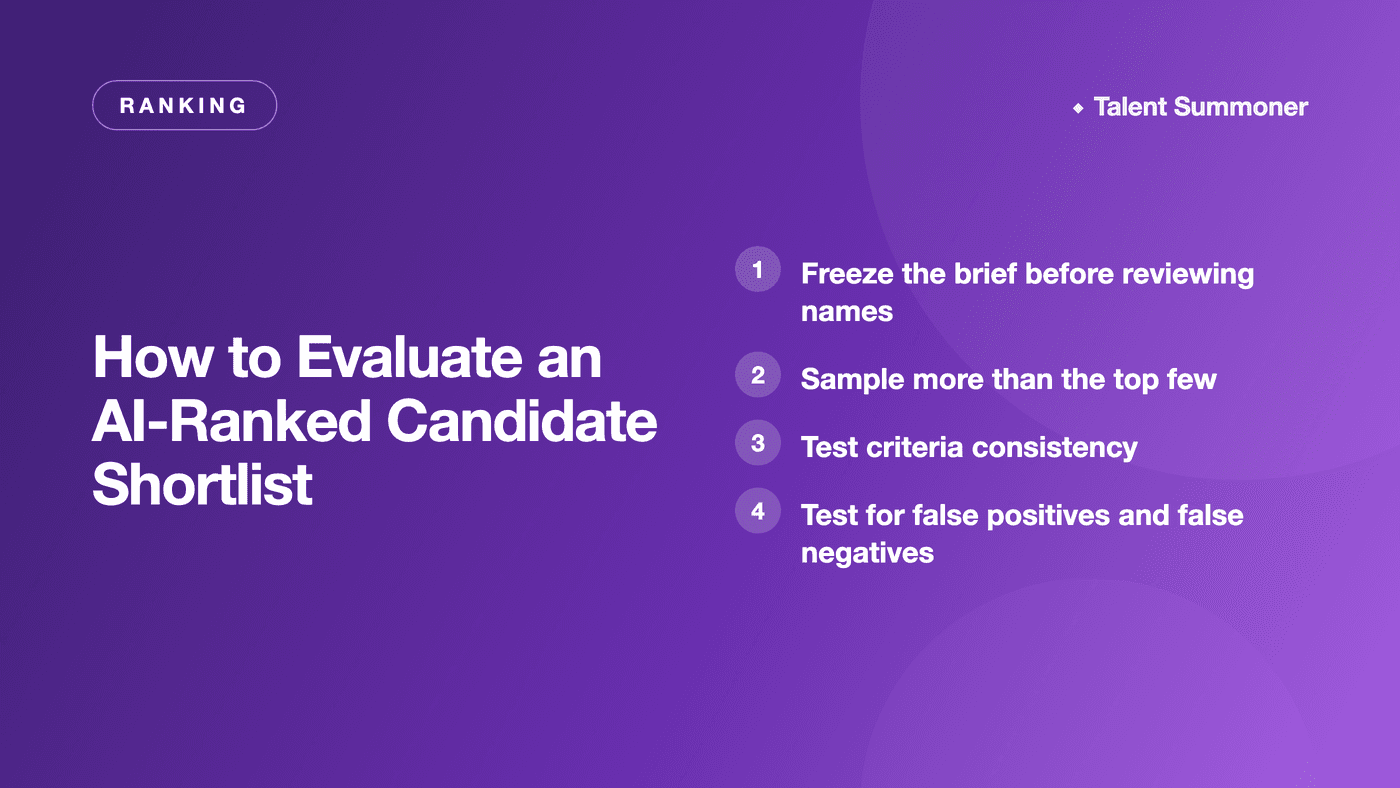
An AI-ranked shortlist is a prioritised review queue, not a hiring decision. Evaluate whether it gives your team job-related evidence, exposes unknowns and supports a defensible next action. Preserve the original output, record corrections, check material public claims where possible before contact, and verify outstanding job-related points before a decision.
1. Freeze the brief before reviewing names
Save the role brief version and ranking date. Record the must-haves, nice-to-haves, boundaries and approved adjacent backgrounds before a compelling profile changes your mind. For each must-have, define evidence that would count: a project, responsibility, qualification or relevant context.
Clarify trade-offs in advance. Decide whether equivalent scope can satisfy a years requirement. Label location or working pattern as a boundary or preference. Do not rewrite criteria to explain why the top-ranked person looks suitable.
2. Sample more than the top few
Review a sample from the top, middle and bottom of the ranking, plus any surprising result. For a small set, inspect every profile. If possible, hide the rank while a reviewer first labels evidence; this tests whether the explanation stands alone.
For each candidate, record the criterion, supporting passage or project signal, source and date. Label it supported, adjacent, unknown or contradicted. Unknown means the material does not establish a fact, not that the candidate lacks it. "Strong leadership" needs a concrete context or verification question.
3. Test criteria consistency
Apply the same definitions to every candidate. Ask, "Would this evidence satisfy the requirement if the name and rank were hidden?" Check that a nice-to-have is not compensating for an unproven must-have and that a familiar title is not receiving more credit than equivalent work.
Use a compact requirement matrix. Compare each explanation with its source, looking for generic reasoning, missing criteria, contradictory dates or conclusions stronger than the evidence. A ranking organises attention; it does not establish performance or make a score a probability.
4. Test for false positives and false negatives
A false positive is a profile that appears high because its wording or title resembles the brief, while its scope is weak, adjacent or unverified. Check for keywords without a relevant project, seniority inferred from a title or a must-have treated as optional.
A false negative is a plausible person ranked low or omitted because the CV uses different language, shows a non-linear career path or gives limited context. Compare the result with known examples and approved adjacent backgrounds. Do not use a demographic characteristic or a proxy for one as evidence of fit.
Record the cause separately: unclear brief, narrow wording, missing source detail, duplicate profile or reviewer interpretation. This makes the next correction specific. A surprising result is a prompt to inspect evidence, not proof that the ranking is accurate or inaccurate overall. If the search used agent-proposed filters, review the candidate filters before evaluation as one more possible cause of a missing person.
5. Surface reviewer disagreement
Ask two reviewers to label the same sample independently. Compare disagreements by criterion: evidence, definitions or trade-offs. If a fact is unclear, add a verification question. If a requirement is ambiguous, revise the brief, record the change and run a new pass; do not average disagreement into a more confident score.
Keep both reasons when dispositions differ. The hiring manager can decide whether uncertainty is worth a conversation, but that decision should be visible. Calibration aligns people; it does not prove that the system is unbiased or one reviewer is always right.
6. Turn the audit into a next action
Give each candidate one human-owned disposition: progress, verify, hold, revise or close. Progress means the evidence merits a conversation. Verify names the missing fact and owner. Hold records why timing or a second opinion matters. Revise means the brief or search needs a controlled change. Close records a job-related reason; it is not an automatic rejection triggered by rank.
If high-ranked profiles share missing evidence, create a verification set. If low-ranked profiles reveal a credible route the brief allowed, add it explicitly and rerun with one change. If the pool is incomplete, source more candidates rather than treating the ranking as a view of the whole market.
Where Talent Summoner fits
Talent Summoner is our product for AI candidate sourcing, CV ranking and outreach you confirm before it sends. The live candidate-ranking tool, checked 19 August 2026, accepts up to 50 CVs in PDF, DOCX, MD or TXT format, requires no account and creates a shareable report. Use it as starting material; your team verifies evidence, chooses whom to contact and makes the hiring decision.
When the CV pool is the problem, candidate sourcing starts from a role brief and searches LinkedIn, GitHub and other public professional sources across 200M+ profiles, returning a ranked shortlist with must-haves, nice-to-haves and plain-English reasoning. Feedback can adjust a later search and weighting. See current pricing for sourcing terms.
Bottom line
Audit rank bands, test the same criteria, log false positives and negatives, then resolve disagreement with a named next action. Preserve the original output so changes remain explainable.
FAQ
Should I only review the top-ranked candidates?
No. Sample the top, middle and bottom, including surprising results. The first few cannot reveal false negatives or inconsistent criteria.
Does an AI ranking prove candidate fit?
No. It organises attention and relates submitted material to the brief. People inspect sources, verify claims, assess the candidate and decide.
What does an unknown requirement mean?
It means the available material does not establish the requirement. Record a verification question instead of treating missing information as absence.
Can Talent Summoner automatically reject a candidate?
No. The report supports human review. Your team owns dispositions, outreach, interviews and decisions; it is not an ATS and does not automatically reject candidates.
Related: How to Compare Two Candidate Profiles Fairly · How Missing Evidence Should Affect Candidate Fit · How Feedback Improves the Next Candidate Search
Talent Summoner product facts read from our live candidate sourcing, candidate ranking and pricing pages, verified 3 October 2026. We re-verify this page quarterly — tell us if something changed.