 Talent Summoner
How to Read Evidence Behind a Candidate Match
Learn how to read one candidate match explanation by separating source text, criteria, interpretation, uncertainty, contradiction and verification.
 By Nicholas Yan · Published · Updated · in Ranking & Evaluation
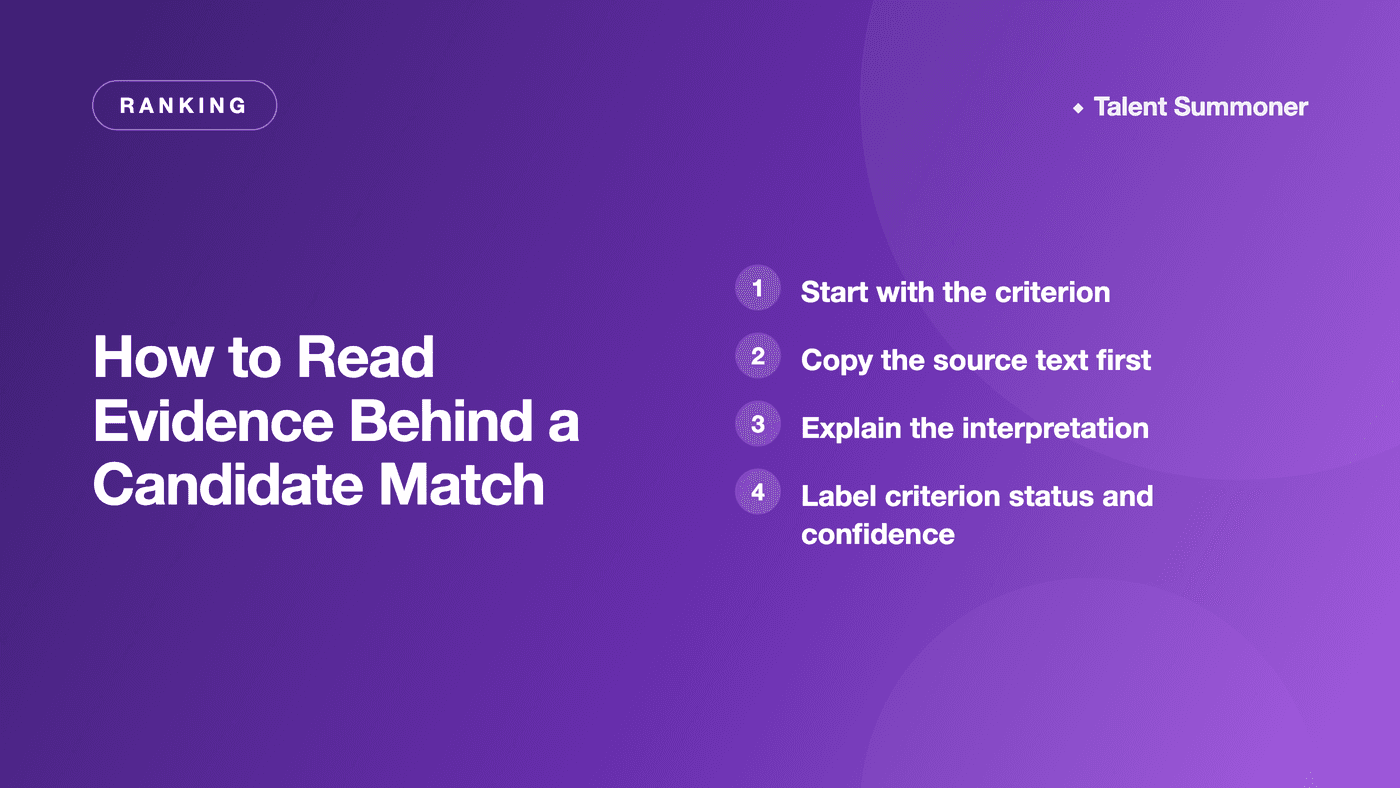
A candidate match explanation is useful when a reviewer can trace it back to the role requirement and original source. Read it as a chain of claims: what does the CV or profile say, which criterion does it address, what has been inferred, what is unknown and what should someone verify next?
This creates a reviewable trail. A match explanation can help decide where to look first, but it does not predict job performance, prove accuracy or make the hiring decision.
Start with the criterion
Before reading the candidate's name or explanation, write the criterion in plain language. Separate a must-have, nice-to-have and boundary. An example role might require owned production API migrations, prefer payments experience and require the agreed work schedule.
Ask what evidence would satisfy it. "Owned a migration" might require a named project and responsibility; a keyword alone is insufficient. Define acceptable adjacent evidence before reviewing profiles so a familiar title cannot change the standard.
Copy the source text first
Source text is the observable material: a CV sentence, project description, public profile field or other permitted professional source. Record the wording and source.
Consider this labelled example: a CV says, "Migrated payments workloads to Kubernetes." That is the source text. It does not establish the number of services, the candidate's ownership, production context, result or whether the work is current. Do not add details that make the match sound stronger.
Keep source text and interpretation separate so a reviewer can challenge the reasoning. If the source is missing, stale or ambiguous, record that limitation rather than presenting a paraphrase as evidence.
Explain the interpretation
Interpretation answers how the source relates to the criterion. In the example, the sentence is relevant to migration work and Kubernetes exposure. It is a direct signal for "worked on a Kubernetes migration", but only adjacent evidence for "owned production API migrations" until ownership, API scope and production context are established.
Use modest language such as "indicates" or "suggests" for a possibility. Reserve "shows" for what the text establishes. Do not infer seniority from a title, leadership from a team name or outcomes from an activity verb. Note what is explicit and what is inferred.
Label criterion status and confidence
Give the criterion a status that another reviewer can understand:
- Supported: the source directly addresses the requirement in relevant context.
- Adjacent: the source describes a related route that may transfer, but needs a deliberate check.
- Unknown: the available material does not answer the question. Unknown is not evidence that the candidate lacks the capability.
- Contradicted: the source conflicts with the requirement or with another reliable source.
Describe confidence in the reading of the evidence, not confidence that the candidate will perform well. High confidence can mean a specific, current source clearly tied to the criterion; lower confidence can reflect vague wording, missing context, an uncertain date or a substantial inference. It is not a prediction or accuracy percentage.
For the example, mark Kubernetes migration exposure supported, but ownership of production API migrations unknown unless another passage answers it. Keep labels criterion-specific: a candidate can be supported for one requirement and unknown for another.
Investigate contradictions carefully
A contradiction is more than missing detail. It is a material conflict: one source places a project after a role ended, a profile conflicts with a required location boundary, or the CV says the candidate supported rather than owned the work. Quote both sides and name the affected criterion.
Check for an old profile, shorthand, overlapping dates or a different meaning of "led". If the conflict remains material, mark it contradicted or unresolved and create a verification question. Do not turn it into automatic rejection without human review of the requirement and context.
Write one verification question
A good verification question closes a specific gap, names the work and asks for context rather than a simple confirmation. For the example: "What parts of the payments migration did you personally own, which APIs or services were in scope, and how was the work operated in production?" This is more useful than "Tell me about Kubernetes."
Use the same question for comparable candidates where possible. Record the follow-up owner and what answer would change the status. Update the record after an answer; keep the original source.
Where Talent Summoner fits
Talent Summoner is our product for AI candidate sourcing, CV ranking and outreach you confirm before it sends. The live candidate-ranking tool, checked 3 October 2026, lets a reviewer paste or upload a job description, upload up to 50 CVs in PDF, DOCX, MD or TXT format and receive plain-English reasoning with a ranked shortlist. It requires no account and produces shareable reports. Open the source, test the criterion and record a question.
When the CV pool is incomplete, candidate sourcing starts from a role brief and searches LinkedIn, GitHub and other public professional sources across 200M+ profiles. It returns a ranked shortlist with must-haves, nice-to-haves and reasoning; feedback can adjust a later search. See pricing for current options. Talent Summoner is not an ATS and does not automatically reject candidates.
FAQ
What is the difference between source text and interpretation?
Source text is what the CV or profile says. Interpretation explains how it relates to a criterion. Keep both visible for review.
Does confidence mean the match is accurate?
No. Confidence describes how strongly the source supports the interpretation. It does not prove ranking accuracy or job performance.
Is unknown the same as a weak match?
No. Unknown means the material does not answer the criterion. Record a verification question; missing information is not proof of absence.
For your next review, choose one match explanation and make a six-line record: criterion, source text, interpretation, status, confidence and verification question. Ask the role owner to challenge each line before assigning a disposition.
Related: How to Evaluate an AI-Ranked Candidate Shortlist · How to Compare Two Candidate Profiles Fairly · How Missing Evidence Should Affect Candidate Fit
Talent Summoner product facts read from our live candidate sourcing, candidate ranking and pricing pages, verified 3 October 2026. We re-verify this page quarterly — tell us if something changed.