Talent Summoner
How to Review Transferable Skills in a Shortlist
A panel-ready method for comparing transferable skills in a shortlist, separating evidence from assumptions and recording the next check.
Transferable skills are easiest to overrate when a panel is already looking at names. A familiar title can feel reassuring, while a different background can be dismissed before anyone asks what work the person actually did. A sound shortlist review keeps both possibilities open: compare the capability the role requires, describe the context in which it was demonstrated, and record what still needs checking.
Use it after a shortlist exists, before a ranking becomes a progression decision. Record a traceable next step, not a score that pretends to measure future performance.
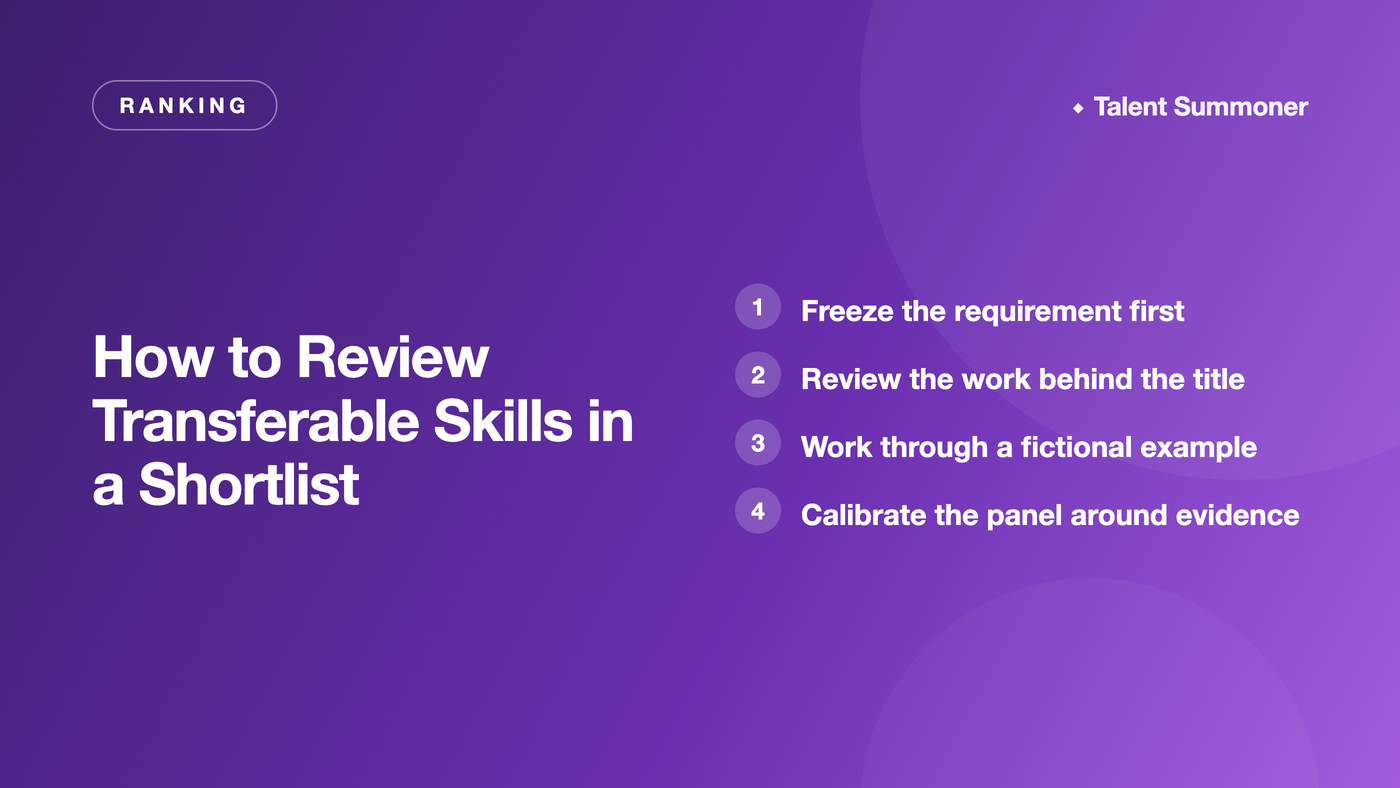
Freeze the requirement first
Write the criterion in terms of an action and its context. "Leadership" or "commercial experience" is too broad to review consistently. "Own a multi-team implementation from technical scoping through go-live" gives the panel a job-related question. Define:
- Activity: what the person must do.
- Context: the customers, systems, constraints or environment that matter.
- Scope: the size or complexity that is genuinely necessary.
- Boundary: a job-related requirement or constraint the role cannot accommodate or reasonably teach during its expected onboarding period.
Mark the criterion as a must-have, nice-to-have or boundary before reopening the shortlist. Write what evidence counts and which gap needs a follow-up. If the role changes, save a new brief version and review everyone against it.
Review the work behind the title
For each candidate, separate five questions: what work is described, where it happened, what the person owned, what changed, and what is unclear. A title or project name does not establish responsibility, scale or outcome.
Use these labels for the relationship between the evidence and the criterion:
| Label | Meaning | Panel action |
|---|---|---|
| Direct | The described activity and important context closely match the requirement. | Verify material scope or outcome, then assess against the same gate. |
| Adjacent | The activity is relevant, but a context or ownership bridge remains. | Ask one focused question about the bridge. |
| Unknown | The available material does not answer the criterion. | Record the missing fact; do not convert silence into a fail. |
| Contradicted | A reliable source conflicts with the requirement or another material source. | Preserve the conflict and assign a human resolution. |
These are review labels, not universal ratings. "Adjacent" does not mean weaker in every role, and "direct" does not prove the person will perform well. The label should make the next check easier to see.
Work through a fictional example
Imagine a role where the approved must-have is: own a customer-facing implementation across technical and commercial stakeholders. The panel has three shortlisted profiles:
| Candidate | Visible evidence | Transfer view | Record next |
|---|---|---|---|
| A | Describes coordinating a customer API launch, dependencies and go-live decisions. | Direct activity and context; ownership and scale still need confirmation. | Ask which decisions they personally owned and how the launch was measured. |
| B | Describes leading an internal platform migration across engineering and finance. | Adjacent coordination and delivery evidence; customer-facing context is unproven. | Ask how they handled customer requirements, trade-offs and escalation. |
| C | Lists "enterprise project management" but gives no project, responsibility or result. | Unknown, even though the wording sounds relevant. | Request a specific example or keep the criterion unresolved. |
Do not award Candidate C credit for a keyword or dismiss Candidate B solely because the title differs. Candidate A has the clearest initial fit for this criterion, but the record still says what to verify. Candidate B may become viable if the bridge is confirmed. If evidence remains unresolved, preserve that uncertainty rather than manufacture a narrow order.
Calibrate the panel around evidence
Ask each reviewer for a short source trace and one-sentence interpretation before discussion. Compare one criterion at a time rather than defending an overall impression. For every disagreement, ask:
- Which words or work sample support the interpretation?
- Is the disagreement about the evidence, the criterion or the acceptable gap?
- Would the same question be asked of a candidate with a familiar title?
Keep interpretation separate from source wording. "Coordinated an API launch" is a trace; "can own our implementation" is a conclusion. If the latter needs a work sample or structured question, apply it to comparable candidates and document the owner.
Do not infer transferability from age, nationality, school, employer prestige, career gap, name, photograph or another personal proxy. Keep location, authorisation, schedule and compensation separate from skill evidence, using your organisation's approved process.
Choose a next action, not a hidden score
Close each criterion with one action: progress, verify, hold, revise or close. A close decision needs a job-related reason, such as a confirmed boundary the role cannot accommodate. A verify decision names the question, owner and stop condition; a hold decision says what would reopen it. If evidence cannot distinguish two candidates, a tie with the same next step is more honest than extra decimal places.
Keep the decision note short:
Criterion and brief version:
Candidate / source trace:
Transfer label: direct / adjacent / unknown / contradicted
What the evidence supports:
What remains unresolved:
Comparable verification question:
Action / owner / stop condition:
Where Talent Summoner fits
Talent Summoner is our product. Its candidate-ranking tool, checked 2 September 2026, accepts a pasted or uploaded job description and up to 50 CVs in PDF, DOCX, MD or TXT format. It returns a ranked shortlist with plain-English reasoning and shareable reports without requiring an account. Use that output to organise the panel's reading; the panel still defines the transferable-skill test, checks the underlying material and owns the decision.
When the existing CV pool does not contain enough relevant routes, candidate sourcing, checked 2 September 2026, starts from a role brief and searches LinkedIn, GitHub and other public professional sources across 200M+ profiles, returning a ranked shortlist against the stated criteria. Public-source discovery is a reason to review, not proof of ownership, availability or interest. See pricing for current Role options when a new sourcing search is approved.
What is a transferable skill in a shortlist?
A transferable skill is a job-related capability shown in a different role, industry or operating context that may still apply to the open role. Describe the shared activity and context gap, then verify the bridge.
Should direct experience always outrank adjacent experience?
No fixed rule answers every role. Direct evidence may be the clearest starting point, while adjacent evidence may satisfy the requirement if the activity, ownership and bridge are confirmed. Use the same standard for everyone.
Is missing evidence proof that a candidate lacks the skill?
No. Mark the criterion unknown when the material does not answer it. Check whether the source is incomplete, then ask a comparable question before deciding.
Can Talent Summoner decide whether a skill is transferable?
No. Our product can organise CVs or public-source candidates against a role brief and show ranking reasoning. Your panel must define the acceptable transfer, inspect evidence, resolve unknowns and make the hiring decision.
Choose one must-have in an open role and write its activity, context, scope and boundary before the next panel review. For each shortlisted candidate, record one source trace, one transfer label and one comparable verification question. Then use candidate ranking for supplied CVs or candidate sourcing for an approved discovery pass, keeping the panel's decision record with the role brief.