 Talent Summoner
How to Shortlist Candidates When You Are Not an Expert in the Role
A practical hiring manager method for shortlisting unfamiliar roles: own the outcome, document unknowns and involve a subject expert for technical evidence.
 By Kevin Wong · Published · Updated · in Ranking & Evaluation
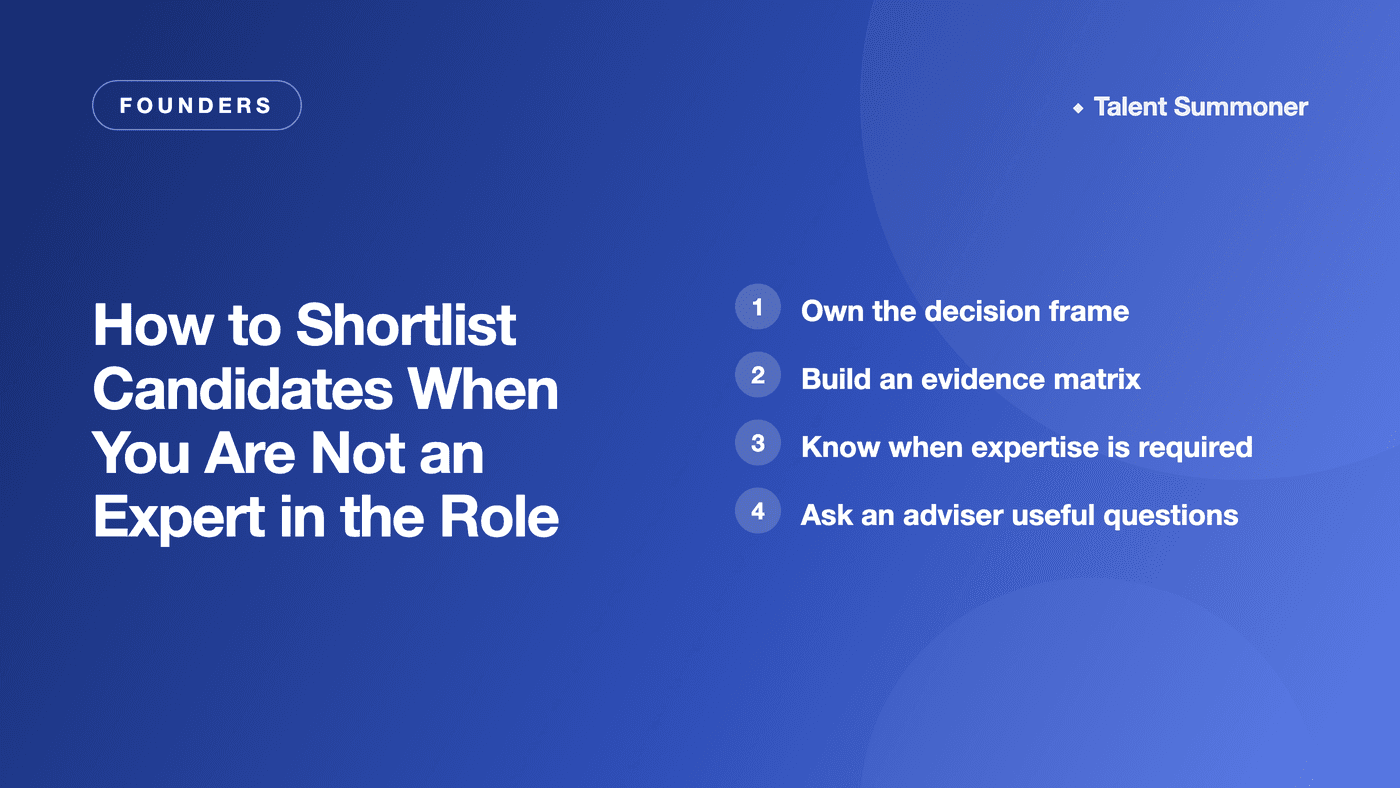
You can shortlist candidates without being the role expert. Make the decision frame clear, apply it consistently and bring in the right reviewer for evidence you cannot interpret. A shortlist is a review queue, not proof someone can do the work.
Own the decision frame
Start with the outcome: what the hire must deliver in the first agreed period and what progress will look like. Record boundaries: work in this role, work elsewhere, real location or time-zone constraints, and approved compensation or working-pattern limits. Define the process: who reviews profiles, answers technical questions, contacts candidates, decides and records evidence.
This is what a non-expert hiring manager can own: why the role exists, what success means, trade-offs and how review will run. Do not turn a familiar title or tool name into a requirement merely because it is easy to search.
Build an evidence matrix
Translate each must-have into an observable question before reading profiles. Keep preferences separate from conditions of success. Use this matrix for every candidate:
| Requirement | Evidence to look for | Status | Next owner and question |
|---|---|---|---|
| Owns the stated outcome | A specific project, responsibility and result in context | Supported, adjacent or unknown | Hiring manager: what did the person personally own? |
| Has the technical capability | Relevant work, artefact or explanation defined by a subject expert | Unknown until inspected | Technical reviewer: what would demonstrate competent execution? |
| Can operate within the boundaries | Location, schedule, scope or collaboration evidence | Supported or unknown | Hiring manager: which constraint needs confirmation? |
| Meets a preference | Related experience or transferable evidence | Nice-to-have | Hiring manager: would its absence change the decision? |
Use supported when the source directly addresses the requirement, adjacent when experience may transfer, unknown when material does not answer it, and contradicted when reliable information conflicts. Unknown is not rejection: record the missing fact and the responsible way to check it.
Know when expertise is required
Ask a subject expert to define evidence when a wrong interpretation could change the shortlist. This includes technical ownership, architecture, security practice, research methods, specialist tooling, regulated workflows or work where a polished description can conceal a gap. The expert should define competent evidence, acceptable adjacent evidence and a suitable test.
The expert should inspect the evidence itself. A hiring manager can note that a profile names a migration or model; the expert must assess depth, decisions, constraints and trade-offs. Review may be limited to top candidates, but must happen before a technical claim is supported. AI ranking can prioritise inspection; it does not substitute for expertise or verify ability.
Ask an adviser useful questions
Do not ask, "Is this person good?" Give an adviser a criterion and request an inspectable answer:
- What outcome does this evidence relate to, and what does it fail to establish?
- Which details distinguish personal ownership from participation or exposure?
- What is the smallest work sample or conversation to resolve this unknown?
- Which adjacent background could transfer, and what assumption needs testing?
- What would count as a contradiction, and which source should we check?
Ask for reasoning and a follow-up question, not just yes or no. Use the same core questions for comparable candidates.
Check independence and conflicts
A useful reviewer can challenge the brief as well as the candidate. Record their relationship to the role and candidate, any incentive connected to the hire, and whether they helped write the requirement. A referrer or paid adviser may provide valuable context, but that perspective should be visible rather than treated as neutral.
Where independence is limited, add a second reviewer for the criterion, separate evidence from recommendation and record who made the final call. Document the relationship and safeguard without assuming its relevance. Apply the same standard to referred and unfamiliar candidates.
Turn the matrix into a shortlist
Review strong, borderline and surprising profiles against the same matrix. For each person, write one reason to continue, one unknown and one next action. The next action might be technical inspection, a structured conversation or a work sample. Do not hide uncertainty behind a score or imply that order verifies performance.
Talent Summoner is our product for this first pass. The free Candidate Ranking tool, checked on 3 October 2026, accepts a job description and up to 50 CVs in PDF, DOCX, MD or TXT format, requires no account and creates a shareable report with plain-English reasoning. It ranks supplied material; your team inspects evidence, assesses candidates and decides. It is not an ATS and does not automatically reject candidates.
When the pool is incomplete, candidate sourcing starts from a role brief and searches LinkedIn, GitHub and other public professional sources across 200M+ profiles. It returns must-haves, nice-to-haves and plain-English reasoning; feedback can adjust a later search and weighting. Sourcing is free to start with no credit card. The pricing page, checked 3 October 2026, lists US$29 for one Role, US$79 for three, US$59 per month for ten or US$299 per month for Unlimited, which covers every open role. Your first Role is free and your second is US$4, an intro price shown at checkout, not on the pricing page. Check live terms before purchase.
Next step
Choose one open role, write its outcome and boundaries, complete an evidence matrix for three must-haves and name the subject expert before you review a candidate shortlist.
FAQ
Can a non-expert hiring manager shortlist candidates?
Yes. Own the outcome, boundaries and process; record evidence and unknowns. Ask a subject expert to define and inspect specialist evidence first.
What should I do when a CV does not prove a requirement?
Mark it unknown, state the missing evidence and assign a focused follow-up such as a structured question, work sample or expert review. Missing information is not proof of inability.
Should an adviser make the final hiring decision?
The adviser should inspect a defined criterion and explain limitations. The decision-maker weighs the evidence, boundaries and process, with relationships or incentives recorded.
Does Talent Summoner verify technical ability?
No. Talent Summoner ranks supplied CVs or sources public professional profiles with plain-English reasoning. Your team verifies claims, inspects technical evidence and decides; it is not an ATS and does not automatically reject candidates.
Related: How to Hire Your First Employee as a Startup Founder · How to Hire When You Do Not Have a Talent Database · How to Choose Between an Agency, Recruiter and Sourcing Tool
Talent Summoner product facts read from our live candidate sourcing, candidate ranking and pricing pages, verified 3 October 2026. We re-verify this page quarterly — tell us if something changed.