Talent Summoner
How to Test a Matching Rubric on Edge Cases
Use synthetic edge cases to test a candidate matching rubric, expose rule failures and hand off a human-owned correction before reviewing a close shortlist.
Testing a matching rubric on edge cases means checking how the rules behave at their boundaries before a close shortlist is treated as ready for review. The purpose is not to prove that a rubric predicts performance. It is to find whether the same requirement is interpreted consistently when evidence is incomplete, phrased differently or in tension with another requirement.
For a recruiter comparing a close shortlist, a useful test leaves a repeatable record: the fixture, the expected treatment, the actual result, the reason for any difference and the owner of the correction. Keep these tests separate from real candidate evidence. A synthetic record can expose a rule failure without becoming an opinion about a person.
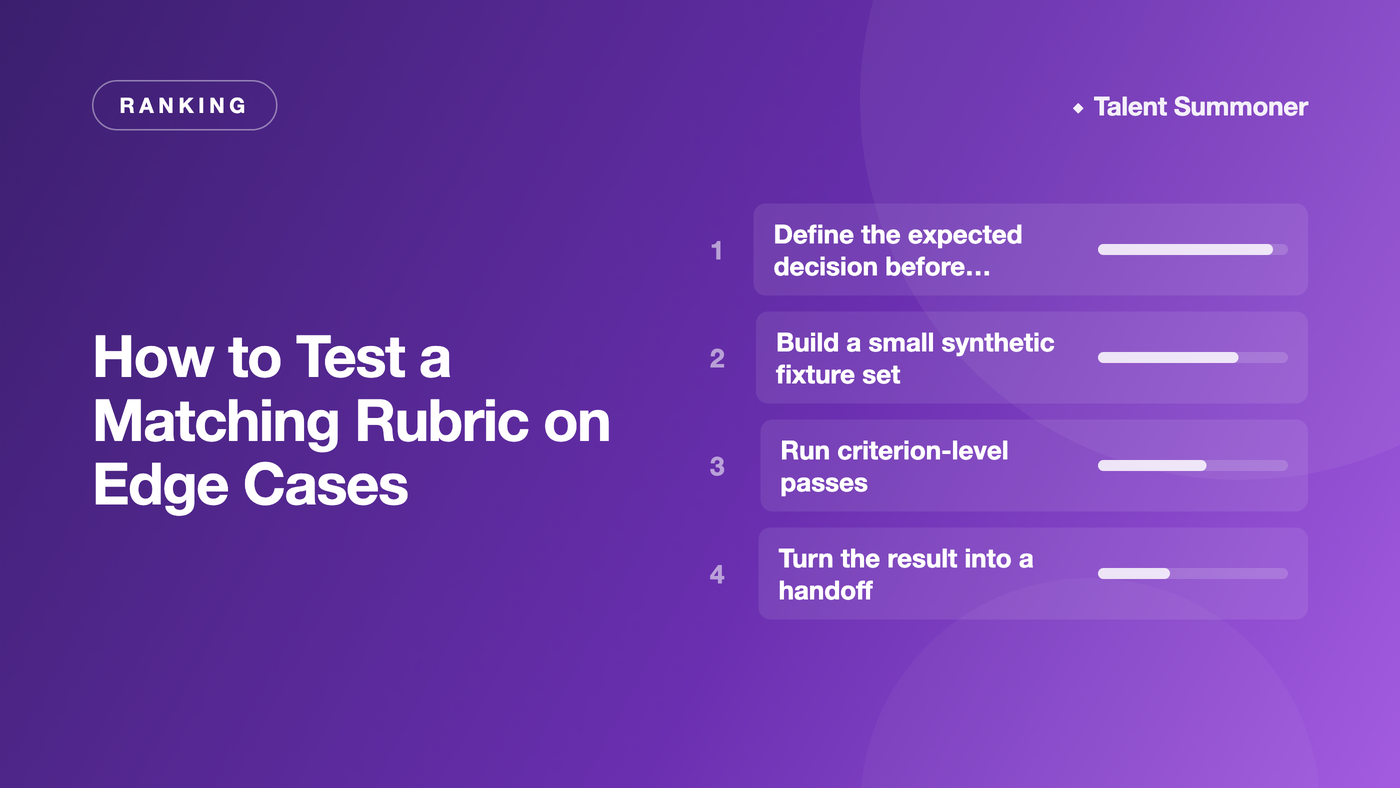
Define the expected decision before the test
Freeze the role brief version, review question and decision owner. Split the brief into must-haves, nice-to-haves and operating boundaries. For each criterion, write the narrow evidence that would count and the status to use when the material does not answer it: for example, supported, adjacent, unknown or contradicted.
Then write the expected treatment for each fixture before running the rubric. This is the test oracle: a statement about how the rule should handle the input, not a preferred candidate order. For example, “a relevant equivalent project is adjacent until the role owner confirms the bridge” is testable; “this profile should rank highly” is not.
Label the test as retrieval, interpretation, precedence or hand-off. Check that the signal is surfaced, described no more strongly than its source allows, protected from preference override and connected to a visible human next action.
Build a small synthetic fixture set
Create short, fictional records that change one material property at a time. Do not copy personal details from a real applicant, and do not add an invented employer, outcome or credential that could be mistaken for evidence. A fixture should contain only what is needed to exercise the rule.
| Fixture | Boundary being tested | Expected treatment |
|---|---|---|
| Direct evidence | The requirement is stated with relevant context and ownership. | Supported; preserve the source and narrow interpretation. |
| Equivalent wording | The work is relevant but uses a different title or term. | Evaluate the work signal, then mark supported or adjacent according to the approved bridge. |
| Missing must-have | The record is silent on a material requirement. | Unknown, not failed; assign a comparable verification question. |
| Explicit conflict | One supplied statement conflicts with the requirement or another source. | Contradicted or hold for human review; do not average the conflict away. |
| Nice-to-have pull | A preference is strong while a must-have is unknown. | Keep the unknown visible; the preference must not silently override the gate. |
| Keyword decoy | A familiar term appears without relevant work or context. | No support for the criterion; record why the term is insufficient. |
Add a boundary pair when possible. State that one fictional person owned a production migration, then change only "owned" to "supported". This tests responsibility without relying on title or keyword. Another pair can change only the approved location boundary. These are process probes, not benchmark data; do not calculate an accuracy percentage from them.
Run criterion-level passes
Run every fixture through the same version of the rubric and retain the input, output and timestamp. First compare the rubric's status and explanation with the expected treatment. Review the evidence claim before looking at overall order: a plausible rank can conceal a wrong criterion label, and a lower rank can result from an explicit boundary rather than a defect.
For each difference, classify the failure narrowly:
- False positive: the output treats a keyword, title or adjacent activity as proof of the requirement.
- False negative: the output misses an approved equivalent expression or relevant context.
- Unknown collapse: missing information becomes a negative, positive or confident conclusion.
- Precedence error: a nice-to-have compensates for an unresolved must-have or boundary.
- Evidence overreach: the explanation adds scope, ownership, recency or results absent from the fixture.
Save the smallest reproducible example for every failure. If the requirement is ambiguous, pause and ask the decision owner to revise the brief. If the rule is clear but the output is wrong, change one rule, rerun the affected pair and note whether other fixtures moved. Avoid candidate-specific exceptions that weaken the next review.
Turn the result into a handoff
Another teammate should be able to rerun the test without a verbal explanation. Include the role and rubric version, fixture ID, criterion, expected status, actual status, source or input excerpt, failure class, proposed change, reviewer, owner and stop condition.
Edge-case test ID: [ID]
Role / rubric version: [role] / [version]
Criterion and class: [criterion] / [must-have | nice-to-have | boundary]
Fixture input: [synthetic record or controlled change]
Expected treatment: [status + narrow reason]
Actual treatment: [status + explanation]
Difference class: [false positive | false negative | unknown collapse | precedence | overreach | inconsistent pair]
Proposed correction: [one rule or brief change]
Rerun scope: [fixture IDs or candidate set]
Owner / stop condition: [name or role] / [condition]
Disposition: [retain | revise | pause | escalate]
Close the test only when the owner records the disposition and the rerun scope. A stable output is not proof that the rubric is fair, accurate or complete; it only shows that this fixture produced the same result under the tested version. Keep the test record with the rubric change history so a later reviewer can tell whether a shortlist moved because the evidence changed or because the rule changed.
Where Talent Summoner fits
Talent Summoner is our product. Its current Candidate Ranking tool, checked on 2 September 2026, accepts a pasted or uploaded job description and up to 50 CVs in PDF, DOCX, MD or TXT format, then returns a ranked shortlist with plain-English reasoning and a shareable report without an account. Use a controlled set of fictional inputs to inspect how supplied requirements are represented, while keeping your expected treatments and edge-case record outside the report. The product page does not document a dedicated rubric test harness or universal edge-case status scale.
When the supplied CV pool is the gap, candidate sourcing starts from a role brief and searches LinkedIn, GitHub and other public professional sources across 200M+ profiles, returning ranked results with must-haves, nice-to-haves and plain-English reasoning. Treat public-source results as discovery material to verify. Your team still owns the rubric, comparable checks and shortlist decision.
What counts as an edge case in a matching rubric?
A controlled input at a rule boundary: missing evidence, equivalent wording, conflict or a preference paired with an unknown must-have. Use synthetic fixtures.
Should missing evidence fail a must-have test?
No. Mark it unknown unless an evidence-based gate applies. Record the missing fact, comparable check and owner.
How many fixtures should a rubric test include?
There is no universal number. Give each material rule a normal and boundary case, then add pairs for controlled changes.
Can Talent Summoner run edge-case tests automatically?
The page documents uploads, ranked results, reasoning and shareable reports, not an edge-case harness. Keep fixtures and reruns in your process.
For the next close shortlist, freeze the role brief, create a small paired fixture set and have a teammate replay it from the handoff record. Resolve one rule difference at a time, then use candidate ranking for supplied CVs or candidate sourcing when discovery is the gap.