Talent Summoner
Ranking Candidates with Non-Linear Career Paths
A practical runbook for reviewing non-linear career paths, separating chronology from evidence and correcting ranking failures before a decision.
Ranking candidates with non-linear career paths starts with a simple boundary: a tidy chronology is not a job requirement. A candidate may have changed functions, moved employers, taken a career break or moved internally without following a conventional promotion ladder. Those facts tell you where to inspect evidence; they do not decide whether the person fits the role.
For an internal-mobility lead, the task is to make an unfamiliar path reviewable. Translate each relevant work episode into the same criteria used for every candidate, keep missing context visible and correct the process when chronology or familiarity becomes a shortcut.
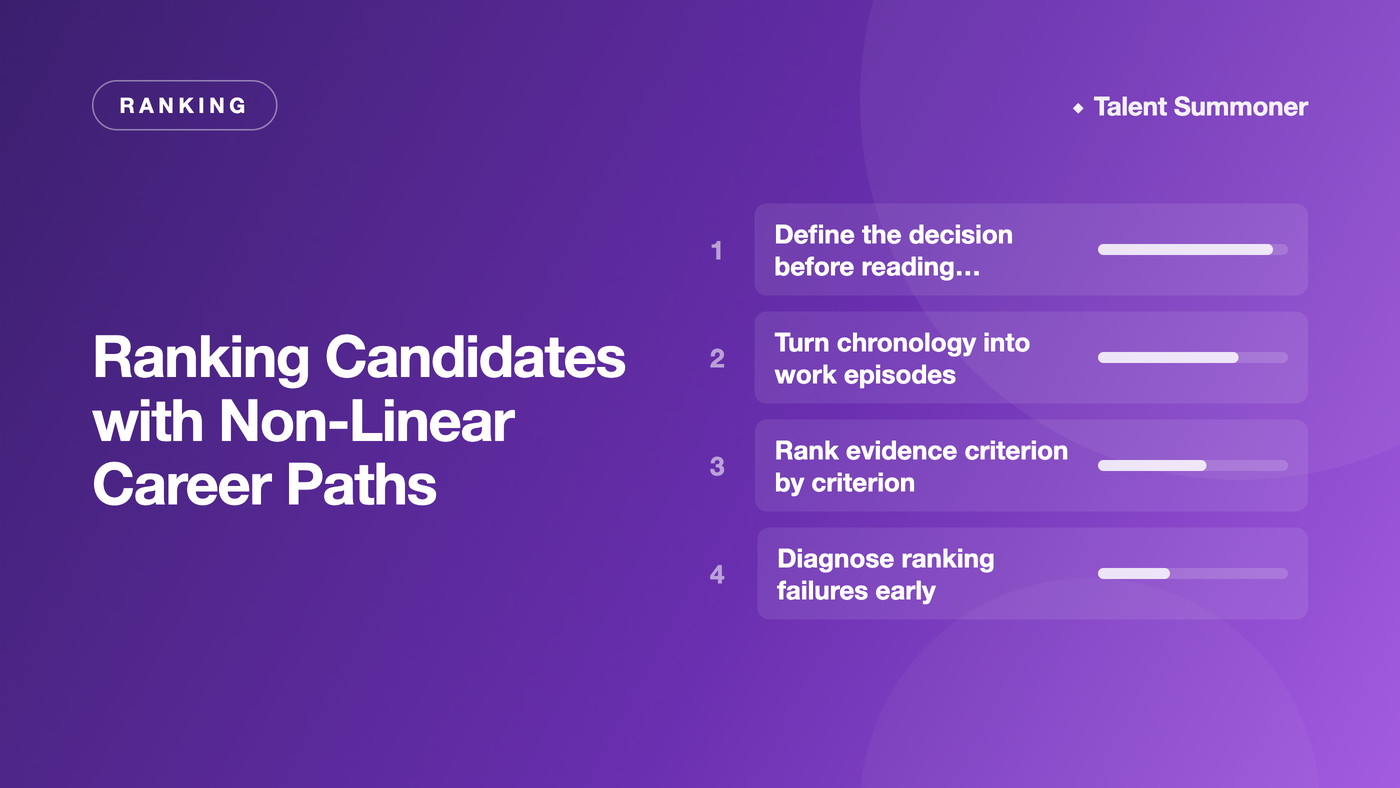
Define the decision before reading the path
Start with the approved role brief, not the candidate's sequence of titles. Separate must-haves, nice-to-haves and genuine operating boundaries. For each must-have, write the activity, context and minimum supporting evidence. Replace "steady career progression" with a job-related requirement such as "own a cross-team implementation through launch" if that is what the role needs.
Record which requirements can be learned or verified. Do not add a conventional-path preference after seeing an unusual profile. If internal mobility is the purpose, define whether the candidate must meet the criteria now, show readiness for development or satisfy a transition condition. Those decisions need different evidence.
Turn chronology into work episodes
Read the path as work episodes rather than one continuous story. An episode can be a role, project, secondment, study period or other work-related record the team may review. For each, capture the stated dates or period, activity, context, ownership and what remains unclear.
| Path signal | Inspect | Failure to avoid |
|---|---|---|
| Career break | Evidence of relevant work before or after the break and any role-related transition condition. | Treating time away as proof that a capability is absent. |
| Lateral title change | Responsibilities, decision scope and relationship to the new role. | Ranking title sequence as a proxy for growth or readiness. |
| Internal move | The work actually delivered in each team, not only the shared employer name. | Treating organisational familiarity as evidence for every criterion. |
| Industry change | The activity that may transfer and the context that still needs checking. | Rejecting an adjacent route without naming a job-related gap. |
| Several concurrent roles or projects | Ownership, dates and whether the same work is being counted twice. | Adding repeated descriptions as independent evidence. |
Use the source's own precision. If a profile gives a year but not the month, preserve that limitation. A title locates an episode; it does not establish seniority, ownership, scale or outcome.
Rank evidence criterion by criterion
Make a separate record for each material requirement. Copy the relevant source passage or reference, then write a narrow interpretation: what does it establish, suggest or leave unanswered? Mark the criterion supported, adjacent, unknown or contradicted according to your team's definitions. Keep the label attached to the requirement, not the person or whole career.
This prevents a strong episode from compensating invisibly for an unproven must-have, and prevents a gap, title change or industry switch becoming a hidden penalty. When a source is incomplete, record the missing fact and a focused question. When sources conflict, keep both traces and name a reviewer. Do not turn uncertainty into a low score because a ranking needs an order.
Diagnose ranking failures early
Watch for signals that the process is ranking the shape of a career instead of evidence for the role.
- Chronology is doing the scoring. A continuous sequence of similar titles is treated as positive evidence. Remove continuity from the criteria and compare episodes against the same must-haves.
- A title mismatch hides relevant work. Inspect responsibilities, outputs and context before calling evidence missing. Add a synonym only if it describes the actual requirement.
- A career break is a negative signal. Replace the assumption with unknown and ask for role-relevant information, such as a work sample or transition condition.
- Internal familiarity inflates fit. Ask whether the same evidence would be accepted from an external candidate. Separate work and criteria from reputation or reporting line.
- Recency has no stated reason. Explain why recent experience matters and what period is relevant. Do not let an unexplained freshness preference replace a capability requirement.
Use a corrective-action runbook
When a failure signal appears, pause the ranking discussion and record one correction. Use this sequence:
1. Freeze the role brief and identify the criterion affected.
2. Copy the source passage, episode and date or stated period.
3. Separate what the source establishes from what the reviewer inferred.
4. Mark supported, adjacent, unknown or contradicted using the team definition.
5. Check one comparable candidate against the same criterion and evidence standard.
6. Name the correction: revise the criterion, inspect another source, ask a focused question or retain the uncertainty.
7. Assign an owner and stop condition before changing the candidate order.
8. Record the human-owned action: progress, verify, hold, revise or close.
The stop condition matters. "Investigate the path further" can expand indefinitely; "role owner reviews one work sample against the approved must-have" is bounded. Keep the original ranking and corrected record so the reason for a change remains visible.
Where Talent Summoner fits
Talent Summoner is our product. Its current Candidate Ranking tool, checked on 2 September 2026, accepts a pasted or uploaded job description and up to 50 CVs in PDF, DOCX, MD or TXT format. It scores candidates against supplied requirements, provides plain-English reasoning and creates a shareable report without an account. Use it to organise attention, then apply the review above. It does not establish why a career changed, whether a gap is material or whether an internal move is ready.
When the supplied pool is too small, candidate sourcing is the separate discovery route. Its current page describes role-brief searches across LinkedIn, GitHub and other public professional sources with ranked results against stated criteria. Public-source information is a lead for review, not proof of ownership, availability or interest. Keep the same criteria after discovery.
What is a non-linear career path?
A non-linear path does not follow one obvious ladder of similar titles or promotions. It may include role changes, internal moves, project work, a career break or an industry change. The label describes chronology, not fit.
Should a career break lower a candidate's ranking?
Not by itself. Check the criteria and record available evidence before and after the break. If a material fact is missing, mark it unknown and use a consistent verification step rather than treating the gap as a failed requirement.
How should an internal-mobility lead handle a title mismatch?
Inspect the episode's work, context, ownership and scope. Compare it with the criterion and ask a focused question about any genuine bridge. Do not require identical titles for an observable activity.
Can an AI ranking tool judge whether a career path is ready for internal mobility?
No. A ranking tool can organise submitted material against a role brief, but the team decides what evidence is sufficient, what development or verification is appropriate and whether to progress the person.
For the next internal-mobility review, choose one must-have, map every candidate's relevant work episodes to it and run the corrective-action sequence before discussing overall order. Use candidate ranking for supplied CVs and keep the final action human-owned.