Talent Summoner
Scoring Leadership Signals Without Title Bias
A practical guide to evaluating leadership through observable work evidence, using the same role criteria for managers and individual contributors.
Leadership is work someone does, not a word printed in a job title. A candidate called "Head of" may have broad accountability, narrow authority or an inflated title. An individual contributor may lead a cross-team decision, coach colleagues or own a difficult delivery without managing anyone. The title is context, not a comparable score.
For a hiring manager, define the leadership the role needs, find observable signals and keep gaps as unknown until checked.
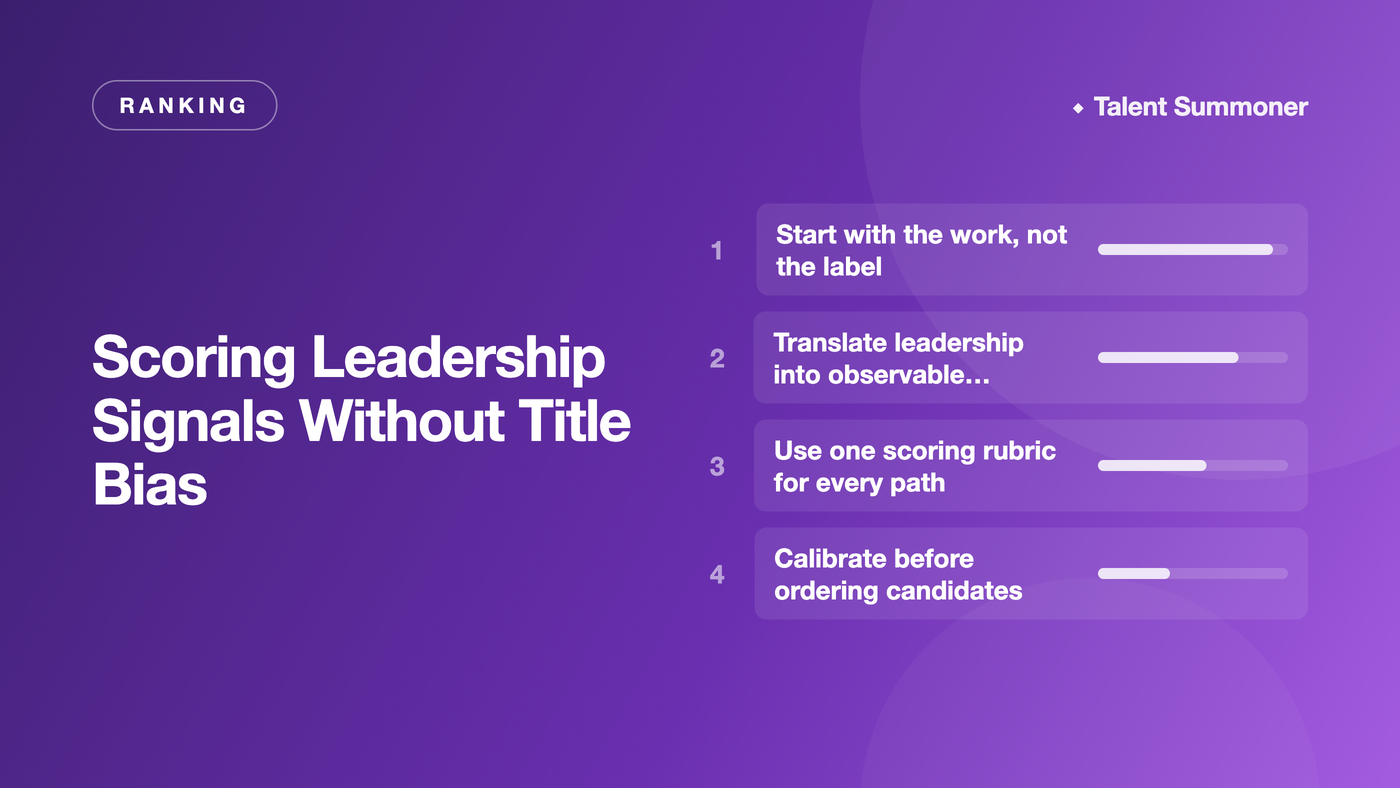
Start with the work, not the label
Write the role's leadership requirement as tasks and conditions. "Strong leader" is too broad to assess. "Set priorities for a cross-functional launch, explain trade-offs to affected teams and adjust the plan when evidence changes" gives reviewers something to inspect. Include decisions, affected people or systems and relevant constraints.
The US Office of Personnel Management (OPM) describes job analysis as examining tasks, competencies and their connection. Its assessment guidance recommends a current analysis and a documented link between requirements and assessment content. Apply this general process with advice for your jurisdiction.
Freeze criteria before comparing names. Separate must-haves, nice-to-haves and development areas. Decide whether the role needs people management, organisational influence, technical direction or a combination. Do not add "has held a senior title" after seeing a candidate. Record a relevant title separately from criterion evidence.
Translate leadership into observable signals
Use a small set of behaviours tied directly to the work. For each, write what evidence could support it and what it cannot establish.
- Direction setting: identifies a problem, sets priorities and explains a trade-off. A roadmap may show the action, not who owned it.
- Influence: brings people with different constraints to a decision or changes an approach through reasoning. A stakeholder list is not proof.
- Developing others: gives specific feedback, delegates meaningful work or creates a route to ownership. A mentoring claim without an example is unverified.
- Accountability: names the result, acknowledges a miss and changes the plan. A successful project label does not show what happened when conditions changed.
- Judgement: chooses among options using the role's constraints and makes reasoning visible. A senior title is not a decision example.
These signals are examples, not a universal model. Keep only behaviours the role requires. OPM defines a competency as a measurable pattern of knowledge, skills, abilities, behaviours and other characteristics needed for a work role. Use that behaviour-based definition, then let the hiring team validate its criteria.
Use one scoring rubric for every path
Create a short record for each candidate and criterion. The following scale is an illustrative internal rubric; it is not a benchmark or a prediction:
Criterion and role context:
Evidence source and date checked:
Action the candidate is shown to have taken:
Decision, constraint or people impact visible in the source:
Evidence status: clear / adjacent / unknown / contradicted:
Illustrative evidence strength: 0 not shown / 1 asserted / 2 specific and relevant:
What the source cannot establish:
Verification question, owner and stop condition:
Human disposition: progress / verify / hold / revise / close:
The "clear" label means the source describes a relevant action and context. "Adjacent" means a material bridge remains. "Unknown" means the source does not answer the criterion. "Contradicted" means reliable records conflict. Keep status separate from strength so a title cannot become extra credit.
Compare like with like. Give a manager and an individual contributor the same prompt, then inspect scope and action. A manager might set a team priority; an individual contributor might align teams around a technical decision. Neither receives title credit or a penalty for taking the less familiar route. Do not count one project description for several signals unless it supports each one.
Calibrate before ordering candidates
Have reviewers score fictional or historical examples before discussing the shortlist. Ask where a signal is clear, asserted or unknown. Resolve disagreements by returning to the criterion and source. OPM's structured-interview guidance recommends selecting critical competencies from job analysis and confirming them with subject-matter experts; this keeps questions tied to the work.
Before changing a candidate's order, require a criterion-based reason and bounded action. Ask: "What decision did you make?", "Which constraint changed your approach?", and "How did another person's work or decision change?" Use the same questions for comparable evidence. If the answer remains unestablished, retain unknown rather than converting title confidence into a score.
Review the process for barriers as well as individual scores. The EEOC's federal-sector guidance says qualification standards and selection criteria should be job-related, and discusses alternative ways to measure necessary skills where a barrier is identified. Laws vary by location, so treat this as general information, not legal advice.
Where Talent Summoner fits
Talent Summoner is our product. Its current Candidate Ranking tool, checked on 2 September 2026, accepts a pasted or uploaded job description and up to 50 CVs in PDF, DOCX, MD or TXT format, requires no account and returns a ranked shortlist with plain-English reasoning and a shareable report. Use it to organise CV evidence against your criteria. It does not establish leadership ability, verify ownership or make the human decision.
When discovery is the gap, Candidate Sourcing, also checked on 2 September 2026, starts from a role brief and searches LinkedIn, GitHub and other public professional sources across 200M+ profiles. A surfaced profile is a lead for the same review, not proof of leadership, availability or interest.
What is a leadership signal in hiring?
A leadership signal is observable, role-related evidence of a behaviour the job requires, such as setting direction, influencing a decision or developing another person. A title is context, not proof.
Should a manager always score higher than an individual contributor?
No. Compare evidence against the role's criteria. They may demonstrate the same behaviour through different work or scope.
How do I handle a senior title with little evidence?
Record the title as context and mark the criterion unknown or asserted if the source does not show the action. Ask one comparable verification question before changing the order.
Can Talent Summoner remove title bias from a ranking?
No. Our product can organise CVs against supplied requirements, but your team must define criteria, inspect evidence and own the decision.
For the next shortlist, hide titles during the first evidence pass where your process allows, score one approved leadership criterion for every candidate and attach an owner to each unknown. Then use candidate ranking for supplied CVs or candidate sourcing when discovery is the gap.