Talent Summoner
Shortlist Review Meeting Agenda
Use this shortlist review meeting agenda to test candidate evidence, expose assumptions, assign follow-ups and record a human-owned next step.
A shortlist review meeting should help a hiring team decide what to verify next, not simply confirm the person who made the strongest first impression. A useful agenda keeps the role brief and evidence in view, separates observable facts from interpretation and gives every unresolved point an owner.
This agenda is for a team reviewing one role's shortlist. It can follow a sourcing pass or ranking report, but does not replace interviews, reference checks or the hiring decision. Its job is to make the next human action clear and comparable.
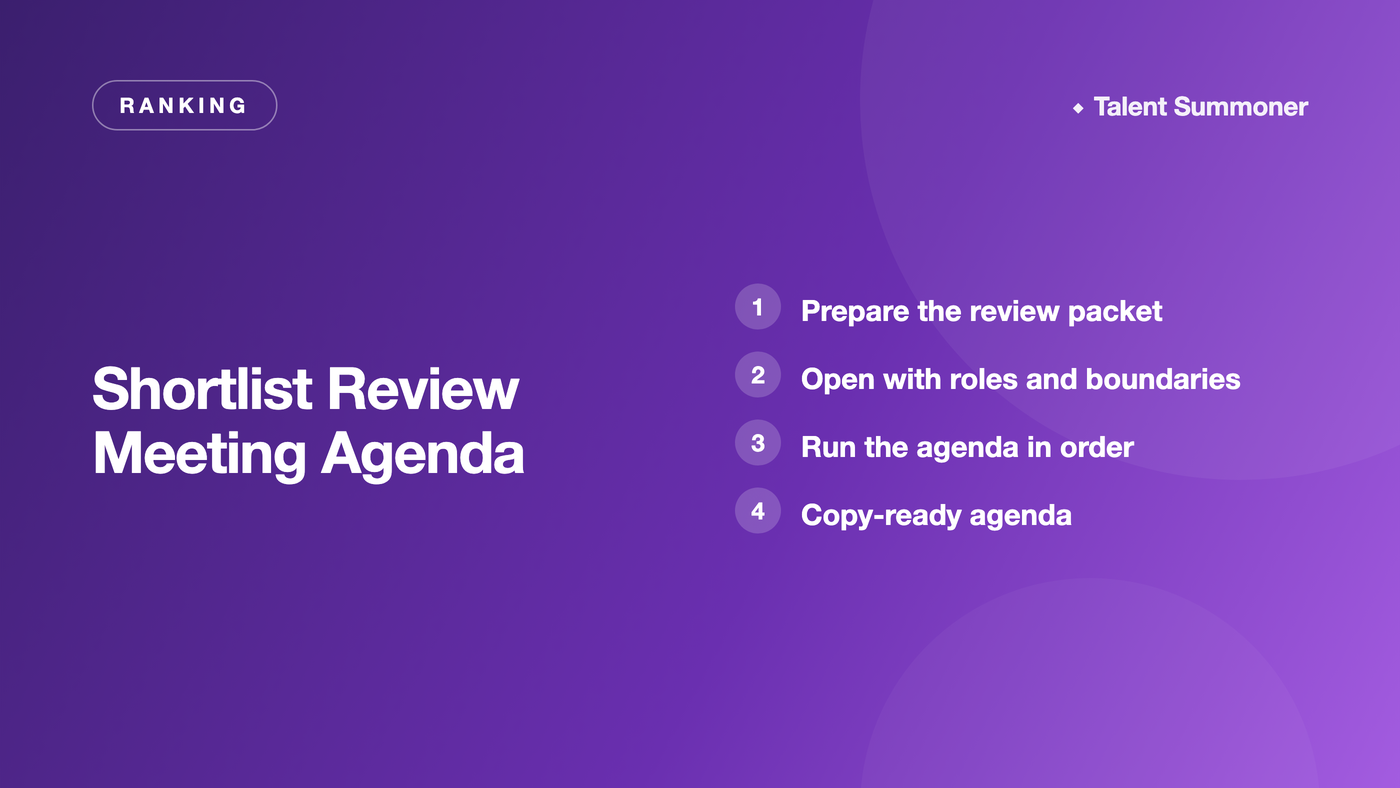
Prepare the review packet
Start with one frozen question: what does this candidate material establish about the requirements for this role? Record the role, working pattern, approved brief version, review date, candidates in scope, decision owner and facilitator. Name a note-taker who can capture source wording and actions.
Send the same packet to everyone attending. Include the current brief, shortlist order if one exists and relevant CV or profile passages. Do not add a new must-have because a candidate's background made it seem important; log a brief change for a later review instead.
Before names are discussed, agree the evidence labels. Supported means the material addresses a criterion with useful context; adjacent may be relevant but needs a bridge; unknown means the material does not answer the question; and contradicted means sources conflict. These are review states, not performance predictions.
Open with roles and boundaries
The facilitator should read the purpose, scope and decision boundary aloud. The role owner explains which criteria are must-haves, preferences or genuine operating constraints. A reviewer can challenge whether an interpretation follows from the source. The note-taker records the criterion, evidence, disagreement, action, owner and due point. Keep job-related reasons separate from personal preferences.
Agree how to handle interruptions and new information. Finish the current evidence question, capture the new item with its source and decide whether it changes this review or belongs in a new brief version. This prevents an anecdote from changing the standard for remaining candidates.
Run the agenda in order
Confirm the question
Restate the role criteria before looking at shortlist order. Ask whether any requirement is ambiguous, duplicated or no longer relevant. If the brief is not ready, record the owner for clarification and pause the comparison rather than ranking against different interpretations.
Review evidence by criterion
Take one material criterion at a time and apply it to every candidate. Read the source passage first, then state the narrowest interpretation it supports. A sentence describing work on a system may show exposure, but does not automatically show ownership, scale, production context or a result. Keep missing details visible.
Test assumptions
When reviewers disagree, ask: what exact source supports the claim, what is inferred and what answer would change the next action? Check dates, scope and wording before treating a contradiction as decisive. Do not turn a missing phrase into a failed requirement or ask one favoured candidate for context that comparable candidates were not offered.
Assign one next action
End each candidate discussion with one current disposition and a reason. Progress means the available evidence supports the next stage; verify identifies a focused question or work sample; hold names a dependency and review owner; revise records a justified brief or search change; and close states the job-related evidence that supports ending consideration. Rank alone is not a reason to close.
Write each action so another person can carry it out. "Check leadership" is vague. "Ask which part of the migration the candidate owned, in what operating context, and record the answer against the ownership criterion" identifies the evidence gap. Use comparable questions for comparable gaps and preserve the original source when the record is updated.
Read back the record
Before the meeting ends, the facilitator reads unresolved assumptions, changed brief items, candidate actions and the decision owner back to the group. Confirm that every material unknown has an owner and every close action has a job-related reason. Save the review date and brief version with the notes. If comparison is incomplete, schedule a follow-up rather than filling gaps from memory.
Copy-ready agenda
Purpose: review [role] against brief version [version]
Date: [date]
Facilitator: [name]   Note-taker: [name]   Decision owner: [name]
Candidates in scope: [names or identifiers]

1. Confirm criteria, evidence standard and review boundary.
2. Review each material criterion across all candidates.
3. Separate source wording, interpretation and unknowns.
4. Record contradictions and the question that could resolve each one.
5. Assign progress, verify, hold, revise or close with an owner and reason.
6. Read back actions, brief changes and the next review point.
Where Talent Summoner fits
Talent Summoner is our product. Its current Candidate Ranking tool, checked on 2 September 2026, lets a user paste or upload a job description and upload up to 50 CVs in PDF, DOCX, MD or TXT format. It returns a ranked shortlist with plain-English reasoning and provides a shareable or downloadable report without requiring an account. Bring that report into the meeting as an input, then inspect the source material and make the human-owned review record separately.
When the existing CV pool is too small, candidate sourcing, also checked on 2 September 2026, starts from a role brief and searches LinkedIn, GitHub and other public professional sources across 200M+ profiles. It returns must-haves, nice-to-haves and reasoning for a ranked shortlist. Treat public-profile information as a discovery lead to verify, not proof of current availability, interest or working-pattern fit.
What is the purpose of a shortlist review meeting?
It compares candidates against approved criteria, exposes unsupported assumptions and assigns the next human-owned action. It is not an automatic hiring decision.
Should the highest-ranked candidate automatically progress?
No. A ranking organises attention for one brief and pool. The panel should inspect evidence, resolve material gaps and record the next action.
What should the team do when evidence is missing?
Label it unknown or not supplied, write a focused verification question and assign an owner. Missing information is not proof of absence.
Can Talent Summoner run the shortlist review meeting?
Its Candidate Ranking tool provides a ranked report and plain-English reasoning for supplied CVs. The hiring team still compares evidence, asks questions and owns progress, hold or close decisions.
For the next shortlist review, freeze the brief, appoint a facilitator and note-taker, circulate one evidence packet and use the agenda above. Leave the meeting with one recorded owner and next action for every material unknown.