 Talent Summoner
What a Transparent Candidate Ranking Report Includes
Learn which evidence, criteria, uncertainty, ordering and review details a transparent candidate ranking report should show.
 By Nicholas Yan · Published · Updated · in Ranking & Evaluation
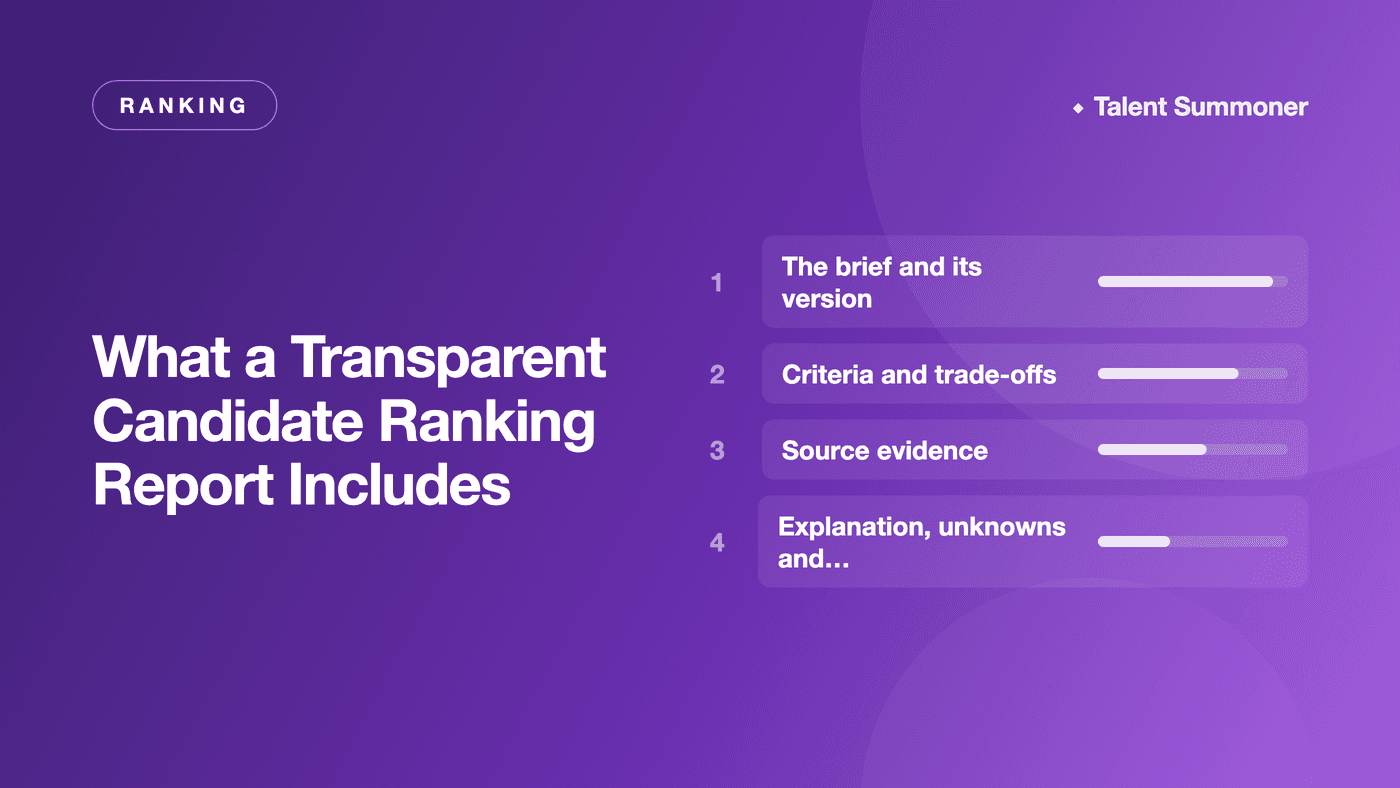
A candidate ranking report should do more than place names in order. It should let a hiring team reconstruct why the order was produced, inspect the evidence, see what remains unknown and agree on a human-owned next action.
Use the report as a review record, not as a hiring decision. A transparent candidate ranking report should contain these components.
1. The brief and its version
Start with the job description or role brief that produced the ranking. Show the role title, location or working pattern, ranking date and a brief version or identifier. Preserve the exact text or a reliable reference to it.
Versioning matters because a ranking can change when the brief changes. If the hiring manager adds a must-have after seeing the first results, save the revised brief as a new version and keep the earlier report. Otherwise, reviewers may compare outputs without knowing that the question changed.
2. Criteria and trade-offs
List each requirement in plain language and label it as a must-have, nice-to-have or genuine boundary. Explain trade-offs, such as whether an adjacent project can satisfy a capability requirement.
The report should make clear which criteria influenced ordering. A familiar title or keyword should not outweigh relevant scope, and a preference should not compensate for an unproven must-have. Define what evidence would count before reviewing names.
3. Source evidence
For every material criterion, show the source passage that supports the match: a CV sentence, project description or permitted professional profile detail. Identify the source and date where relevant. Keep evidence separate from the system's interpretation.
This makes the report auditable. A statement such as "led a migration" may not establish system size, personal ownership, production context or outcome. Preserve the wording rather than turning a short claim into a stronger conclusion.
4. Explanation, unknowns and contradictions
Each candidate needs an explanation tied to the criteria, not a generic paragraph about suitability. Use careful labels such as supported, adjacent, unknown and contradicted. Explain what the evidence establishes and what is inferred.
Unknown means the available material does not answer a question; it is not proof that the candidate lacks the capability. A contradiction is different: two sources or a source and the brief materially conflict. Show both sides, name the affected criterion and leave it visible until resolved.
Do not turn an unresolved contradiction into an automatic rejection. Create a focused verification question and apply it consistently to comparable candidates.
5. Ordering context
Show where each candidate sits in the ranked set and what the order means. A rank is relative to this brief, candidate pool and report version; it is not a measure of ability or a prediction of job performance.
Include enough context to review borderline and surprising results, not only the first few names. A candidate near the top may have strong evidence for a preference but an unknown must-have. A lower-ranked candidate may use different terminology or have an adjacent background worth checking.
6. Reviewer notes and next action
Give reviewers a place to record corrections, disagreements, verification answers and source dates without overwriting the original explanation. Tie notes to a candidate and criterion.
Every candidate should have a clear next action, such as progress, verify, hold, revise or close, with an owner and reason. The action belongs to the hiring team. It should never be implied by rank alone, and closing a candidate should have a job-related explanation rather than an unexplained score threshold.
7. Sharing and access
State who can view the report, whether a sign-in is required, how a link can be revoked and whether an export preserves evidence and notes. Candidate information is sensitive, so limit access to people involved in the hiring decision.
What Talent Summoner verifies today
Talent Summoner is our product for AI candidate sourcing, CV ranking and outreach you confirm before it sends. The live candidate-ranking page, checked on 3 October 2026, verifies that a user can paste or upload a job description, upload up to 50 CVs in PDF, DOCX, MD or TXT format, and receive a ranked shortlist with plain-English reasoning. It also states that reports can be downloaded as PDF or shared by link, and that a team can review without an account.
That page does not document dedicated fields for brief version, source excerpts, unknowns, contradictions, reviewer notes or next actions. Treat those as recommended components to confirm in your workflow, not as claims about current Talent Summoner fields. For a new candidate pool, candidate sourcing describes role-based search across LinkedIn, GitHub and other public sources, with must-haves, nice-to-haves and reasoning. Check pricing for current sourcing options.
FAQ
What is the most important part of a candidate ranking report?
Traceable evidence. A reviewer should be able to move from a criterion to the source passage, interpretation, uncertainty and next question without relying on an unexplained score.
Should an unknown lower a candidate's rank?
Not automatically. Record what the material does not establish and ask a consistent verification question. Missing evidence is not evidence that the candidate lacks the requirement.
Does ranking order prove candidate quality?
No. Order is relative to the brief, candidate pool and report version. People must inspect job-related evidence, resolve material gaps and make the decision.
Does Talent Summoner provide every recommended report field?
The live candidate-ranking page verifies ranked results, plain-English reasoning, supported CV formats and shareable or downloadable reports. It does not publicly document every recommended audit field, so confirm your required notes and review workflow during use.
For your next review, save one report with its brief version, criterion evidence, unknowns, reviewer notes and a named next action. Then ask a second reviewer to retrace the order from the sources before anyone treats the ranking as a decision.
Related: Resume Ranking vs Candidate Matching: What Is the Difference? · Must-Have vs Nice-to-Have Requirements in Candidate Matching · How to Spot a Weak AI Shortlist Before Contacting Anyone
Talent Summoner product facts read from our live candidate sourcing, candidate ranking and pricing pages, verified 3 October 2026. We re-verify this page quarterly — tell us if something changed.