Talent Summoner
When to Override an Automated Recommendation
When should an internal-mobility lead override an automated recommendation? Use this guide to document the evidence and next step.
An automated recommendation is a review input, not a final decision. An internal-mobility lead should override it when it does not answer the approved question, relies on incomplete or misread evidence, or conflicts with a documented role boundary. The override should correct a traceable problem, not provide a private preference with a technical-sounding label.
Use this guide when a ranking is already available and someone must follow it, pause it or record a different next step. Preserve the original output, test the disagreement and leave an evidence-based handoff.
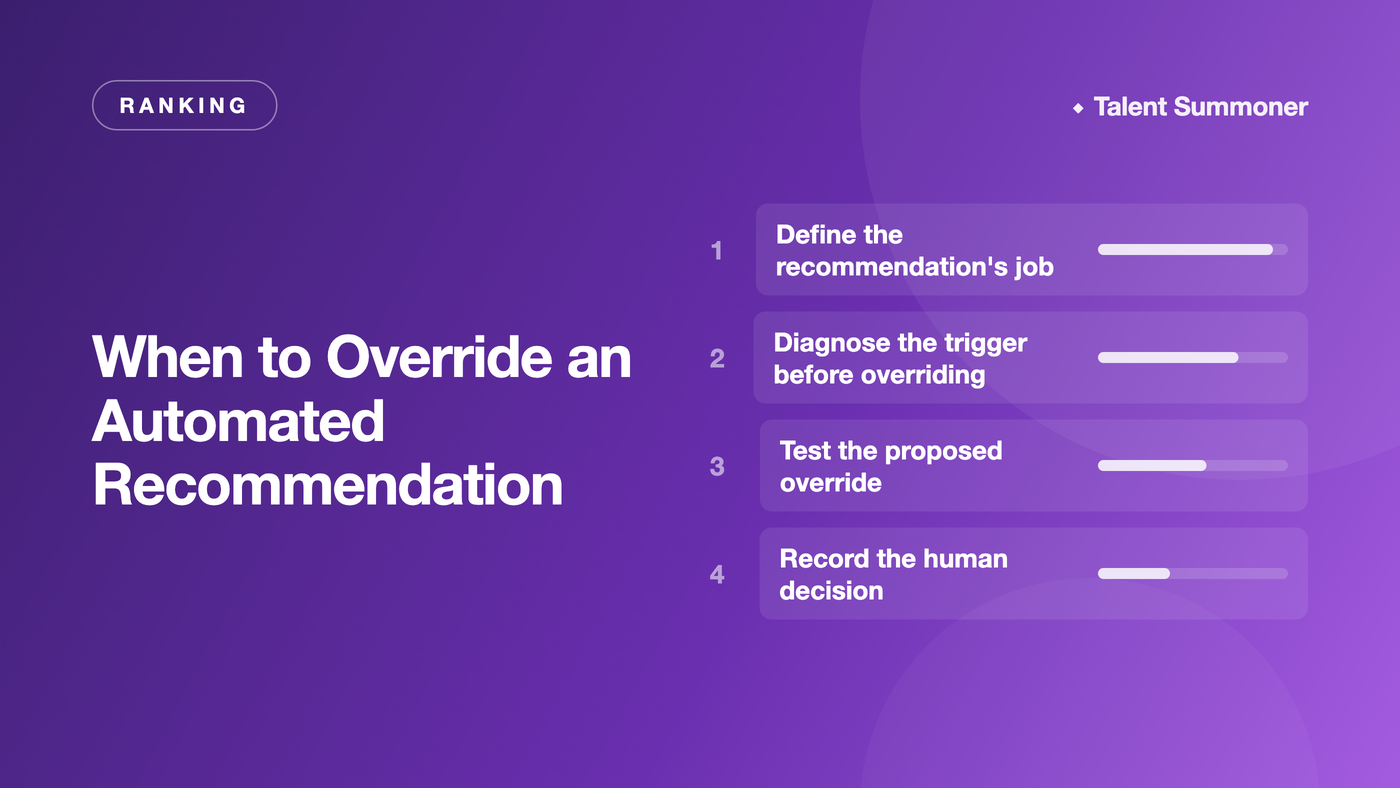
Define the recommendation's job
Before changing the disposition, record what the recommendation was meant to do: the role brief version, internal-mobility question, candidate set, recommendation date and decision owner. A first-conversation recommendation is different from a decision about eligibility, promotion or appointment.
Separate the target role's must-haves, nice-to-haves and operating boundaries. For each material criterion, define the evidence that would support it, an acceptable equivalent route and the status for information that is missing. Keep the internal employee's current title, reputation and performance context in a separate field from evidence against the target role. Familiarity can help locate records, but it should not silently alter the standard.
Do not edit or replace the first recommendation while investigating. Save the original report or review record, explanations and input version. This prevents a corrected interpretation from being mistaken for the system's original output.
Diagnose the trigger before overriding
Most disagreements belong to one of four categories. Diagnose the category first because each has a different owner and response.
| Trigger | Diagnostic question | Appropriate response |
|---|---|---|
| Missing internal context | Does an authorised internal record answer a material question that the supplied profile could not? | Mark the recommendation incomplete, add the relevant evidence and rerun or review the criterion. |
| Evidence overreach | Does the explanation claim ownership, scope, recency or an outcome that the source does not establish? | Narrow the interpretation, apply the correction to comparable candidates and record the source passage. |
| Brief or boundary mismatch | Did the output apply a preference as a gate, miss an approved equivalent or ignore a genuine operating boundary? | Pause the disposition and ask the role owner to confirm or version the criterion. |
| Process or record error | Is the wrong profile, duplicate record or stale role brief attached to the recommendation? | Preserve the error, correct the input and rerun the affected set rather than making a candidate-specific exception. |
These are reasons to investigate, not automatic instructions to progress. If the trigger cannot be tied to the role brief or a permitted source, keep the recommendation as verify and name the remaining question.
Test the proposed override
Use this sequence before choosing a different next step:
- State the conflict. Quote the relevant criterion or explanation and write the narrower claim the source supports.
- Check the source. Read the internal record, CV, work sample or approved note. Distinguish participation from ownership and context from evidence.
- Apply the same standard. Recheck candidates affected by the same correction. An internal employee should not receive a relaxed requirement because the reviewer knows more about them.
- Check the boundary. Decide whether the issue is a must-have, learnable gap, operating boundary or unknown. Missing information is not a negative finding by itself.
- Choose a disposition. Use progress, verify, hold, revise or close, with a job-related reason and named owner.
An override is usually defensible when it points to a source, frozen criterion or genuine input correction. It is weak when it says the employee is "known to be good", has a "better cultural fit", deserves an exception because of tenure or should move up because the ranking "feels wrong". Those statements may signal a panel question, but they are not an evidence trail.
Record the human decision
Write the override as a change to the review state, not a claim that the method is always wrong. Keep the recommendation, proposed override and uncertainty visible together. This record can sit beside the original report:
Role / brief version:
Recommendation date and source:
Candidate identifier:
Original recommendation and criterion:
Override trigger:
Source checked and narrow finding:
Comparable candidates rechecked:
New disposition and job-related reason:
Owner, next action and stop condition:
Review date:
For an internal move, limit the record to information needed for the target-role decision and follow the organisation's access and retention process. Do not copy unrelated personal details into a ranking note. If a manager has a conflict or strong influence, add an independent reviewer rather than disguising that concern as a score adjustment. Local requirements vary; this is general process guidance, not legal advice.
Review the override at the next gate
An override is not complete until its next action happens. The owner might verify project scope, ask a comparable work-sample question, confirm a boundary or revise the brief. Set a stop condition, such as "do not progress until the required licence is confirmed" or "rerun all candidates after the must-have wording is versioned". Close the note with the evidence reviewed and resulting state.
If new authorised internal evidence changes the recommendation, preserve both versions and explain the scope. If the brief changes, create a new version and decide whether every candidate needs a fresh review. Do not quietly apply a new rule to one employee. The record distinguishes a corrected input from a disagreement about judgement.
Where Talent Summoner fits
Talent Summoner is our product. Its current Candidate Ranking tool, checked on 3 September 2026, accepts a pasted or uploaded job description and up to 50 CVs in PDF, DOCX, MD or TXT format, requires no account and returns a ranked shortlist with plain-English reasoning and shareable reports. Use that report as the preserved starting recommendation, then add authorised internal context and the human override record. Our product does not decide whether an employee should transfer or verify private performance evidence.
When the approved internal pool needs an external comparison, candidate sourcing, checked on 3 September 2026, starts from a role brief and searches LinkedIn, GitHub and other public professional sources across 200M+ profiles. Treat public-source results as discovery material to verify, not proof of current availability, interest or ownership. Keep the source route visible when comparing internal and external candidates.
What does it mean to override an automated recommendation?
It means a human records a different next-step disposition after checking the recommendation against the approved brief and authorised evidence. It is not permission to delete the original output or invent a candidate-specific exception.
When should an internal-mobility lead pause rather than override?
Pause when the brief is ambiguous, a material source is missing, a record is attached to the wrong person or an operating boundary is unresolved. Name the owner and stop condition before making a progression decision.
Should missing evidence trigger an override?
Not by itself. Mark the criterion unknown, identify a comparable verification step and keep the gap visible. Treat missing evidence as a negative only when the approved process defines a reliable, job-related gate and the required evidence was properly obtained.
Can Talent Summoner make the transfer decision?
No. Our product can rank supplied CVs against a job description and explain the result. Internal context, evidence verification, conflict handling and the decision about progression or transfer remain with people.
For the next internal-mobility review, save the original recommendation, classify the trigger, recheck comparable candidates and record one named next action. Use candidate ranking for supplied CV material or candidate sourcing for an approved external discovery pass.