Talent Summoner
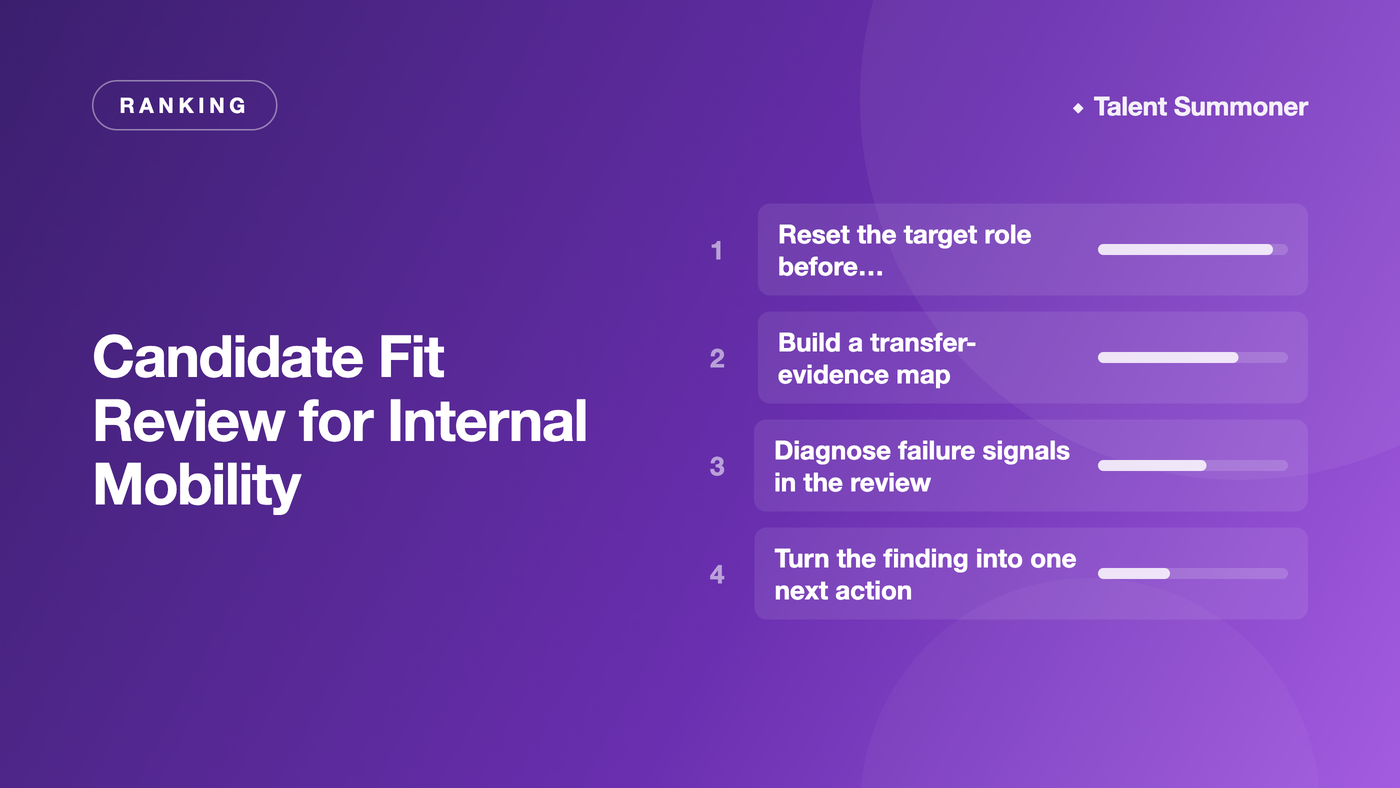
Candidate Fit Review for Internal Mobility
Review internal candidates against a new role with a transfer-evidence map, failure signals and a clear next action.
A candidate fit review for internal mobility is a structured checkpoint for deciding what an employee's existing evidence says about a different role, what does not transfer yet and what should be checked next. It is not a shortcut to promotion, a performance review or a manager's informal recommendation.
Internal candidates bring context that an external applicant may not: prior work, known collaborators and an existing record of delivery. That context can help reviewers ask better questions, but it can also create familiarity bias. A reviewer may give credit for reputation, punish a past disagreement or assume that success in one team will repeat in another. The review should make the job-related evidence and the transfer gap visible before the panel chooses a next step.
Reset the target role before reviewing the person
Start with the same discipline you would use for an external search. Freeze the target role's brief and record the decision owner, version and review date. Describe the outcomes the new role must deliver, then separate:
- must-have capability that needs evidence now;
- learnable capability that can be developed with a defined plan;
- operating boundary such as an agreed schedule, location or licence requirement;
- useful signal that should not decide the review on its own.
For each must-have, define what evidence would count. "Strong communicator" is too broad. "Can explain a customer-impacting change to technical and non-technical partners" gives the panel something to inspect. State acceptable equivalent experience before names are discussed, including work from another function, project, market or level where it genuinely demonstrates the same outcome.
Do not import the employee's current title, appraisal label or manager's confidence as a requirement. Those may be useful context, but they do not describe the target work by themselves. Keep employment eligibility and role fit as separate records so that a process question does not become a judgement about capability.
Build a transfer-evidence map
For every criterion, record the current-role evidence, the target-role application and the remaining gap. A compact map can look like this:
| Target criterion | Evidence from current work | Transfer question | Status |
|---|---|---|---|
| Owns a cross-functional delivery | Led a release with two named partner teams | Has the employee made trade-offs when priorities conflicted? | supported / verify |
| Handles the target customer context | Worked with internal stakeholders | What direct customer decisions would the new role require? | adjacent |
| Operates within the role boundary | Current schedule and location are recorded | Is the new arrangement agreed and feasible? | verify |
| Uses a required technical method | Evidence is not present in the supplied record | What equivalent work sample or learning plan would answer this? | unknown |
Use the narrowest claim the source supports. A completed project can evidence participation, ownership or a result only if the record establishes which one. A manager's summary can identify context to verify; it should not silently replace a comparable question. If records conflict, preserve both statements and assign an owner to resolve the conflict.
The status labels should be deliberately modest: supported, adjacent, unknown, contradicted or verify. Unknown means the material does not answer the question. It is not proof that the employee lacks the capability. Adjacent means the transfer path is plausible but still needs a role-specific check.
Diagnose failure signals in the review
When the panel cannot agree, classify the failure before changing the recommendation:
| Failure signal | What may be happening | Corrective action |
|---|---|---|
| Familiarity is doing the work | A well-known employee receives credit without an evidence note | Require the same criterion and source note used for every applicant |
| Current title is treated as seniority | The title is used instead of the scope and decisions owned | Rewrite the criterion around observable work |
| Current manager becomes a gatekeeper | A release or transfer is blocked by an untested opinion | Ask the decision owner to apply the approved process and document the job-related reason |
| A past appraisal decides the future role | Historical feedback is treated as a complete prediction | Use it as context, then gather current evidence against the target outcomes |
| Missing context becomes a rejection | Internal records are assumed to be complete | Mark unknown and set a comparable verification step |
| Development is treated as disqualification | A learnable gap is handled like a must-have failure | Decide whether a time-bound development plan is an approved route |
Do not solve disagreement by averaging scores. First identify whether the problem is an unclear criterion, unequal evidence, a genuine requirement gap or a process boundary. If the target role changed during discussion, pause the review, update the brief with the decision owner and create a new version rather than applying the new rule to one employee.
Turn the finding into one next action
Give each material finding a disposition: progress, verify, develop, hold or close. "Develop" is useful for internal mobility because a person may have a credible transfer path without already having every learnable skill. It should name the skill, practice or work sample, owner, review point and evidence that would support progression. It is not a promise that the move will happen.
For verify, write one question or exercise that is comparable for internal and external applicants where both are in scope. For hold, name the dependency, such as a role approval or access requirement. For close, state the approved criterion or boundary that is confirmed not met by reliable evidence; do not write "not a fit" as the whole reason. For progress, record what remains to be checked before the next stage.
Keep the employee's privacy in mind. Limit the review record to relevant information, control access and follow your organisation's retention rules. The review is general process guidance, not legal advice; local employment, privacy and accessibility obligations may require specialist review.
Where Talent Summoner fits
Talent Summoner is our product. Its current Candidate Ranking tool, checked on 2 September 2026, accepts a job description and up to 50 CVs in PDF, DOCX, MD or TXT format, requires no account and returns a ranked shortlist with plain-English reasoning and a shareable report. An internal-mobility team can use it to organise supplied CV material against the frozen target brief, but the report cannot supply private performance context, manager conversations or a development agreement. Treat the ranking as a review input, not the mobility decision.
If the internal pool is not enough and an external search is approved, candidate sourcing starts from a role brief and searches LinkedIn, GitHub and other public professional sources across 200M+ profiles. Public profiles are discovery material to verify; they do not establish current availability, interest or transfer readiness. The CIPD's internal mobility guidance, published 21 January 2026 and checked on 2 September 2026, discusses visibility of skills and lateral as well as upward moves. A separate Civil Service Commission recruitment principles page, checked on the same date, gives one public-sector example of collecting broadly equivalent evidence while allowing for differences in how internal and external experience is demonstrated. Neither source is a universal policy for every employer.
Is an internal candidate review the same as a performance review?
No. A performance review looks at work in the employee's current context. An internal-mobility review tests evidence against the outcomes and boundaries of a different role. Current performance can be relevant context, but it should not replace target-role evidence.
Should internal candidates be assessed differently from external candidates?
The evidence source may differ because an employee has work records that an external applicant does not. Keep the criterion, evidence standard and decision reason comparable, and record why a particular source answers the question. If both groups are in the process, use comparable verification steps where practical.
What should happen when an employee has a development gap?
First classify the gap as a must-have, operating boundary or learnable capability. If it is learnable and the organisation allows development as a route, write a time-bound plan with an owner and evidence check. Do not describe the plan as a guaranteed transfer.
Can Talent Summoner decide whether an employee is ready to move roles?
No. Our product can rank supplied CVs against a job description and explain the result. Humans must add internal context, verify evidence, handle sensitive records and own the decision about progression or transfer.
For the next internal-mobility review, freeze the target brief, create one transfer-evidence map per employee, classify each disagreement and assign a named owner to the next check. Use candidate ranking for supplied CV material, and add candidate sourcing only when an external comparison is approved.