 Talent Summoner
Candidate Fit Score Explained for Hiring Managers
Learn what a candidate fit score means, what it cannot prove, and how to inspect criteria, evidence, unknowns and ties before deciding.
 By Nicholas Yan · Published · Updated · in Ranking & Evaluation
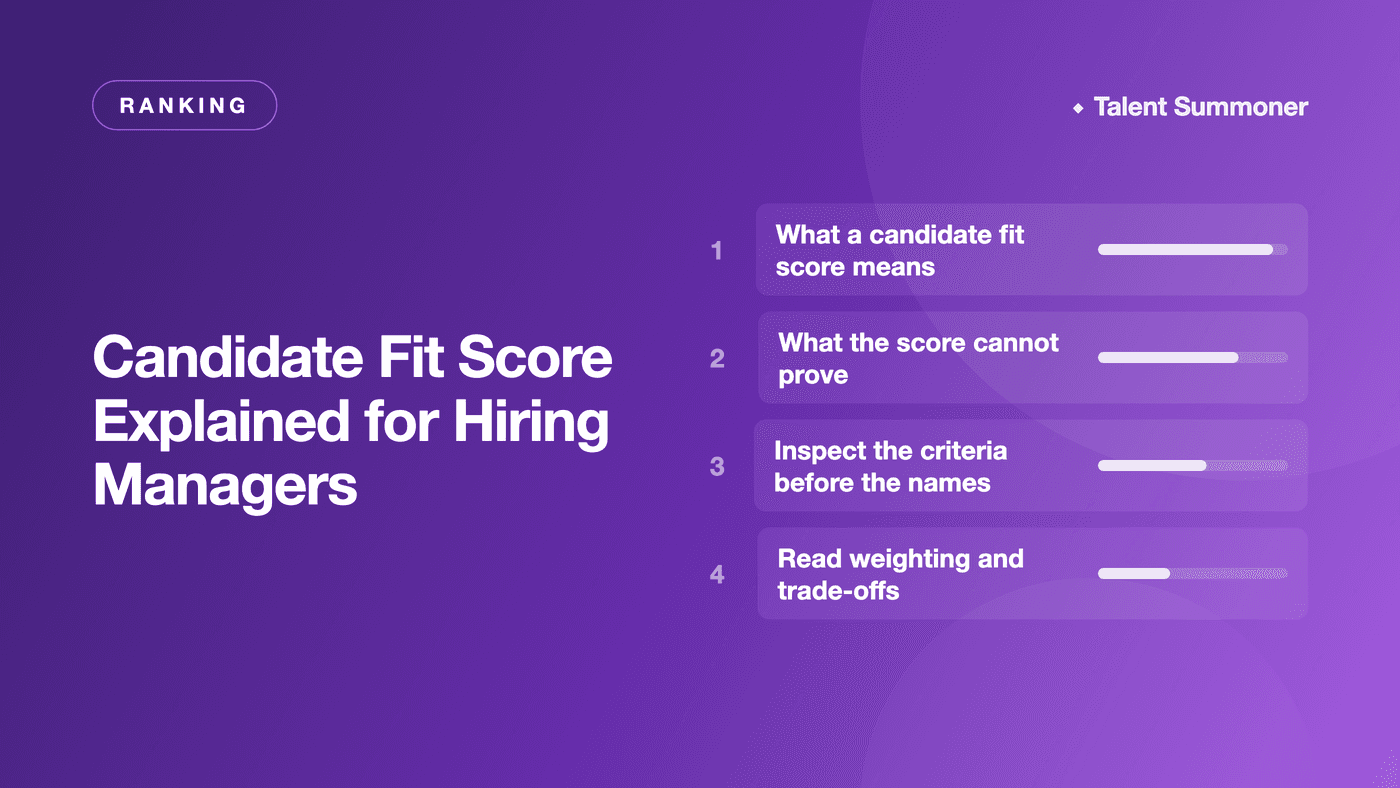
A candidate fit score is a prioritisation aid. It summarises how a tool has related the information supplied about a candidate to the criteria in a role brief. It can help a hiring manager decide what to review first, but it is not a verdict on a person. Ask what criteria and evidence produced the order, what remains unknown and what a person should verify next.
What a candidate fit score means
There is no universal definition of a fit score. One product might compare keywords, another might summarise weighted requirements, and another might combine several signals. A percentage, colour or position in a list only has meaning within that tool, that version of the brief and that candidate set.
Treat the result as a tool-specific summary of stated criteria and available evidence. It is a relative signal about where to focus review, not a measurement that transfers between vendors or roles. A changed rank means the inputs changed, not that a person became more suitable.
What the score cannot prove
A fit score is not an objective probability of getting the job, a prediction of future performance, a fairness certificate or an assessment of a candidate's worth. It cannot establish motivation, reliability, collaboration, interview performance or results that the source material does not show, nor prove that the shortlist represents everyone who could do the work.
Do not turn a low score into an automatic rejection or a high score into an automatic interview. A hiring team still needs to inspect job-related evidence, check material facts, use suitable assessments and make the decision. Keep ordering separate from the human-owned disposition.
Inspect the criteria before the names
Start with the role brief that produced the ranking. List the must-haves, nice-to-haves and genuine constraints in plain language. For each requirement, define what evidence would count: a relevant project, responsibility, qualification, work sample or other observable signal.
Check that every criterion is necessary and that the same definition applies to every candidate. A familiar job title should not receive extra credit over equivalent work under a different title. Avoid proxies for personal characteristics, such as an unexplained preference for a particular school, employer or career path.
Freeze the brief before reviewing names. If you change it because a candidate looks appealing, record the change and run a new review; otherwise, the score becomes a post-hoc explanation.
Read weighting and trade-offs
Ask how the tool handles a must-have compared with a preference. A strong nice-to-have should not compensate for an unproven requirement the role genuinely needs. Conversely, a rigid threshold can hide an adjacent background if the brief never described acceptable equivalents.
You do not need to reverse-engineer a formula. Look for the criteria that influenced the order and ask whether those priorities match the hiring team's intent. If the vendor does not document a numeric scale or formula, do not infer one from a number or rank.
Separate evidence from unknowns
For each important criterion, label the material as supported, adjacent, contradicted or unknown. Supported means the source gives relevant evidence. Adjacent suggests a transferable route but needs checking. Contradicted conflicts with the requirement. Unknown means the material does not answer the question; it is not proof that the candidate lacks the capability.
Read the explanation against the original CV or profile. Check the source, context, dates, scope and ownership. "Led a migration" may leave size, responsibility and outcome unclear. Write a verification question instead of silently lowering confidence because a detail is missing. Separating the strength of the evidence from the strength of the fit is the idea behind candidate match confidence levels.
Handle close scores and ties carefully
Close scores should trigger closer evidence review, not a manufactured distinction. Compare candidates criterion by criterion and note where evidence is equivalent, adjacent or missing. Preserve a tie; do not assume a narrow order reflects a meaningful difference.
Use a structured next step: verify one missing fact, request the same work sample, or invite both candidates to the same stage when evidence is comparable. Record why a person progressed, remained on hold or closed. The score can organise attention; it should not hide the decision reasoning.
Where Talent Summoner fits
Talent Summoner is our product for AI candidate sourcing, CV ranking and outreach you confirm before it sends. Its Candidate Ranking tool, checked 3 October 2026, accepts up to 50 CVs in PDF, DOCX, MD or TXT format, requires no account and produces a shareable report with plain-English reasoning. The page describes candidates as scored against the supplied requirements; it does not establish a universal formula or numeric scale. Use the report to start review, then verify evidence yourself.
When you need candidates beyond an existing CV pool, candidate sourcing starts with a role description and searches LinkedIn, GitHub and other public professional sources across 200M+ profiles. It returns a ranked shortlist with must-haves, nice-to-haves and reasoning. See pricing for current sourcing options. Talent Summoner does not automatically reject candidates or replace your decision.
FAQ
Is a higher fit score always better?
No. It is higher only within the tool's criteria and candidate set. Inspect the evidence, unknowns and trade-offs before deciding what action is appropriate.
Does a fit score predict job performance?
No. It summarises available evidence against a brief. It cannot establish future performance, motivation or hiring success.
Should missing information lower a score?
Not automatically. Mark the requirement unknown, state why it matters and create the same verification question for comparable candidates.
What should I do when two candidates are tied?
Review the criteria side by side and use a consistent next step, such as the same work sample or a targeted verification question. Do not invent precision the evidence cannot support.
Choose one open role, write evidence-based must-haves and review a sample across the ranking. Record evidence, unknowns and next action before treating the score as a decision.
Talent Summoner product facts read from our live candidate sourcing, candidate ranking and pricing pages, verified 3 October 2026. We re-verify this page quarterly — tell us if something changed.