 Talent Summoner
Candidate Ranking Checklist for Founders
A copyable founder checklist for reviewing candidate rankings, checking evidence, controlling changes and assigning the next action.
 By Nicholas Yan · Published · Updated · in Ranking & Evaluation
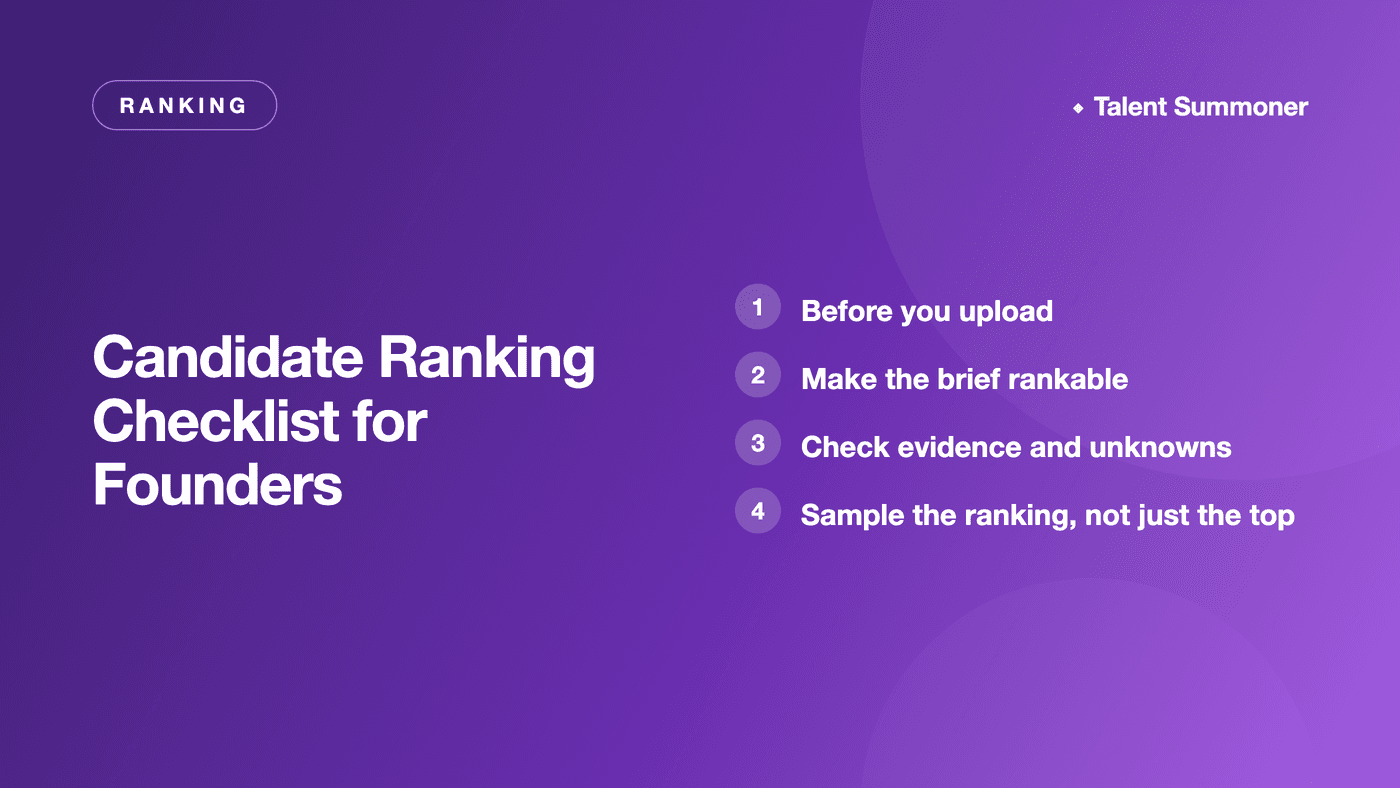
When you are the founder hiring for a role, a candidate ranking is a review queue, not a hiring verdict. You own the role definition, evidence standard, questions and decision. Use this checklist to make the pass consistent for a co-founder or hiring manager.
Copy it into the hiring record; keep the original and log changes. Missing facts are unknowns to verify, not proof of inability.
1. Before you upload
Set the context before a memorable profile influences the brief. Name the role owner and change approver, and separate preferences from requirements that affect the work.
2. Make the brief rankable
Vague language is difficult to test. Replace "great communicator" with an observable requirement, such as explaining technical trade-offs to customers. Define acceptable adjacent experience before seeing names, so you do not move the goalposts for a favourite profile.
3. Check evidence and unknowns
Read the explanation against the source. Separate what the CV says from what the reviewer infers. A title does not establish ownership, scale or outcome. Label each criterion rather than giving one broad impression.
4. Sample the ranking, not just the top
Limited review time is not a reason to inspect only the first few results. Sample the top, middle and bottom, plus one surprising result. Review everyone in a small pool; ask a second reviewer to assess a sample without seeing the rank when practical.
5. Make controlled changes
Change one input at a time. If criteria, weighting and CVs all change, you will not know why the next ranking differs. Keep the original output and version each pass. A controlled change might clarify "owned" or move a preference to nice-to-have.
6. Assign a human-owned next action
Every reviewed candidate needs a disposition and owner: progress, verify, hold, revise or close for a stated job-related reason. Closing is your decision, not an automatic rejection from rank. Make the next question specific enough for another person to carry out.
7. Keep a review record
Store the role brief version, ranking date, candidate-set description, reviewers and original report together. Record sources, verification answers and access according to your organisation's retention and privacy practices.
Where Talent Summoner fits
Talent Summoner is our product for AI candidate sourcing, CV ranking and outreach you confirm before it sends. Its live Candidate Ranking tool, checked 3 October 2026, accepts a job description and up to 50 CVs in PDF, DOCX, MD or TXT format. No account is required and it creates a shareable report. Your team still verifies evidence and decides.
If your pool is too small, candidate sourcing starts from a role brief and searches LinkedIn, GitHub and other public professional sources across 200M+ profiles. It returns must-haves, nice-to-haves and plain-English reasoning; feedback can adjust a later search. See pricing for current terms, checked the same date.
Bottom line
Freeze the brief, inspect rank bands, change one input at a time, and record a human next action.
FAQ
Can a founder use this checklist without a recruiter?
Yes. The role owner can define the evidence standard, sample results, ask questions and record dispositions. Add a reviewer for ambiguity.
Should the highest-ranked candidate always progress?
No. Rank orders attention. Progress depends on job-related evidence, unresolved questions and human review.
What should I do when a strong candidate ranks low?
Inspect the brief, evidence and adjacent routes. Record the cause, make one justified change and rerun the set.
Does Talent Summoner make the hiring decision?
No. Talent Summoner is our ranking and sourcing product. Founders and hiring teams verify candidates, choose actions and decide. It is not an ATS and does not automatically reject candidates.
Related: Candidate Matching Software: What Should Be Scored? · Candidate Fit Score Explained for Hiring Managers
Talent Summoner product facts read from our live candidate sourcing, candidate ranking and pricing pages, verified 3 October 2026. We re-verify this page quarterly — tell us if something changed.