Talent Summoner
Candidate Screening Rubric for Portfolio Roles
Build a portfolio-role screening rubric that separates job criteria from polish, keeps missing evidence visible and gives reviewers consistent next checks.
A portfolio can make screening subjective. One person presents polished screenshots, another a confidential case study, and a third relevant work but no public portfolio. A rubric turns the brief into the same evidence questions. It should improve consistency without treating presentation, a URL or an algorithmic rank as proof of performance.
Use it after a candidate enters review and before a panel decides progression. This example uses a product designer joining a complex B2B workflow; it is illustrative, not universal.
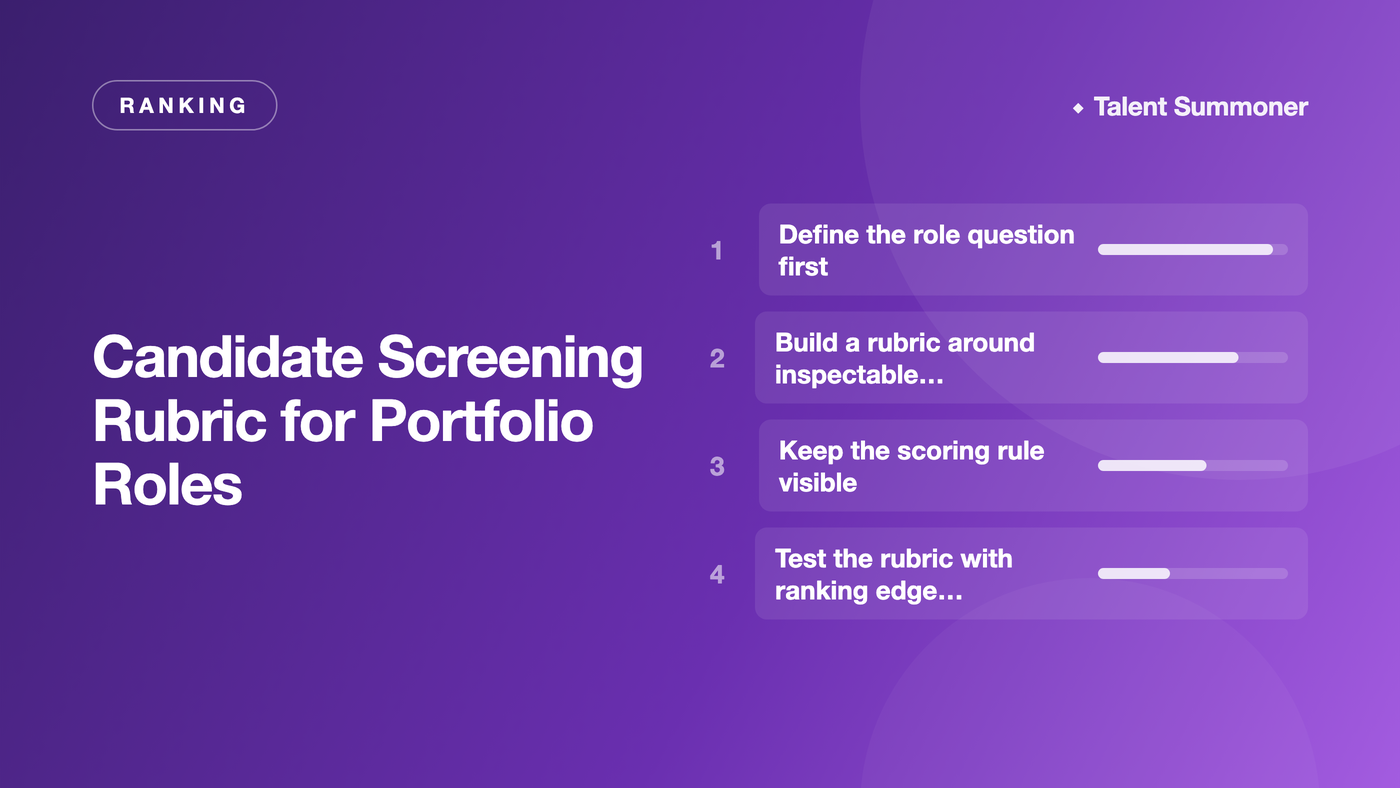
Define the role question first
Start with the work the person must do, rather than asking whether a portfolio looks impressive. For the example role, the decision question could be: “Can this person show relevant product-design work, explain their contribution, and reason through user, technical and business constraints?”
Break the question into must-haves, nice-to-haves and operating boundaries. Define evidence and the reviewer's remaining question for each. Do not add criteria after seeing a candidate's work.
Build a rubric around inspectable evidence
Use one row per job-related criterion. Keep the source observation separate from the reviewer's interpretation, and keep both separate from the next action.
| Criterion for the example role | Evidence to inspect | Status to record | Comparable next check |
|---|---|---|---|
| Problem framing | The user, problem, constraints and role context are stated | Supported, adjacent, unknown or contradicted | Ask the candidate to explain the brief and one constraint |
| Design reasoning | Alternatives, trade-offs, iterations or rejected options are described | Supported, adjacent, unknown or contradicted | Ask for one decision they would change and why |
| Interaction detail | Flows, states, edge cases or interaction choices are visible where relevant | Supported, adjacent, unknown or contradicted | Use the same short scenario or work sample for comparable gaps |
| Personal contribution | The candidate identifies what they owned in collaborative work | Supported, adjacent, unknown or contradicted | Ask what they personally decided, made or changed |
| Outcome and learning | Any result is attributed and its scope or measurement is clear | Supported, adjacent, unknown or contradicted | Ask how the result was assessed; do not fill in a missing baseline |
| Access and recency | The source is available, permitted to inspect and dated where relevant | Supported, adjacent, unknown or contradicted | Request an approved alternative or record the limitation |
Labels describe evidence for one criterion, not candidate value. Supported directly addresses the requirement; adjacent needs a bridge; unknown leaves the question unanswered; contradicted records conflicting sources for human review. Unknown is not no, and adjacent is not proof of a must-have.
Keep the scoring rule visible
If the panel needs a numeric aid, define it before reviewing the pool. One convention is supported = 2, adjacent = 1, and unknown = blank; keep contradicted outside the total until resolved. This is a team aid, not a validated measure. A total must not let a nice-to-have compensate for an unresolved must-have, and unknown must not become a rejection score.
For each row, capture the source URL or file, relevant observation, date when available and narrow interpretation. “Shows a dashboard” is an observation; “can design reliable enterprise workflows” needs more evidence. Keep it open unless the rubric defines a comparable test.
Test the rubric with ranking edge cases
Before relying on a ranking or panel score, create synthetic fixtures that exercise the rubric's boundaries; they are process tests, not candidate evidence:
- Polished but thin: a refined case study gives no contribution or decision context. Leave contribution unknown rather than awarding presentation credit.
- Relevant but confidential: a candidate cannot publish screens or client details. Allow an approved walkthrough or work sample; do not treat the absent public link as failed experience.
- Collaborative repository: a project names a large team and shared outcome. Ask what the person owned rather than counting the whole result as individual evidence.
- Adjacent background: a related workflow comes from another domain. Mark the bridge adjacent and specify a transfer question rather than requiring the same industry label.
- Strong result, unclear attribution: a case study reports an improvement without the candidate's role or measurement method. Record it as unverified and keep attribution open.
Run every fixture through the same criteria and record expected treatment before viewing output. If a ranking changes because of an unapproved criterion, freeze the result and revise the rubric. A test should reveal a rule problem, not manufacture a favourable profile.
Calibrate the reviewers and hand off clearly
Have reviewers label a fixed set of test records independently, then compare disagreements by criterion. Discuss unclear standards, broad interpretations or criteria that are not job-related. Update the definition and retain the change note; do not average impressions.
At hand-off, every material row needs a status, source or explicit unknown, owner and stop condition. One action is “role owner asks comparable candidates the same contribution question and reviews answers before progression.” Use progress, verify, hold, revise or close with a job-related reason, and retain each rubric version.
Where Talent Summoner fits
Talent Summoner is our product. Its current Candidate Ranking tool, checked on 2 September 2026, accepts a job description and up to 50 CVs in PDF, DOCX, MD or TXT, requires no account and returns a ranked shortlist with plain-English reasoning and a shareable report. Use it to organise attention, then apply this rubric. The report does not establish authorship, contribution, design quality, availability or job performance.
When the pool is too small, candidate sourcing, checked on 2 September 2026, starts from a role brief and searches LinkedIn, GitHub and other public sources across 200M+ profiles before returning a ranked shortlist. A public profile or portfolio link is a review prompt, not a screening decision. Your team owns evidence checks, comparable questions and progression.
What is a candidate screening rubric for a portfolio role?
It is a set of job-related criteria, evidence prompts, status definitions and next actions for reviewing portfolio-based work consistently. It is a review aid, not a prediction of performance.
Should a candidate without a public portfolio fail the rubric?
No. A missing public artefact is an unknown or an access limitation. Use an approved walkthrough, work sample or comparable question when that evidence is material, and apply the same route to comparable candidates.
Should visual polish be a scored criterion?
Only when the role brief makes a specific, job-related presentation capability material. Do not use general polish as a proxy for problem framing, contribution, interaction reasoning or outcomes.
Can Talent Summoner screen portfolio roles automatically?
The current product ranks uploaded CVs or discovers profiles against a role brief. It does not verify portfolio authorship or replace the human rubric, work sample, interview or progression decision.
Choose one open portfolio role, freeze its criteria and run the edge-case fixtures before reviewing live candidates. Then use candidate ranking for an existing CV pool or candidate sourcing when discovery is the gap, keeping the rubric and final action with the hiring team.