 Talent Summoner
Candidate Ranking and Screening: From a Pile of CVs to a Shortlist
Too many CVs for one role? Rank them with a free tool, then screen the best ones yourself. Five steps from a pile of CVs to a shortlist, with a worked example.
 By Nicholas Yan · Published · Updated · in Ranking & Evaluation
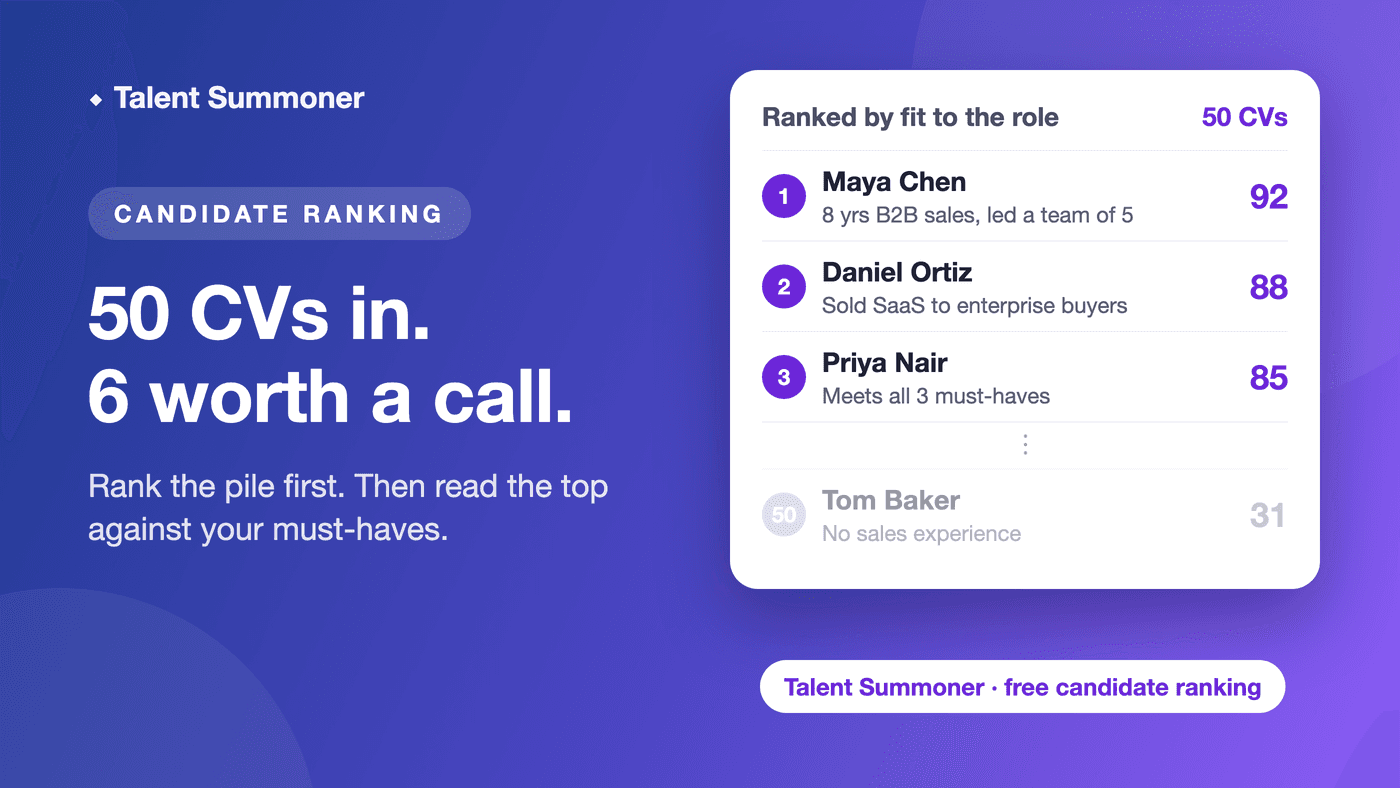
Applications for one role keep arriving, and you cannot read them all today. Here is how to find the few people worth a call.
- Ranking puts CVs in order of fit to the role, and a tool can do it.
- Screening decides who moves on, and a person does it.
Our free candidate ranking tool does the ranking, with no account needed. Paste a job description, upload up to 50 CVs, and get each one ranked with a reason.
If a role has only a few applicants, skip ranking and read them all.
Key takeaways
- Rank first, so you read the best-fitting CVs first. Our free tool ranks up to 50 CVs in one run.
- Read the top of the list against 3 must-haves, then skim the bottom for anything the ranking misread.
- A person owns every screening decision and records a reason that relates to the job.
- A ranked list covers only the CVs you upload. To find people who did not apply, use candidate sourcing.
How to get from a pile of CVs to a shortlist
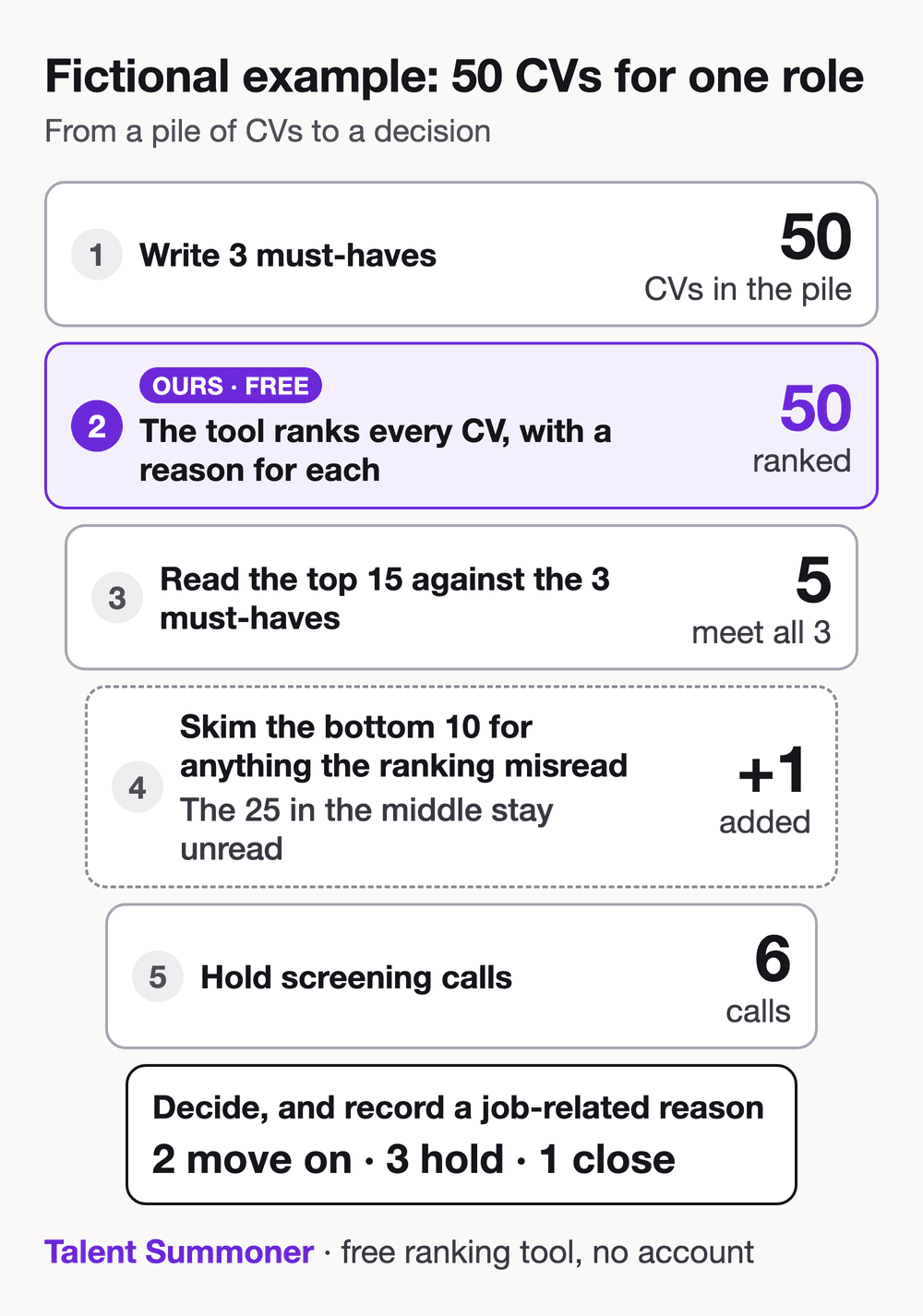
- Write the job description and pick 3 must-haves. A must-have is something the person cannot do the job without; everything else is a preference.
- Rank the CVs. Paste the job description into our free tool and upload up to 50 CVs, and you get an ordered list with a plain-English reason for each CV and a report you can share.
- Read the top of the list against your 3 must-haves (15 CVs in our example), and mark each as met, not met or unknown. Treat unknown as a question for the screening call, not a no; read further down only if you need more people.
- Skim the bottom of the list for anything the ranking misread (10 CVs in our example), because a strong CV buried at the bottom would never be read. A CV may use a different job title or leave out relevant work, so move up any that meets the must-haves.
- Screen the people who pass. Run the same steps for everyone, then record the decision: move on, hold or close.
Step 5 in detail: the screening methods
Screening is the human step. Common methods, in a typical order:
- CV or application review against the must-haves.
- Knockout questions for hard requirements, such as a licence or work authorisation. Even if a tool asks them, a person owns the rule.
- A short screening call to confirm interest, logistics and unclear evidence.
- A work sample or skills test, if the job has an output you can observe.
- Reference or eligibility checks near a conditional offer, under local rules. Do not run them before a first conversation.
A person owns every screening decision. For each one, record a reason that relates to the job.
Missing CV wording does not prove a missing skill. Mark it unknown, then ask every candidate the same question.
Never turn a score into an automatic interview or rejection. Check the evidence first.
For portfolio roles, use a candidate screening rubric for portfolio roles.
When ranking is the wrong tool
- You have a few applicants. Read them all.
- You need people who have not applied. Ranking cannot find them, but candidate sourcing can.
- You need proof of a claim. Ranking cannot verify a licence or a degree, so use a knockout question or a check.
FAQ
Is candidate ranking the same as candidate screening?
No. Ranking puts CVs in order of fit to a role, and screening is the decision about who moves on.
Can ranking replace a screening interview?
No. Ranking tells you which CVs to read first, and it cannot replace an interview, a work sample or a check.
Does a high-ranked candidate automatically progress?
It should not. Check the evidence first, because a person makes the final decision.
Does Talent Summoner offer automated candidate screening?
No. Our free tool ranks uploaded CVs and gives a reason for each, and your team makes every screening decision.
Try it on one open role this week: write 3 must-haves, rank the CVs, and read the top of the list first.
Related: Candidate Ranking for Technical and Product Roles · Candidate Ranking Checklist for Founders · Candidate Matching Software: What Should Be Scored?
Product facts checked against our live candidate sourcing, candidate ranking and pricing pages on 5 October 2026. We re-verify this page quarterly — tell us if something changed.