 Talent Summoner
Candidate Ranking for Technical and Product Roles
Learn how evidence differs for technical and product hiring while keeping candidate ranking criteria, unknowns and human decisions consistent.
 By Nicholas Yan · Published · Updated · in Ranking & Evaluation
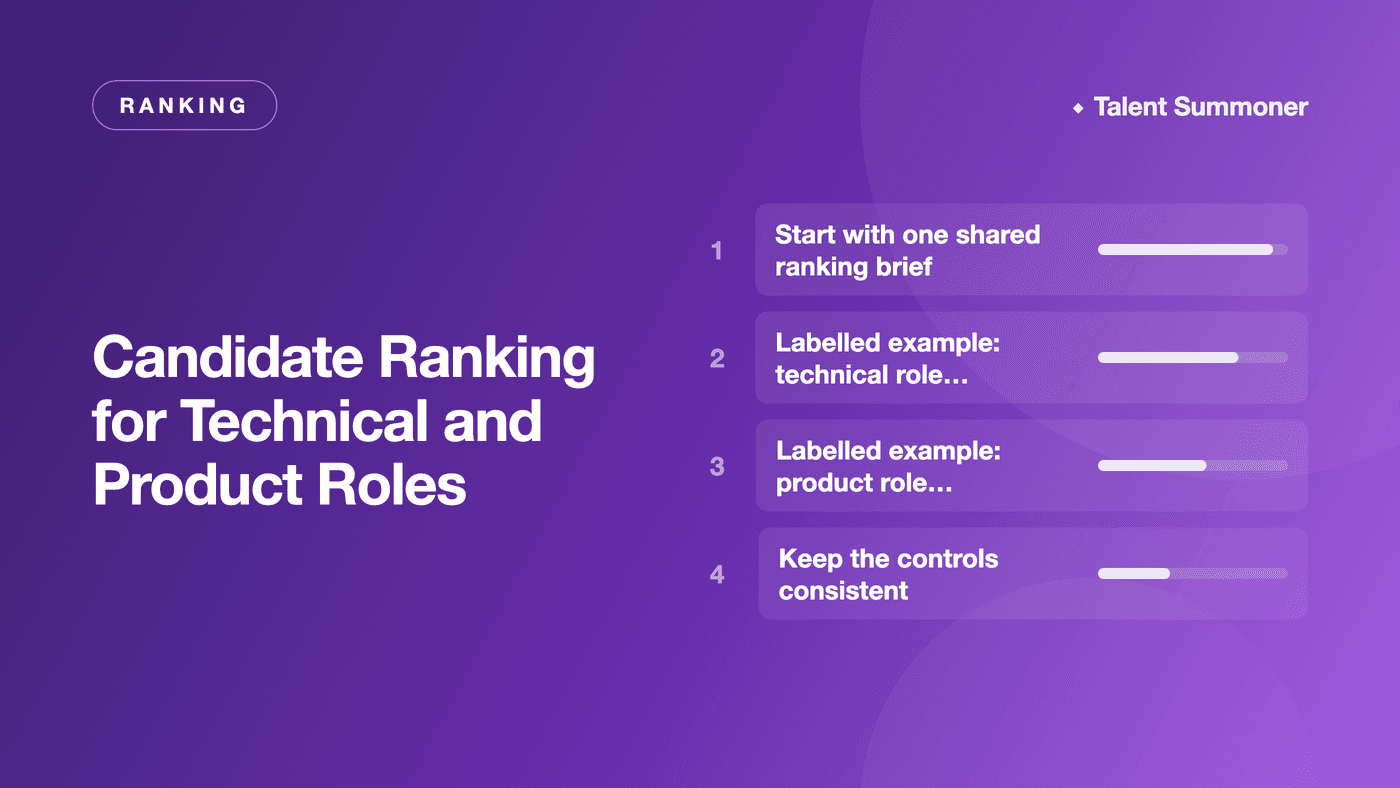
Candidate ranking should change with the work, not with a universal idea of what a "good" technical or product candidate looks like. The evidence you ask for will differ; the controls used to compare it should not.
Start with one shared ranking brief
Before reviewing names, write the role in plain language. Separate must-haves, nice-to-haves and genuine boundaries such as location or working pattern. For every must-have, state what evidence could support it and what would remain a question. Record acceptable adjacent routes before seeing profiles.
This structure applies to both role families. "Owns production reliability" and "takes products from discovery to launch" need different evidence, but both require defined scope and context. Keep the brief versioned. If a requirement changes after seeing a favourite profile, rerun the same candidate set and retain the old result.
Labelled example: technical role evidence
Example brief, not a universal model: a backend engineer must have owned a production API migration, explain operational trade-offs and work within the agreed schedule. A nice-to-have is cloud-provider experience.
Evidence for "owned a production API migration" might describe responsibility, services in scope, constraints and result. A portfolio may add context. "Used Kubernetes" signals exposure, not ownership, production scale or outcome. Label the criterion supported only when the source establishes the detail; label it adjacent when experience may transfer but needs checking.
Do not infer ability from GitHub activity. A public repository can be relevant when it documents a role-related project and its limits are clear. Activity volume, stars, commit frequency or an absent profile do not establish skill. "Staff Engineer" does not prove scope. Ask the same ownership and systems questions next.
Labelled example: product role evidence
Example brief, not a universal model: a product manager must take a B2B workflow from customer discovery through a measurable launch, make prioritisation trade-offs with engineering and design, and communicate decisions to stakeholders. A nice-to-have is target-market experience.
Evidence could describe the problem, customer input, decision, collaborators, launch context and result. "Led product strategy" is too broad. A well-known employer provides context, not evidence that this person owned the decisions. A product title does not prove discovery depth, delivery responsibility or stakeholder influence.
Mark a requirement unknown when the material does not answer it. A missing launch metric, short CV or unfamiliar company is not a negative finding. Write a targeted question: "Which customer evidence changed the roadmap, what did you decide, and how did you assess the launch?" Use contradicted only when reliable material conflicts with the requirement. When you reach interviews, our product manager interview questions include scoring notes for each answer.
Keep the controls consistent
Use the same review sequence for technical and product pools:
- Freeze the brief, evidence definitions and approved adjacent backgrounds.
- Apply the requirements to every candidate, separating source text from interpretation.
- Label each criterion supported, adjacent, unknown or contradicted.
- Review the top, middle and bottom of the ranking, plus a surprising result.
- Give material unknowns a human-owned verification question.
- Record progress, verify, hold, revise or close with a job-related reason.
Keyword counts are not a ranking control. One technical CV may use "Go" while another describes equivalent systems work without it. A product CV may repeat "discovery" without showing what was learned or decided. Read surrounding evidence and apply the same standard. Do not reward polish, length, familiar titles or prestige as substitutes for role evidence.
Where Talent Summoner fits
Talent Summoner is our product for AI candidate sourcing, CV ranking and outreach you confirm before it sends. Its live Candidate Ranking tool, checked 3 October 2026, accepts a job description and up to 50 CVs in PDF, DOCX, MD or TXT format, requires no account and creates a shareable report with plain-English reasoning. Use it to organise review, then inspect evidence and decide what to verify; it does not make the hiring decision or automatically reject candidates.
When the pool is incomplete, candidate sourcing starts free with no credit card. It uses a role brief to search LinkedIn, GitHub and other public professional sources across 200M+ profiles, returning must-haves, nice-to-haves and plain-English reasoning. Feedback can adjust a later search and weighting. Public signals still require human interpretation; they are not proof of ability, interest or availability.
For sourcing, the pricing page, checked on 3 October 2026, lists US$29 for one Role, US$79 for three Roles, US$59 per month for 10 Roles or US$299 per month for Unlimited, which covers every open role. Unused monthly Roles do not carry over; extra Roles are US$15, and one-time pack Roles remain valid for 24 months. Your first Role is free and your second is US$4, an intro price shown at checkout, not on the pricing page. Recheck terms before purchase.
Bottom line
Technical and product roles need different labelled evidence, but the discipline is shared: freeze the brief, separate evidence from inference, preserve unknowns and give people the final decision. Start with one role, define three job-related must-haves and test the sequence.
FAQ
Should technical and product candidates use the same criteria?
No. Requirements and evidence differ. Apply the same controls: a versioned brief, explicit evidence standards, visible unknowns and consistent human review.
Does GitHub activity prove technical ability?
No. A relevant project may provide context, but activity, stars, commit counts or an absent profile do not prove skill, ownership or performance.
Does a product title or prestigious employer prove product fit?
No. Ask for role-related evidence such as the problem, decisions, collaboration, delivery context and result. Treat missing detail as unknown.
Can Talent Summoner choose the best technical or product hire?
No. Its report ranks submitted CVs against your brief and explains the result. Your team checks sources, asks questions and owns every hiring decision.
Related: Candidate Ranking Checklist for Founders · Candidate Matching Software: What Should Be Scored? · Candidate Fit Score Explained for Hiring Managers
Talent Summoner product facts read from our live candidate sourcing, candidate ranking and pricing pages, verified 3 October 2026. We re-verify this page quarterly — tell us if something changed.