Talent Summoner
How to Rank Candidates for Shift-Based Roles
A practical guide to separating shift requirements from skill evidence, calibrating a panel and recording schedule checks without guessing availability.
Shift-based roles are difficult to rank when a panel treats schedule fit as a vague personality trait. A candidate may have the required skills but not yet have confirmed access to the published shift, while another may have worked nights before but lack a role-critical capability. These are different questions and need separate records.
For a panel calibrating scores, define the operating pattern first, treat it as a stated boundary, then compare job evidence against the same criteria for every candidate. Keep an unresolved schedule question as unknown until the approved human process checks it. Do not turn personal circumstances into a score.
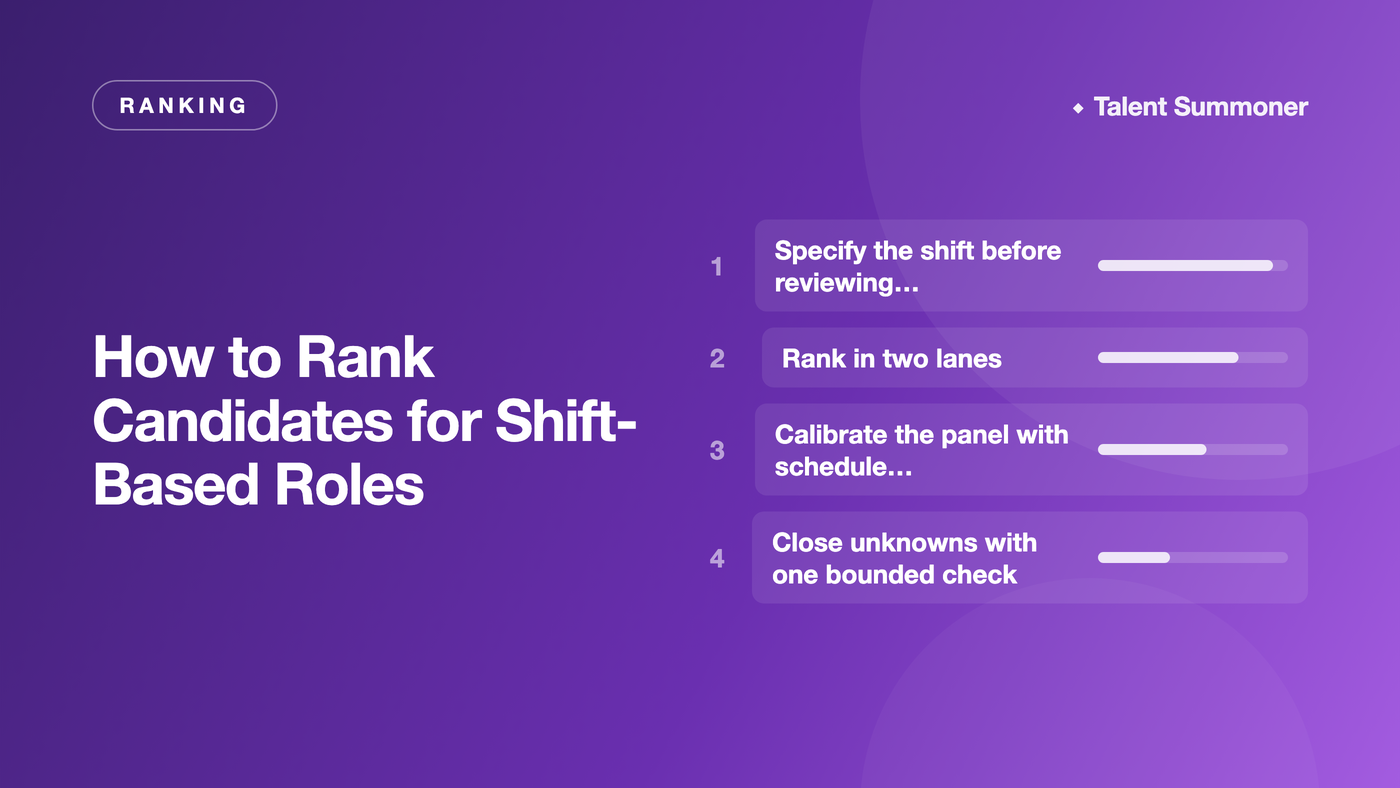
Specify the shift before reviewing names
Write the coverage requirement in the role brief. Include the shift window and time zone, whether it is fixed, rotating or irregular, required days, handover expectations, on-call periods and location or remote arrangement. Add material training, meeting or occasional-change requirements. "Flexible schedule" does not tell a reviewer what the work requires.
The US Office of Personnel Management's job-analysis guidance describes examining job tasks, competencies and their connection before selection. Start with work performed during the shift, not a preferred background. CDC/NIOSH guidance on fatigue identifies night work and extended hours as nonstandard schedules and notes effects on attention, concentration, reaction time and judgement. This is general safety information; involve local specialists.
Classify each requirement before opening the candidate list:
- Must-have capability: a task the person must perform, such as resolving an incident and documenting a handover.
- Operating boundary: a required shift, location or time-zone commitment, handled through the approved availability process.
- Nice-to-have context: relevant prior exposure, such as using a similar handover system.
Do not add "has worked nights" as a proxy for reliability if the job does not require that experience. Conversely, do not hide a material coverage requirement in a culture or personality criterion.
Rank in two lanes
Use one record for job evidence and one for the schedule boundary. The schedule lane is a gate or verification state, not extra credit.
The following is an illustrative example for a support engineer covering a published overnight window. It is a team aid, not a universal scoring model.
| Review item | Lane | What to inspect | Status and next action |
|---|---|---|---|
| Diagnose and resolve production issues | Job evidence | A source names the candidate's action, system context and responsibility | Supported, adjacent, unknown or contradicted; ask the same technical question for a material gap |
| Record a clear shift handover | Job evidence | The candidate's own contribution to notes, escalation or follow-up | Supported only when ownership is visible; otherwise keep the gap open |
| Work the published overnight window | Schedule boundary | A candidate confirmation through the approved process, with the relevant time zone and dates | Confirmed, not met or unknown under the organisation's defined rules |
| Prior overnight or rotating-shift experience | Nice-to-have | Relevant context that may help a reviewer ask a better question | Keep separate from the must-have total; it cannot compensate for missing core evidence |
Do not infer schedule commitment from a title, past employer, location label or profile visibility. A CV does not establish current availability or willingness. Ask only the job-related schedule question; route accommodation or employment-status matters through the approved process.
Calibrate the panel with schedule edge cases
Before reviewing real candidates, give the panel a small set of labelled, synthetic records. Write the expected treatment first. For example:
- A candidate has strong incident-response evidence, but the CV says nothing about the required shift. Capability can be supported while schedule status remains unknown.
- A candidate confirms the shift but gives only broad claims about production ownership. The boundary can be confirmed while the core capability remains unknown or adjacent.
- A candidate has rotating-shift experience, but the role requires a different time zone and fixed window. Prior experience is context, not confirmation.
- The manager changes the shift after seeing the shortlist. Pause, version the brief and decide whether comparable candidates must be rerun.
Have reviewers label each lane independently and compare reasons. Resolve disagreements by returning to the requirement, permitted evidence and status definition. An unapproved rule change or inconsistent treatment is a reason to pause and ask the role owner to decide.
Close unknowns with one bounded check
For every unknown that could change progression, name the owner and stop condition. A recruiter might ask comparable candidates at the same process stage whether they can work the stated window and location. Record the answer, time zone and date. Do not ask why someone cannot work a shift when the reason is not needed.
If a candidate requests an adjustment, follow the relevant process rather than letting a panel turn it into a ranking penalty. If the organisation cannot define how a schedule boundary will be handled, mark the brief for revision.
Where Talent Summoner fits
Talent Summoner is our product. Its current Candidate Ranking tool, checked on 2 September 2026, accepts a pasted or uploaded job description and up to 50 CVs in PDF, DOCX, MD or TXT format, then returns a ranked shortlist with plain-English reasoning and a shareable report. Put the approved shift requirement in the brief and use the output to organise evidence. It does not confirm availability or accommodation needs, or make the panel's decision.
When the CV pool is too small, Candidate Sourcing, checked on 2 September 2026, starts from a role brief and searches LinkedIn, GitHub and other public professional sources across 200M+ profiles. Its ranked output supports discovery against must-haves and nice-to-haves, but a public profile is not proof that a person can or wants to work a particular shift.
What counts as a shift-based role?
A role is shift-based when coverage is organised outside a conventional daytime pattern, such as fixed evening or night work, rotating shifts or irregular coverage. Define the window, time zone, rotation and handover duties rather than relying on the label.
Should previous night-shift experience raise a candidate's rank?
Only when it is an approved, job-related preference and the candidate also has the required capability evidence. It does not prove current availability.
What if a CV does not mention shift availability?
Mark the schedule boundary unknown. Keep job evidence separate, assign an owner and ask a comparable question before relying on it.
Can Talent Summoner verify schedule fit?
No. Our product can organise supplied CVs against a job description or help discover public profiles. Your team must confirm schedule details and own the decision.
For the next shift-based opening, freeze a schedule-and-evidence matrix, test the edge cases and assign an owner to every unknown. Then use candidate ranking for supplied CVs or candidate sourcing when discovery is the gap, keeping schedule confirmation and the final decision with the hiring team.