 Talent Summoner
How to Share Candidate Evidence With a Hiring Team
A practical workflow for sharing candidate evidence with the right reviewers, preserving source traces, controlling access and assigning the next action.
 By Derek Chau · Published · Updated · in Ranking & Evaluation
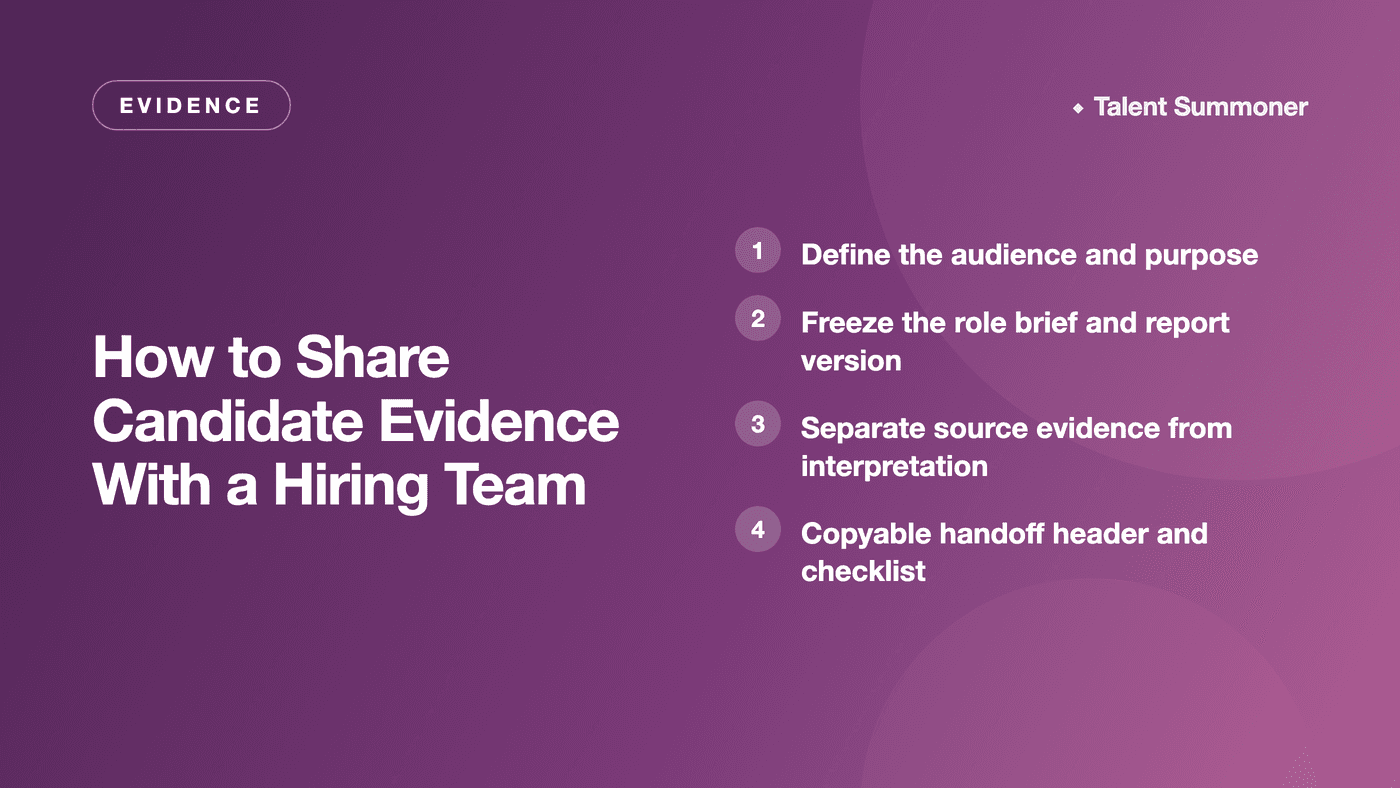
Sharing candidate evidence is a handoff, not a broadcast. State the purpose, role brief version, source behind each material point and what still needs checking. A versioned handoff supports review without turning an unverified summary into a verdict.
Define the audience and purpose
Name the people who need to act: perhaps the hiring manager, one role specialist and the communication owner. Make the purpose specific, such as reviewing two must-haves, verifying a question or approving an interview step. Do not add recipients because they might be interested.
State what is out of scope. A one-role review is not permission to circulate a whole history or unrelated attachments. Share only the needed trace and name the decision owner.
Freeze the role brief and report version
Record the role, brief version, report date and decision owner. Separate must-haves, nice-to-haves and genuine boundaries, and define supporting evidence before names are discussed. If the role changes, create a new version, name the approver and keep the earlier handoff. Keep the original before comments; add dated corrections or a new version when a source changes.
Separate source evidence from interpretation
Source evidence is observable material: a relevant CV passage, candidate answer, work sample observation or permitted public professional detail. Preserve a short passage or precise description, source identifier and capture date. Interpretation explains its relevance to one criterion. Keep them separate.
Use supported when the source addresses the criterion, adjacent when a transferable route needs checking, unknown when it does not answer it and contradicted when reliable sources conflict. Missing evidence is unknown, not proof of inability. Show both traces for a contradiction and assign a human check; labels do not auto-reject.
Copyable handoff header and checklist
CANDIDATE EVIDENCE HANDOFF
Role / purpose / audience:
Brief version / report version / review date:
Decision owner / evidence reviewer / communication owner:
Candidate ID or name permitted for this audience:
Criterion(s) in scope:
Source trace(s) and capture date(s):
Evidence (source wording or observation):
Interpretation / status / uncertainty:
Access granted to / access review or expiry:
Question or contradiction to verify / owner / due date:
Comments and changes since original:
Next action / job-related reason:
Retention or deletion review date:
Candidate status communication owner / date:
Share the minimum necessary material
Use the organisation's approved, access-controlled channel. Verify each recipient, permission level, link setting and revocation route, and record access. Do not email a broad attachment or paste candidate information into an open group. Exclude sensitive or protected characteristics, health or family details, irrelevant history, speculation and third-party confidential material. Public profile information is not a licence to redistribute everything on it.
Share only needed evidence; identify whether a link opens a source, excerpt or interpretation. Access controls do not establish privacy or legal compliance. This is general guidance, not legal advice.
Get independent review before discussion
Ask reviewers to read the frozen brief and comment before seeing colleagues' recommendations. Each should identify the criterion, source, interpretation and unresolved question. This preserves original reasoning; it does not guarantee fairness, bias reduction or collaboration.
In discussion, compare evidence before rank. Classify disagreement as a brief issue, source conflict, missing context or interpretation, then assign a check.
Control comments, changes and ownership
Give reviewers a comment path that does not overwrite the source or original report. Each change states old point, new point, author, date and reason. Label candidate answers as candidate-provided. A changed brief needs a new version and comparable-record review.
End with one action: progress, verify, hold, revise or close for a job-related reason. Name the action owner, due date and communication owner when status needs updating. People verify, interview and decide.
Review retention and candidate status
At close or review date, check whether the report, sources, comments and access are still needed. Record the deletion owner, policy requirement and revocation date. Do not promise a universal retention period; check controlled backups and exports.
Candidate status communication is separate. Assign one owner to send an accurate update without exposing internal comments or another candidate's information. If pending, say so; a ranking is not final.
Where Talent Summoner fits
Talent Summoner is our product for AI candidate sourcing, CV ranking and outreach you confirm before it sends. Its Candidate Ranking tool, checked on 3 October 2026, accepts up to 50 CVs, requires no account and creates a shareable report with plain-English reasoning and PDF download. Use it as input, then apply your team's access and privacy judgement. It does not replace source checks, interviews or decisions.
Talent Summoner's candidate sourcing starts from a role brief and searches LinkedIn, GitHub and other public professional sources across 200M+ profiles, returning must-haves, nice-to-haves and plain-English reasoning. It is not an ATS or application pipeline and does not automatically reject candidates. Review pricing; your team owns access, verification, communication and retention.
Wrong fit for this workflow
Do not circulate a full file broadly, decide from rank alone, collect protected details or replace a candidate conversation. Resolve any missing role, access or action owner first.
FAQ
Should I send the full CV to every interviewer?
No. Give each reviewer only the job-relevant material, source trace and access needed for the task. Avoid broad attachments.
What should I do when two sources contradict each other?
Preserve both traces and dates, identify the criterion and assign a human check. A contradiction is not automatic rejection; missing evidence remains unknown.
Can a shareable ranking report replace a hiring-team decision?
No. It can organise review, but people verify, interview, communicate and decide. Sharing still requires the team's access and privacy judgement.
How do we know when to delete the handoff?
Set a review date, name the owner and check controlled copies and access. Follow your policy and obtain qualified legal advice for specific questions.
For the next role, fill in one handoff header, freeze the brief, collect independent comments and assign one human-owned action. Then create a candidate ranking report or start candidate sourcing with an audience and access owner.
Related: How Structured Evidence Can Reduce Interviewer Bias · Hiring Brief Template for Founders · Evidence-Based Candidate Evaluation: What to Capture
Talent Summoner product facts read from our live candidate sourcing, candidate ranking and pricing pages, verified 3 October 2026. We re-verify this page quarterly — tell us if something changed.