Talent Summoner
Evidence Trail Requirements for Hiring Decisions
Define an evidence trail for hiring decisions with source checks, versioned criteria and merge, pause or escalate gates for ranking reviews.
An evidence trail lets another authorised reviewer reconstruct the question, material considered and reason for a hiring action. It does not turn a ranking into proof of capability. Here, “requirements” means practical process controls, not a universal legal checklist.
For a team testing ranking edge cases, the trail makes a broken input or interpretation visible before it spreads. When a record cannot be traced, merge duplicate evidence, pause the review or escalate a boundary question. A lower rank or confident summary is not, by itself, a hiring reason.
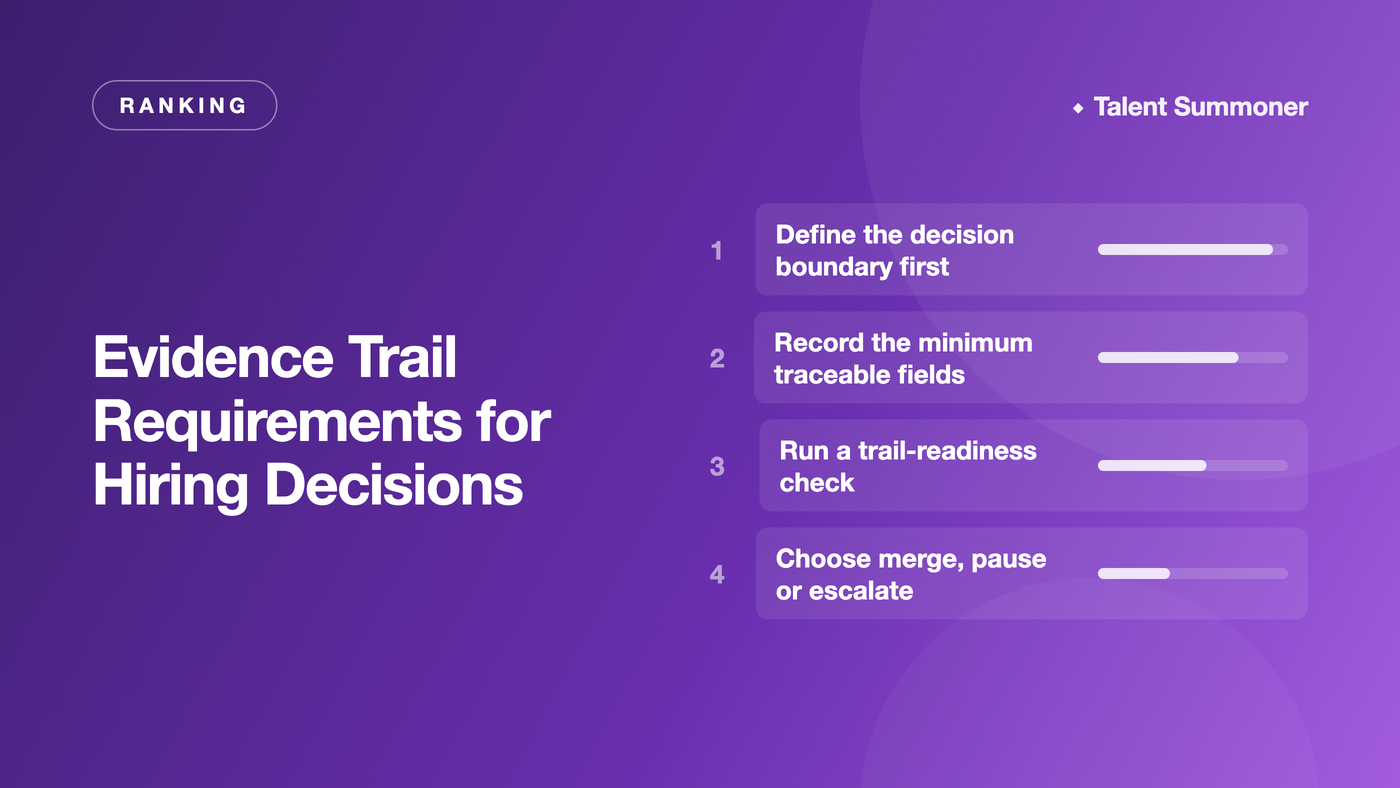
Define the decision boundary first
Start with one role, decision question and accountable owner. Write the approved brief version, review date, candidate-set boundary and stage. State whether the task is human review, verification or a progression decision. Do not let a result silently change the question.
Separate must-haves, preferences and operating constraints. For each criterion, write supporting evidence, an acceptable adjacent route and the status for missing information. Supported, adjacent, unknown and contradicted are process labels, not judgments about a person. Flag criteria that are not job-related or cannot be interpreted consistently.
Record the minimum traceable fields
The trail should reproduce the reasoning without copying every source. Use one record per role and review version, with a stable identifier for each candidate or source.
| Trail field | What to capture | Why it matters |
|---|---|---|
| Decision frame | Role, brief version, question, owner and date | Defines what the review was allowed to decide. |
| Candidate boundary | Records included, excluded, duplicated or added | Stops pool changes being mistaken for fit changes. |
| Source trace | File, URL or record ID, source date if shown and capture date | Lets a reviewer return to the material behind a claim. |
| Interpretation | Narrow statement linked to one criterion | Separates what the source says from what the reviewer infers. |
| Status and unknown | Supported, adjacent, unknown or contradicted, with the missing fact | Prevents silence becoming an automatic negative. |
| Decision event | Progress, verify, hold, revise, merge or escalate, with reason | Makes the next action and its trigger visible. |
| Ownership | Reviewer, approver, follow-up owner and stop condition | Prevents an unresolved question becoming everyone’s assumption. |
Record the criterion, source wording and bounded interpretation, not “strong candidate”. Do not rewrite supporting a project as owning it. Repeated biographies are not independent support.
Run a trail-readiness check
These checks should pass before a ranking or shortlist drives a next step:
- The brief version and decision owner are named, and the criteria have not changed silently.
- Every material inclusion or movement points to a source, approved decision or explicit unknown.
- The source can be identified and opened by an authorised reviewer, subject to the organisation’s access rules.
- The interpretation does not add ownership, scope, recency, availability, interest or outcomes that the material does not establish.
- Comparable candidates were checked when a criterion, boundary or interpretation changed.
- Conflicts, duplicates and inaccessible material have a named owner rather than an implied resolution.
- The proposed action has a stop condition, such as “do not progress until the role owner confirms the working-pattern requirement”.
Treat access and retention as part of the trail. The UK's Information Commissioner’s Office recruitment-AI procurement guidance, published on 6 November 2024, covers documented responsibilities, transparency, fairness and accuracy monitoring, and data minimisation. Apply the rules for the organisation and location; this is general information, not legal advice. NIST’s AI Risk Management Framework is voluntary AI risk guidance, not a hiring certification.
Choose merge, pause or escalate
Use the trail to choose a process disposition. Merge entries only after confirming that they refer to the same source, candidate or event. Keep the authoritative identifier, link the duplicate and record who merged it. Preserve the duplicate when it explains an error.
Pause when the result cannot be interpreted safely: for example, after an unapproved brief change, unresolved identity conflict, missing source, ambiguous criterion or access question. Preserve the version, blocking question and owner who can release the hold. A pause is not a rejection.
Escalate issues outside the reviewer’s authority, such as a sensitive-attribute proxy, unusual data use, policy boundary or disputed requirement. Carry the source, narrow issue, affected scope, decision needed and stop condition. Do not ask an automated result to settle policy.
When the trail is sound, record progress or verify with a job-related reason. If the brief is defective, revise it. Re-run comparable records after a material correction and link versions so reviewers can distinguish changed evidence from a changed rule.
Where Talent Summoner fits
Talent Summoner is our product. Its Candidate Ranking tool, checked on 3 September 2026, accepts a job description and up to 50 CVs in PDF, DOCX, MD or TXT, then returns a ranked shortlist with plain-English reasoning and a shareable report without an account. Use the report as a dated input; it does not replace verification, version history or human decisions.
When the supplied pool is the gap, candidate sourcing, checked on 3 September 2026, searches LinkedIn, GitHub and other public professional sources across 200M+ profiles from a role brief. Treat results as material to inspect, not proof of ownership, availability or interest.
What is an evidence trail in hiring?
It records the decision question, criteria, candidate boundary, sources, interpretation, unknowns, action and owners by version. It supports reconstruction, not a prediction of performance.
Is an evidence trail a legal compliance checklist?
No. Recordkeeping and data-protection duties vary by organisation and location. Use authoritative local guidance or qualified advice for those duties; this guide describes a practical review control.
When should a hiring team pause a decision?
Pause when a material source, identity, criterion, access boundary or approval is unresolved. Preserve the current record, write the blocking question and name the owner and stop condition instead of inferring an answer.
When should duplicate evidence be merged?
After confirming identity, merge records that refer to the same candidate, source or event. Keep the authoritative record, link the duplicate and preserve an audit note.
Can Talent Summoner create the complete evidence trail?
The product pages document ranking reports and public-source discovery. Your team still records brief versions, source checks, access decisions, dispositions and ownership.
For the next ranking review, freeze the brief and candidate boundary, complete one source-backed trail record for each material criterion and label every gap. Merge duplicates, pause unresolved evidence and escalate questions outside the reviewer’s authority. Then use candidate ranking for supplied CVs or candidate sourcing when approved discovery is needed.