 Talent Summoner
How Feedback Improves the Next Candidate Search
Learn how to turn hiring-team feedback into controlled sourcing changes while keeping evidence, weighting and human approval visible.
 By Nicholas Yan · Published · Updated · in Ranking & Evaluation
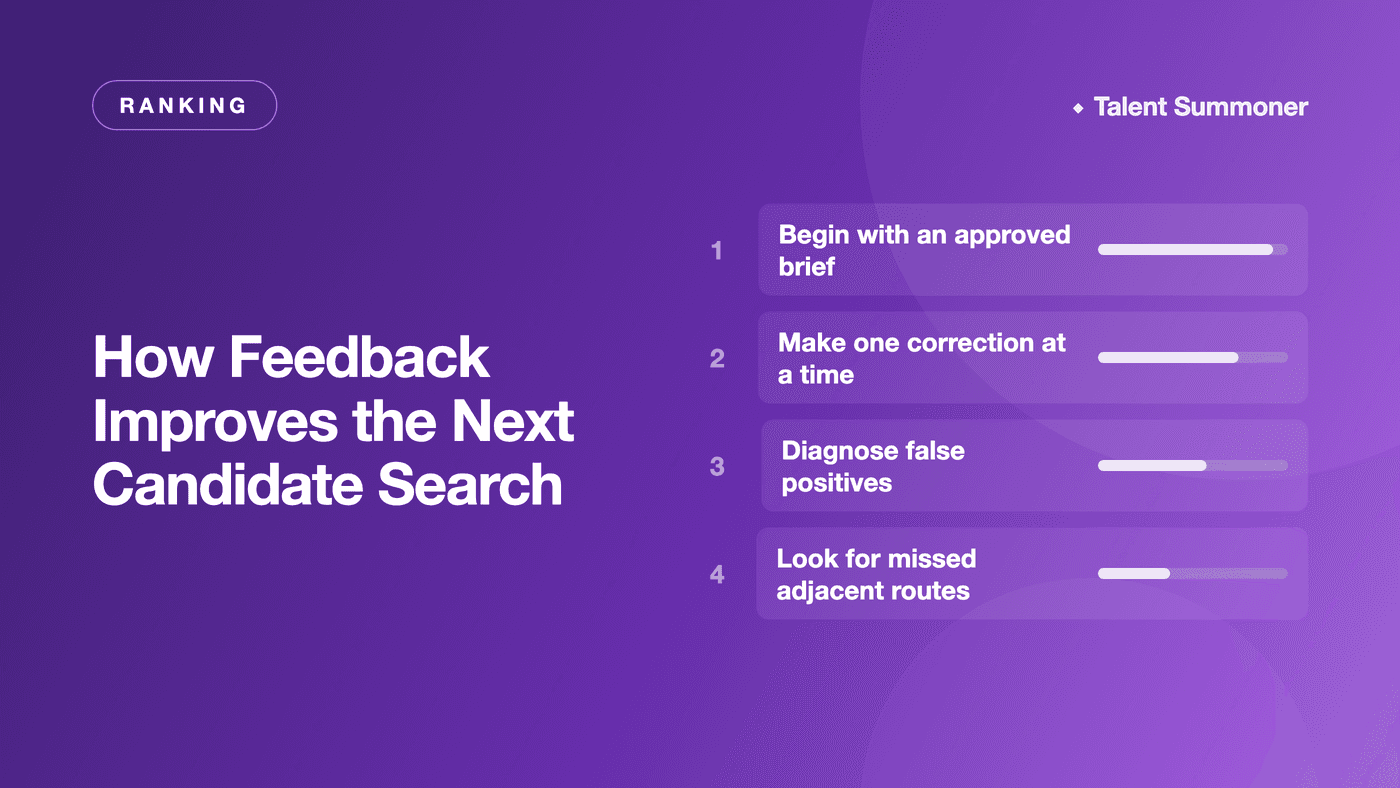
Feedback-based candidate sourcing can make the next search better aligned to an approved role brief. It is not a promise of better candidates, perfect accuracy or a fair outcome.
We build Talent Summoner, where yes/no feedback and preference edits adjust the next round's search and weighting, and your first Role is free with no card. If you run one search and never repeat it, you do not need a feedback process.
Ask a narrower question than "who is better?": what did the last search misunderstand, and what job-related change should the next search test? Treat each search as a reviewable cycle of brief, shortlist, approved change and rerun.
Begin with an approved brief
Before giving feedback, freeze the brief version. Separate must-haves, nice-to-haves and boundaries such as location or working pattern.
Define acceptable adjacent backgrounds in advance, and have the hiring team approve that interpretation before seeing names.
Feedback can quietly change the job. "More senior" might mean larger technical scope, people leadership or a familiar employer.
A project with relevant ownership is a job-related correction; a preference for a school, employer brand or personal similarity is not.
Make one correction at a time
When a shortlist is off target, change one input before changing everything else. Clarify production ownership, remove an unnecessary keyword, add an approved adjacent route or move a genuine preference below a must-have.
One change makes the next result interpretable. If you rewrite the title, add skills and alter every weight together, you will not know what changed the shortlist.
Diagnose false positives
A false positive appears relevant because its title or wording resembles the brief, while the evidence does not establish the required scope. Check for a keyword without a meaningful project, seniority inferred from a title, or a nice-to-have compensating for an unproven must-have.
Write the cause in specific terms: "mentions Kubernetes, but no production ownership shown" is more useful than "weak candidate". If the requirement was unclear, revise the brief.
If the source lacks context, leave it unknown and create a verification question.
Look for missed adjacent routes
Feedback should also examine false negatives: plausible candidates ranked low or absent because they use different titles, describe transferable work differently or follow a non-linear path. Ask which route the brief allowed but the search did not recognise.
Add an adjacent route only when the hiring team can explain why its evidence could satisfy the role. Name the evidence to look for, such as owning a high-volume service rather than using one framework.
Do not infer capability from a demographic attribute or proxy.
Adjust weighting deliberately
Weighting should represent approved trade-offs. A must-have should not become optional because a profile has an attractive nice-to-have.
If operating production systems matters more than a named library, record that decision and test the balance.
The FAQ on Talent Summoner's homepage says yes/no feedback and preference edits directly adjust the next round's search and weighting. That is useful control, not an accuracy guarantee.
Inspect explanations, sample surprising results and confirm that the intended criterion changed. The role owner decides whether the trade-off is acceptable.
Version the search and approve the result
Give every cycle an identifier: brief version, feedback date, change, approver and result. If reviewers disagree, record whether the issue is evidence, the requirement or weighting.
Before contact, a human should approve the revised brief and review the shortlist. The output organises attention; it does not establish job performance, prove ranking accuracy or remove bias.
This is general process guidance, not legal advice.
When this approach is wrong for you
Feedback loops need a stable brief and someone with authority to approve changes. If the role itself is still undefined, fix the brief first, because feedback will only chase whichever profile looks impressive.
Skip repeated feedback rounds when the shortlist is thin for a structural reason such as pay, location or a scarce credential. Rewriting weights will not fix that, so change the constraint or the role and then search again.
Where Talent Summoner fits
Talent Summoner covers AI candidate sourcing, CV ranking and outreach sent from your own connected Gmail, Outlook or LinkedIn after you review each message and confirm the send. Its candidate sourcing workflow starts from a role brief, searches LinkedIn, GitHub and other public professional sources across 200M+ profiles, and returns a ranked shortlist with must-haves, nice-to-haves and plain-English reasoning.
If you already have CVs, the candidate-ranking tool accepts up to 50 files in PDF, DOCX, MD or TXT, needs no account and creates a shareable report. People still verify and decide; see current options on pricing, checked 3 October 2026.
FAQ
Does feedback guarantee better candidates?
No: it can align a later search more closely to the approved brief and trade-offs. It cannot guarantee candidate quality, ranking accuracy, fairness or hiring success.
What is the best first correction?
Name one job-related issue, such as missing ownership evidence or an overly narrow title. Change one criterion, record the version and compare the next result.
Should missing evidence count as a negative signal?
Not automatically: mark it unknown, record the missing source and write a verification question. Silence in a CV or public profile is not proof of absence.
Who approves feedback-based changes?
The hiring owner or authorised human reviewer should approve the brief, trade-offs and next search.
For the next open role, save the current brief and shortlist, choose one false positive or missed adjacent route, and run one approved correction. Compare the evidence and reasoning before deciding what to do next.
Related: Candidate Screening vs Candidate Ranking: What Is the Difference? · Candidate Ranking for Technical and Product Roles · Candidate Ranking Checklist for Founders
Talent Summoner product facts read from our live candidate sourcing, candidate ranking and pricing pages, verified 3 October 2026, and from the FAQ on our homepage, verified 4 October 2026. We re-verify this page quarterly — tell us if something changed.