 Talent Summoner
How Missing Evidence Should Affect Candidate Fit
A practical framework for classifying missing candidate evidence, judging materiality and choosing whether to progress, verify, hold or close.
 By Nicholas Yan · Published · Updated · in Ranking & Evaluation
A candidate fit assessment can only use what the role brief and candidate sources establish. When a CV does not mention a requirement, the disciplined conclusion is usually unknown, not "no". Silence is not a zero.
Ask what the available material establishes, how important that fact is to this role and what the appropriate next action is. Use one status for each material criterion, keep the source beside the interpretation and record why it leads to progress, verification, hold or close.
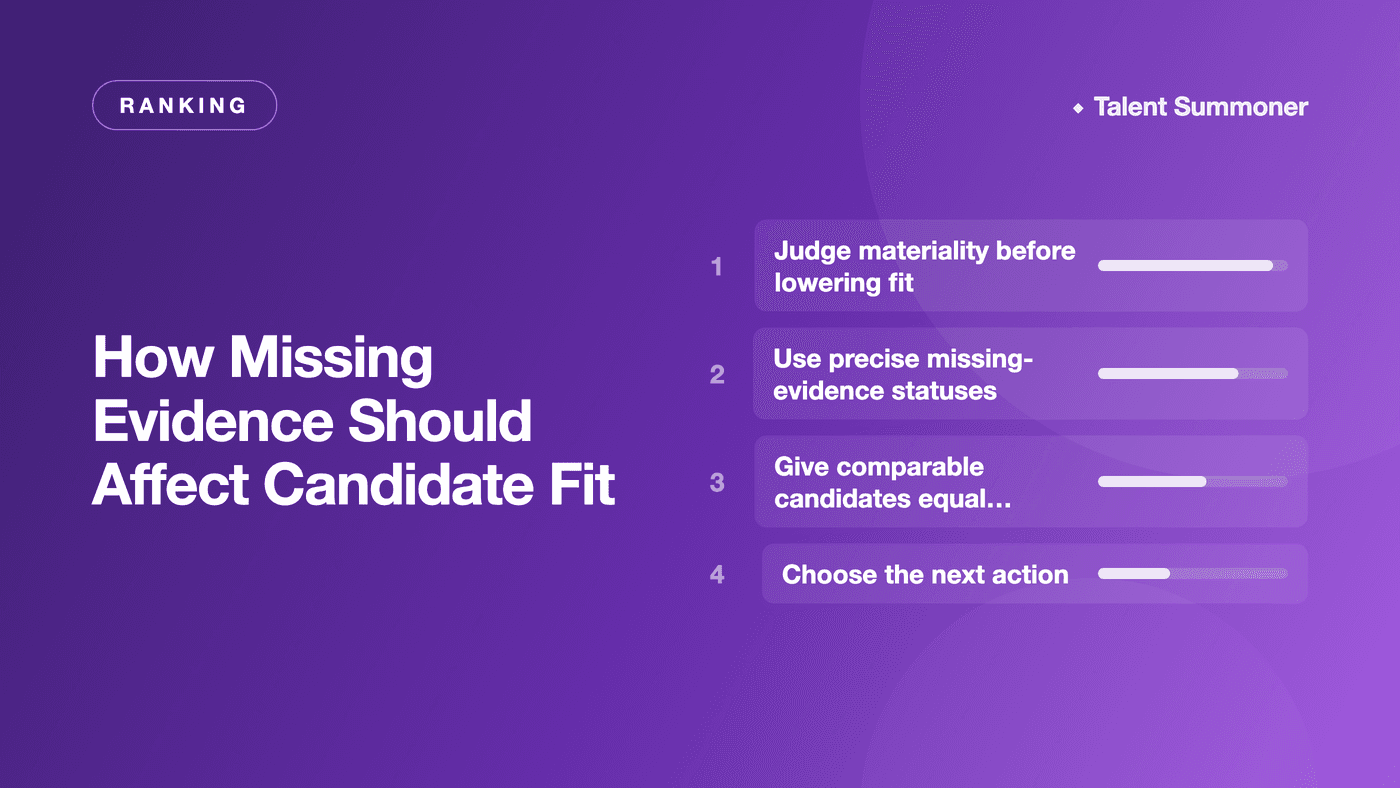
Judge materiality before lowering fit
Materiality is the likely effect of the missing fact on doing this particular job. Define it before reviewing names. A must-have tied to a core responsibility is usually material; a preferred tool or learnable detail may be less so. A working-pattern constraint matters when the role genuinely depends on it, but do not disguise a preference as a boundary.
For each criterion, write what evidence would satisfy it, what would change the decision and how it can be checked. Consider scope, recency, ownership and context. "Worked on an API migration" may support exposure while leaving ownership and production responsibility unknown. That gap matters more when the role requires owning migrations end to end.
Use precise missing-evidence statuses
Unknown means the available material does not answer the question. A CV may omit team size, project outcome or whether a skill is current. Unknown is neutral: it prompts verification, not a negative score.
Not supplied describes an item expected in the review packet but absent, such as a portfolio link, work sample or standard-question answer. It is a process state, not a claim about the candidate. Check whether everyone was asked for it and whether the omission is fixable.
Not applicable means the criterion does not apply under a defined role or candidate context. A specific platform may be irrelevant after the approved environment changes. The role owner must define the condition first; do not use this label to excuse an unmet must-have.
Contradicted means a reliable source materially conflicts with the criterion or another source. A profile may state that a candidate only accepts fully remote work while the approved role requires regular on-site work. Check dates and whether the requirement is current; ask a focused question before closure when clarification could change the result.
Genuinely absent requires the source to establish absence. Examples include a candidate confirming no production ownership or a work history stating a required qualification was not obtained. Silence in a CV is not genuine absence; do not use this label when you did not search, receive or understand the source.
Give comparable candidates equal checks
Missing evidence should affect fit only through a consistent process. Create one verification question for each material gap and offer it to comparable candidates. Keep wording and response opportunity consistent. Do not ask a favoured candidate for context while closing another for the same unknown.
Record the source, date, question, owner and answer. For a work sample, use the same task, instructions and evaluation criteria for the relevant group. Equal verification means the evidence standard is not adjusted after seeing a preferred name.
Choose the next action
Progress when material evidence supports the criterion, or a low-materiality gap can be checked at the next stage. State what will be verified and why progress is reasonable.
Verify when the criterion matters, the status is unknown or not supplied, and a targeted check could change the decision. Ask for scope and context, not just "Do you have this skill?"
Hold when evidence is decision-relevant but a real dependency remains: the brief needs clarification, evidence is pending or comparable candidates need the same opportunity. Set an owner and review date.
Close for a missing-evidence issue only when the approved requirement and evidence show material contradiction or genuine absence, or verification resolves the issue against it. Record the job-related reason. A low ranking or missing phrase alone is not enough.
Apply the framework to a ranking
Start with the frozen role brief, then inspect source text before reading a broad fit explanation. Label each must-have and important preference, separate evidence from interpretation, preserve contradictions and write the next action. Review surprising low-ranked candidates as well as top results; different wording can hide relevant experience without proving weaker fit. Candidate match confidence levels add review owners and stop conditions to those labels.
Talent Summoner is our product for AI candidate sourcing, CV ranking and outreach you confirm before it sends. The live Candidate Ranking tool, checked 3 October 2026, accepts a job description and up to 50 CVs in PDF, DOCX, MD or TXT format, requires no account and produces a ranked report with plain-English reasoning and a shareable link. Use it to organise review; it does not turn an unknown into a zero or make the decision.
When the CV pool is incomplete, candidate sourcing starts with a role description and searches LinkedIn, GitHub and other public professional sources across 200M+ profiles, returning must-haves, nice-to-haves and reasoning. Review and verify the evidence yourself. See pricing for current options.
FAQ
Should missing text reduce a candidate fit score?
Not automatically. Mark it unknown or not supplied, judge materiality and offer a consistent verification step. Treat it as absent only when a source establishes absence.
Is a contradiction the same as missing evidence?
No. Missing evidence does not answer the question; contradiction supplies materially conflicting information. Check current sources and ask a focused question before closing when clarification could matter.
Does Talent Summoner decide whether to reject someone?
No. Talent Summoner is our ranking and sourcing product. The hiring team reviews evidence, verifies gaps and owns every disposition; the tool is not an automatic rejection rule.
For one open role, list each must-have, define its evidence, label every gap and assign one human-owned next action. Revisit the assessment when new evidence or a documented brief change gives you a reason.
Related: How Feedback Improves the Next Candidate Search · Candidate Screening vs Candidate Ranking: What Is the Difference? · Candidate Ranking for Technical and Product Roles
Talent Summoner product facts read from our live candidate sourcing, candidate ranking and pricing pages, verified 3 October 2026. We re-verify this page quarterly — tell us if something changed.