 Talent Summoner
How to Build a Shortlist Without Searching Every Profile Manually
Build a focused candidate shortlist with batches, evidence thresholds, review sampling, correction loops and clear stopping rules.
 By Derek Chau · Published · Updated · in Ranking & Evaluation
A shortlist does not require a human to read every profile. It does require visible evidence and accountable stopping decisions. The goal is to reduce repetitive profile opening without turning a ranking into an automatic hiring decision.
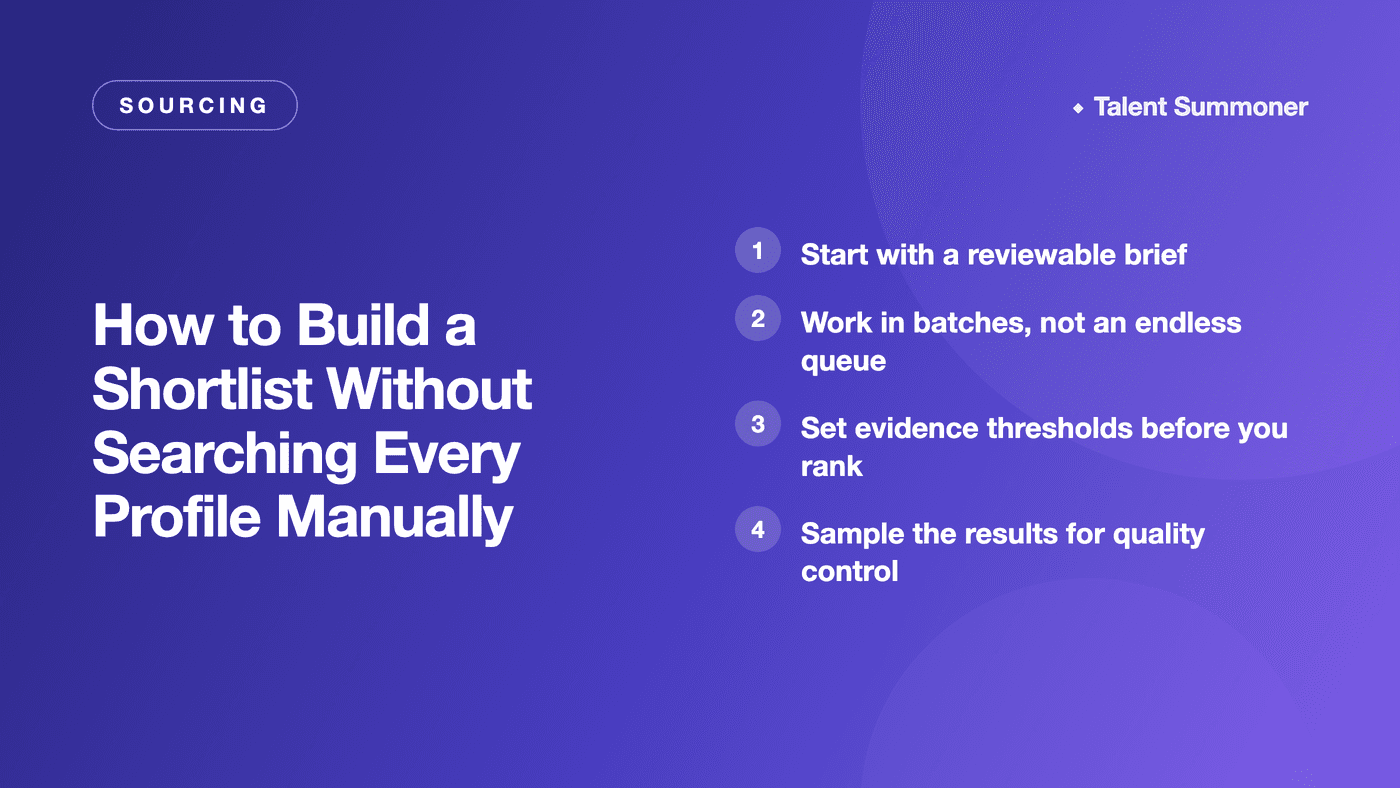
Start with a reviewable brief
Before searching, write the role as a brief with four parts: the outcome, genuine must-haves, useful preferences and boundaries. For each must-have, add supporting evidence. "Strong communication" is too vague; "led customer implementation meetings and documented decisions" gives a reviewer something to inspect.
Separate not found from not present. A public profile can omit a skill, use another title or describe work at a different level. Missing evidence should usually create a verification task, not an instant rejection. Agree which boundaries are truly non-negotiable before seeing names, so the criteria do not shift to favour a convenient result.
Work in batches, not an endless queue
Set a batch size the hiring manager can review in one sitting. As an example, a first batch might contain 15 profiles, followed by a second after feedback. This is a workflow choice, not a quality benchmark. Give each batch a purpose: test the brief, explore adjacent backgrounds, or fill an evidence gap.
For every profile, capture supporting evidence, preference signals, unknowns, the inclusion reason and the next verification question. This lets a second reviewer understand the shortlist without reopening every source, and exposes batches with repeated titles but little evidence of the required scope.
Set evidence thresholds before you rank
An evidence threshold is a review rule, not a prediction of performance. Define the minimum information needed to move a profile forward. For example, a threshold for a senior implementation role could be visible evidence of comparable ownership plus relevant customer or system context. A profile with only a matching title stays in "needs verification".
Use simple states such as supported, adjacent, unknown and contradicted. Do not hide uncertainty inside a single score. A supported must-have can justify deeper review; several nice-to-haves should not compensate for a failed hard boundary. Conversely, an unknown must-have should not be treated as contradicted merely because the profile is brief.
Sample the results for quality control
Reviewing only the first-ranked profiles can hide errors. After each batch, sample high-ranked, borderline and surprising results. You can also sample excluded profiles when available. Label the sample with the same evidence states and record the reason for each correction.
The purpose is not to calculate an accuracy percentage. Ask whether the ordering helps the team investigate sensible candidates and whether adjacent backgrounds are missed. Look for an overweighted title, an overconfident location inference, a preference treated as a must-have, or a relevant project missed because its employer used different language.
Correct one thing at a time
When a batch is weak, change one input before searching again. You might remove an unnecessary degree requirement, add an adjacent title, clarify seniority evidence or strengthen a genuine boundary. Record the change and compare the next batch with the previous one.
If several criteria change together, you will not know which correction helped. Keep a short log of the original rule, observed error, correction and result. Feedback should improve the next search, not become an unexplained manual override.
Use stopping rules that protect judgement
Stop expanding when the process reaches its agreed purpose, not when a ranking looks reassuring. An example stopping rule might require a labelled set ready for verification, every must-have covered by evidence or a named question, and no unresolved correction that would materially change the search. This is a workflow example, not a universal number.
Pause and revise the brief when batches repeat weak evidence, the role boundary is unclear, or the hiring manager cannot explain why candidates are relevant. Continue searching when a must-have has no credible evidence, the sample reveals a recurring false positive, or a newly approved adjacent background has not been tested.
Where a sourcing tool fits
Talent Summoner is our product for AI candidate sourcing, CV ranking and outreach you confirm before it sends. Its candidate-sourcing tool, checked 3 October 2026, starts with a role brief and searches LinkedIn, GitHub and other public professional sources across 200M+ profiles. It returns a ranked shortlist with plain-English reasoning, helping a team organise review into batches.
If you already have an applicant pile, the free candidate-ranking tool accepts up to 50 CVs in PDF, DOCX, MD or TXT format and creates a shareable report, according to the live page checked the same date. Current pricing lists per-Role and monthly options; recheck that page before purchase because terms can change.
The tool can prioritise research; it cannot verify every claim, guarantee fit or replace human review. Your team owns the brief, corrections, outreach, interviews and hiring decision. It is not an ATS, so keep application records elsewhere.
Bottom line
Build the shortlist in purposeful batches, define evidence states, sample beyond the top few, correct one rule at a time and stop against an explicit review rule. Start a sourcing search with one real brief, then ask the role owner to inspect the evidence and sign off the next step.
FAQ
Should I reject a profile when a must-have is not shown?
Not automatically. Mark it unknown when public evidence is incomplete, then decide whether verification is worthwhile. Reject when a genuine boundary is contradicted or the agreed evidence standard is not met after review.
Why sample lower-ranked profiles?
Sampling borderline and surprising results can reveal missed adjacent backgrounds, over-weighted titles or unjustified assumptions. It checks the criteria; it does not prove ranking accuracy.
When should I stop searching?
Stop when the shortlist purpose is met, must-haves are covered by evidence or verification questions, and no material correction remains unresolved. Revise the brief when repeated batches expose the same gap.
Can Talent Summoner replace manual candidate review?
No. Talent Summoner is our sourcing and ranking product. It can organise discovery and show reasoning, but people must check evidence, choose outreach, run interviews and decide. Teams with existing CVs can use the candidate-ranking tool.
Related: How Small Hiring Teams Choose Between Sourcing Options · How AI Turns a Job Description into a Sourcing Plan · Candidate Sourcing Workflow: Brief, Search, Rank and Review
Talent Summoner product facts read from our live candidate sourcing, candidate ranking and pricing pages, verified 3 October 2026. We re-verify this page quarterly — tell us if something changed.