 Talent Summoner
How to Compare Two Candidate Profiles Fairly
Compare two candidate profiles with the same job-related criteria, evidence standards and structured questions while keeping unknowns visible.
 By Nicholas Yan · Published · Updated · in Ranking & Evaluation
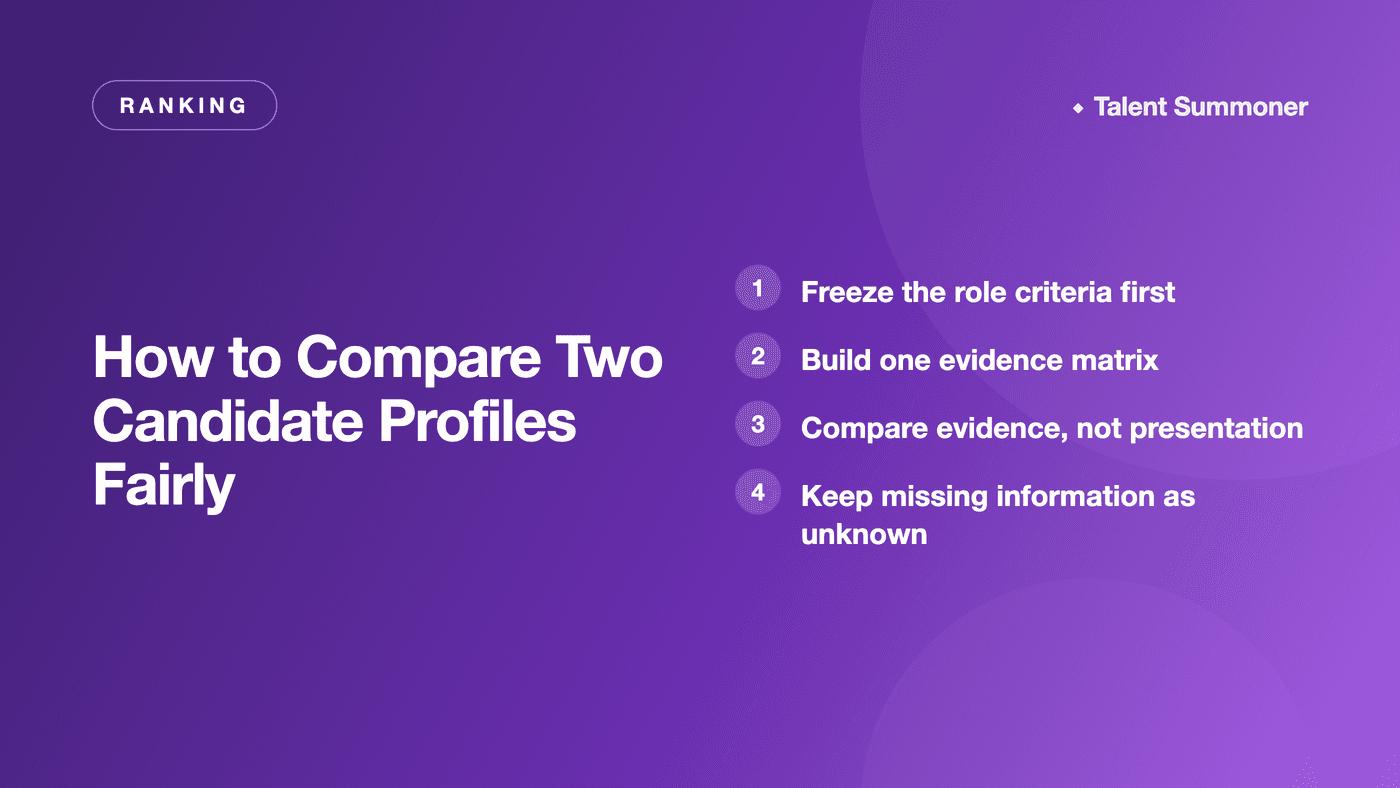
Comparing two candidate profiles fairly starts before you read either name. Use the same job-related requirements, ask what evidence would satisfy each one and give both people the same opportunity to clarify material gaps. Consistency makes reasoning easier to inspect, but it does not guarantee fairness or remove bias.
1. Freeze the role criteria first
Write the role requirements in plain language before opening the profiles. Separate must-haves, nice-to-haves and genuine boundaries such as an agreed working pattern. For each must-have, define acceptable evidence and context.
Also record acceptable equivalents. A different industry or adjacent technology may be acceptable when scope or underlying capability transfers. Decide that in advance. Do not add a new criterion because one profile happens to make it look attractive. For an internal candidate moving into a new role, a candidate fit review for internal mobility maps what transfers from the current job.
Keep criteria tied to the work. A familiar title, prestigious employer or preferred career path is not automatically evidence of capability. Do not use demographic traits or proxies for them in the comparison.
2. Build one evidence matrix
Use one row for every requirement and fill both columns using the same standard. A simple matrix can look like this:
| Requirement | Profile A | Profile B | Same next question |
|---|---|---|---|
| Owned production API migration | Source, context and status | Source, context and status | What did you personally own? |
| Worked with the agreed schedule | Evidence or unknown | Evidence or unknown | Which schedule can you commit to? |
| Payments experience | Direct or adjacent evidence | Direct or adjacent evidence | Which payments problem did you solve? |
Keep the original passage and add a short interpretation: what does it establish, and what does it merely suggest? Apply that reading whichever profile contains it.
3. Compare evidence, not presentation
Profile quality is not the same as job fit. One CV may be polished and detailed while another is brief but accurate. Read beyond formatting, length, job titles and keyword density. Look for scope, ownership, recency, context and outcomes that the source actually supports.
"Migrated services to Kubernetes" indicates migration exposure. It does not establish ownership, production scope or the result. Record those limits for both profiles. If one person provides a portfolio and the other does not, note the difference in available evidence rather than assuming the second person lacks the capability.
4. Keep missing information as unknown
Use a small status vocabulary: supported, adjacent, contradicted and unknown. Supported means the source directly addresses the requirement. Adjacent means it may transfer but needs checking. Contradicted means reliable information conflicts with the criterion. Unknown means the available material does not answer the question.
Unknown is not a low score and is not proof of absence. Do not penalise omissions such as project scale, ownership, availability or different technology wording. Write the missing fact and why it matters. If sources are too different to compare, say that the profiles are currently incomparable and use the same follow-up process for both.
5. Ask the same structured questions
Use one neutral question for a material gap in both profiles, with the same context and evaluation standard. "What part of the payments migration did you personally own, which services were in scope, and how was the work operated in production?" is more useful than "Tell me about your experience."
Ask for comparable detail: situation, responsibility, action and result. Record the answer against the criterion and note whether the status changed. If the role requires a work sample, give both candidates the same brief, time limit and assessment criteria unless there is a documented job-related reason to adjust the process.
6. Handle differences and ties deliberately
Do not force a ranking when the evidence is equivalent or incomplete. A tie can lead to the same next stage, a targeted verification question or a work sample. A narrow score difference is not meaningful unless the evidence supports it.
When sources conflict, record both sides and investigate dates, scope and wording. Do not silently choose the interpretation that favours the preferred profile. If a requirement changes, record the change and reassess both profiles against the new version.
7. Keep the decision human-owned
A comparison can organise attention, but a person must decide what evidence is sufficient, what uncertainty is acceptable and what action follows. Record a job-related reason for each disposition, such as progress, verify, hold or close. Do not make an automatic rejection from a rank, score or missing field.
Talent Summoner is our product for AI candidate sourcing, CV ranking and outreach you confirm before it sends. The Candidate Ranking tool, checked 19 August 2026, accepts up to 50 CVs in PDF, DOCX, MD or TXT format, requires no account and creates a shareable report with plain-English reasoning. Use the same job description, inspect the sources and verify unknowns yourself. When the CV pool is incomplete, candidate sourcing starts from a role brief and searches LinkedIn, GitHub and other public professional sources across 200M+ profiles. See pricing for current sourcing options. Talent Summoner supports review; it does not make the hiring decision.
FAQ
Does a consistent comparison guarantee a fair outcome?
No. Applying the same criteria can make reasoning more consistent and easier to review, but it cannot guarantee fairness or remove bias. Keep the criteria job-related and invite accountable human review.
Is missing profile information evidence that a candidate lacks a skill?
No. Mark the requirement unknown, explain why it matters and ask the same structured question of comparable candidates. Missing evidence and negative evidence are different.
Should I rank two candidates when their evidence is tied?
No. Preserve the tie and use a consistent next step, such as the same work sample or verification question. Do not invent precision that the evidence cannot support.
Can Talent Summoner decide which candidate to hire?
No. Its ranking report helps organise evidence against a supplied role brief. Your hiring team reviews the sources, checks material facts and owns the progression or closing decision.
For the next open role, freeze the criteria, complete one matrix for both profiles and give each person the same questions before recording a human-owned next action.
Related: How Missing Evidence Should Affect Candidate Fit · How Feedback Improves the Next Candidate Search · Candidate Screening vs Candidate Ranking: What Is the Difference?
Talent Summoner product facts read from our live candidate sourcing, candidate ranking and pricing pages, verified 3 October 2026. We re-verify this page quarterly — tell us if something changed.