Talent Summoner
How to Handle Missing Salary or Location Evidence
A practical handoff for reviewing missing salary and location evidence separately, recording uncertainty and assigning a consistent verification step.
Missing salary or location information can make a close shortlist feel easier to order than it really is. A profile may say nothing about compensation expectations, working location or schedule. That silence does not establish that the candidate is too expensive, unavailable or unsuitable.
Use a separate record for compensation and location, then hand each unresolved item to the person who can verify it. This plan-stage guide is narrower than a general missing-evidence framework: the aim is to make these two practical fields explicit without letting either one distort job-fit evidence.
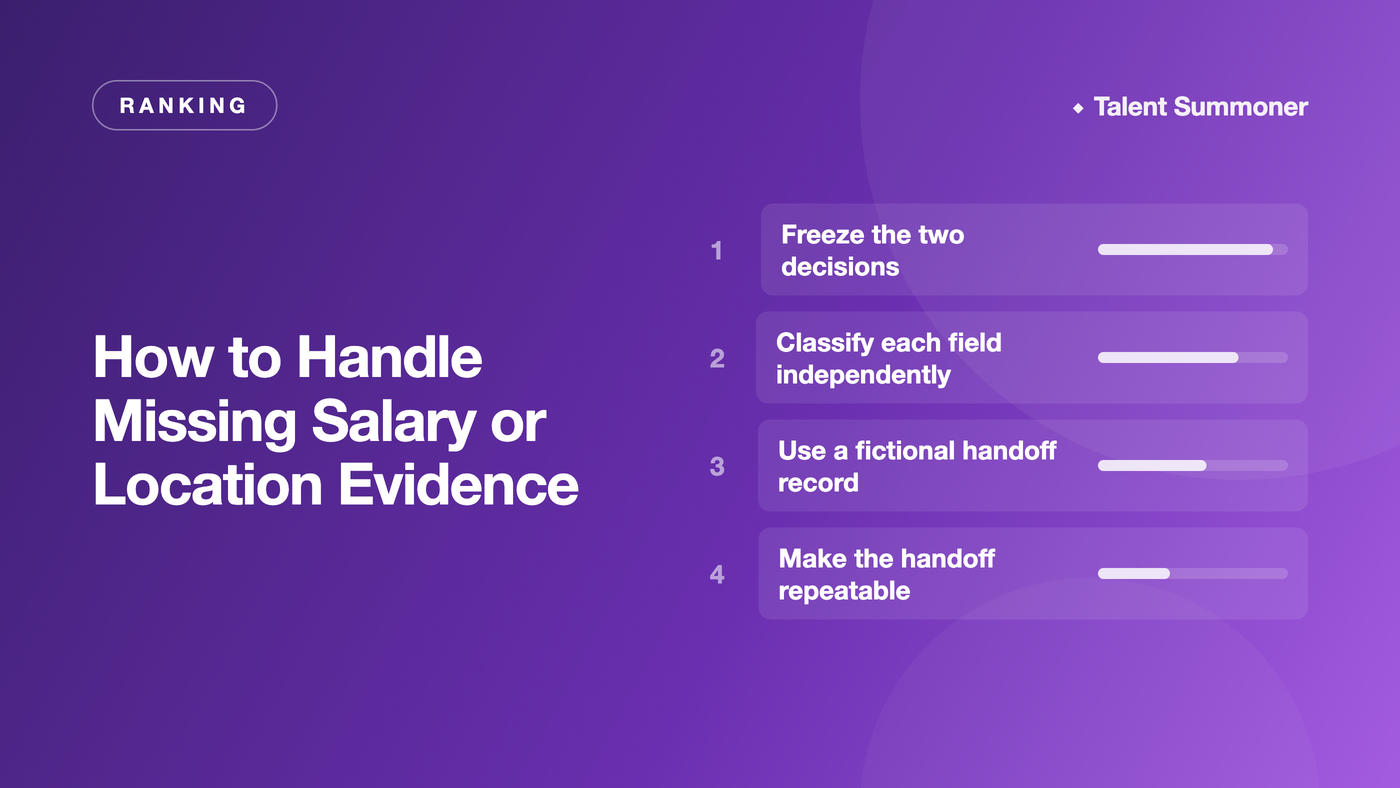
Freeze the two decisions
Start with the approved role brief and write what the team actually needs to decide. For compensation, record the approved range or compensation policy, currency and pay period if defined internally. State whether variable pay, equity or flexibility is part of the decision. Do not fill an undisclosed range with a market estimate or a candidate's current pay.
For location, define the work arrangement in operational terms: the approved city or country, remote or on-site expectation, required time-zone overlap, and any travel or office cadence that genuinely matters. Keep work authorisation separate unless the role brief explicitly makes it part of the approved boundary. A location label alone does not establish a person's current location or ability to meet a schedule.
Write the evidence standard before reopening names. For example, "candidate-stated range after the approved first conversation" is a compensation evidence rule; "candidate confirms they can work from the approved location and schedule" is a location rule. These are local process examples.
Classify each field independently
Do not collapse salary and location into one fit judgement. Label each field using a small vocabulary:
| Status | What it means | Next action |
|---|---|---|
| Supported | The available source directly answers the field against the approved requirement. | Preserve the source and check ordinary details. |
| Conflicting | A reliable, relevant source appears inconsistent with the approved boundary or another source. | Check dates and assign a focused human clarification. |
| Unknown | The material does not answer the field. | Record the missing fact and a comparable question. |
| Ambiguous | The field is mentioned but lacks a necessary qualifier, such as currency, city or schedule. | Ask for the missing qualifier before drawing a conclusion. |
| Not applicable | The approved role brief says the field does not affect this role. | Keep the reason visible; do not use this label to avoid a real constraint. |
"Unknown" is not "outside the range", and "ambiguous" is not "conflicting". A profile that lists "remote" may still leave time zone, travel or employment location unclear. A compensation figure without currency or pay period may need clarification. Keep the source wording beside your interpretation so a reviewer can see exactly what was established.
Use a fictional handoff record
These synthetic examples show how a recruiter can separate fields for three close candidates without inventing salary figures or location assumptions:
| Candidate | Salary evidence | Location evidence | Handoff |
|---|---|---|---|
| A | Unknown: the CV gives no expectation. | Supported for the stated city; schedule is not stated. | Recruiter asks the approved compensation and schedule questions. |
| B | Ambiguous: expectation is mentioned without currency or pay period. | Unknown: no current work location is supplied. | Recruiter requests qualifiers and records the capture date. |
| C | Supported against the approved internal range. | Conflicting: the source states a different working arrangement from the role brief. | Hiring owner confirms whether the boundary is genuinely non-negotiable. |
Do not rank Candidate A below Candidate C merely because A has less compensation detail. Salary evidence is not job-skill evidence. Likewise, do not treat Candidate B's missing location as proof that the person cannot work in the role.
Make the handoff repeatable
Give every unresolved field the same record shape:
Role and brief version:
Candidate and source:
Field: salary / location
Source wording and capture date:
Status: supported / conflicting / unknown / ambiguous / not applicable
What the source establishes:
What remains unresolved:
Comparable verification question:
Owner and stop condition:
Action: progress / verify / hold / revise / close
The recruiter can own a neutral first check, while the hiring owner decides whether a confirmed conflict is material. If the brief is unclear, hold the shortlist and ask the owner to define the boundary. If the requirement changes, version the brief and apply it to every comparable candidate.
Ask the same relevant question at the same process point. A compensation question can request the range the candidate would consider, with the agreed currency and pay period. A location question can ask where the person would work from and whether they can meet the approved arrangement and schedule. Avoid personal reasons that are not needed for the decision. Record the answer, date and owner, and stop when it is answered or escalated.
Close only for a confirmed, job-related conflict with an approved boundary, or for a genuine absence established by verification. If evidence remains unknown, use verify or hold rather than automatic rejection. If two candidates remain indistinguishable after the same check, preserve the tie and send the same next step forward.
Where Talent Summoner fits
Talent Summoner is our product. Its current Candidate Ranking tool, checked 2 September 2026, accepts a pasted or uploaded job description and up to 50 CVs in PDF, DOCX, MD or TXT format. It returns a ranked shortlist against supplied requirements with must-haves, nice-to-haves and plain-English reasoning. Use it to organise reading, then maintain salary and location verification in the human-owned handoff. A rank cannot establish a candidate's expectations, current location or schedule.
When the supplied CV pool is too small, candidate sourcing, checked 2 September 2026, starts from a role brief and searches LinkedIn, GitHub and other public professional sources across 200M+ profiles, returning ranked results against stated criteria. A public profile is a discovery lead, not proof of compensation expectations or working-location fit. Keep the same approved fields and questions after discovery.
Does missing salary evidence mean the candidate is unaffordable?
No. It means the available material does not answer the compensation question. Mark it unknown, use the approved question and record the response before treating a confirmed conflict as material.
Should salary and location be one ranking criterion?
Keep them separate. They answer different operational questions and may have different owners and evidence sources. Combine them only if the approved brief defines one explicit boundary and the team can explain how it will be checked consistently.
Can a CV prove that someone is available for a location or schedule?
Not by itself. A CV or public profile may state a place or working pattern, but the team should verify the requirement through its approved process and record what remains unknown.
Can Talent Summoner infer missing salary or location evidence?
No. Our product ranks supplied CVs or discovers public-source profiles against a role brief. Your team decides what evidence is sufficient, asks follow-up questions and owns progression, holding or closing.
What if the salary or location requirement changes during review?
Record a new brief version, explain the change and reassess comparable candidates against it. Do not edit one candidate's status without reviewing the affected shortlist.
For the next close shortlist, freeze the salary and location fields, complete one handoff record per unresolved item and assign an owner and stop condition. Then use candidate ranking for supplied CVs or candidate sourcing for an approved discovery pass, keeping the final action with the hiring team.