Talent Summoner
Evidence Matrix for Comparing Finalists
Build an evidence matrix that compares finalists against the same criteria, keeps unknowns visible and assigns the next human-owned check.
An evidence matrix for comparing finalists is a side-by-side review record. Put approved role criteria in rows, finalists in columns, and source-backed evidence in each cell. It makes gaps and follow-up work visible. It is not an automatic verdict, a prediction of performance or a reason to reduce a person to one score.
Unlike a shortlist, read across each criterion to apply one evidence standard to every finalist.
Use the matrix at the finalist stage, when the group is small enough for careful comparison. Keep it separate from the original ranking output: a ranking can help focus attention, while the matrix records what the team can support for each decision-changing criterion.
Set the boundary before comparing names
Create a header before anyone edits a cell. Record the role, approved brief version, review date, decision owner and finalists in scope. Note permitted sources and access. If the brief changes, start a new matrix version rather than silently changing the question halfway through.
Turn the brief into material rows. Label each as a must-have, nice-to-have or operating boundary. Define useful evidence and what needs verification. A requirement such as "owns production API migrations" needs a different check from "has experience in a related domain". This is an example criterion, not a claim about a real candidate.
Do not add a row because one finalist has an appealing background. Apply every material criterion to everyone, and keep preferences from quietly outweighing an unproven must-have.
Give every cell the same evidence shape
Each finalist cell should be compact but traceable. Include a status, short source passage or reference, interpretation, and unknown or next check. Record source and capture date when available. Keep source wording distinct from interpretation; a title or keyword does not establish ownership, scale, recency or results.
Use plain labels that help the reviewer act:
| Status | Use it when | Next move |
|---|---|---|
| Supported | The available material directly addresses the criterion with enough context. | Keep the source visible and confirm any ordinary detail. |
| Adjacent | The evidence is relevant but a bridge to the requirement still needs checking. | Ask a focused, comparable question. |
| Unknown | The material does not answer the criterion. | Name the missing fact and an owner to verify it. |
| Contradicted | Material sources conflict on a decision-relevant point. | Preserve both traces and assign a human review. |
These are working labels, not validated ratings. Do not turn "unknown" into "no", or "supported" into a promise about future work. If a source is inaccessible or undated, record that limitation rather than filling the gap with an assumption.
Compare across each row
Read the matrix horizontally. Ask what the same criterion establishes for each finalist, where evidence differs and which uncertainty could change the next step. Use comparable questions or work samples for comparable gaps. A longer CV may look fuller without proving more, so keep the evidence standard constant.
Keep the interpretation close to the source. "Describes leading a migration" is narrower than "can lead a migration at our scale". If the latter is required, write the missing scope and ask for it. Where sources disagree, show both traces and let the accountable reviewer resolve the conflict. Retain a change note instead of overwriting the earlier interpretation.
If a ranking report is an input, review the matrix against the brief rather than copying its order into a decision. A close order prompts evidence review; it does not prove one finalist is better. Where material does not justify a distinction, preserve the uncertainty and use the same verification route for relevant finalists.
Troubleshoot a broken matrix
Common failures include:
- Rows changed during review: freeze the version, record approval and re-check every finalist against the new criterion.
- One column has conclusions and another has quotations: separate source, interpretation and unknown fields, then use the same shape.
- A preference hides a missing must-have: move the must-have into its own row and document the decision owner for any exception.
- Unknowns are rejection reasons: replace the conclusion with a focused question, owner and stop condition.
- A contradiction is averaged away: keep both traces and record the human resolution instead of a blended score.
Before hand-off, check that every material row has an owner, every cell has a source or explicit unknown, and every action has a job-related reason. Actions are progress, verify, hold, revise or close. "Close" needs a requirement-based reason; rank alone is not an explanation.
Copy-ready review sequence
Use this sequence in the matrix header or team hand-off:
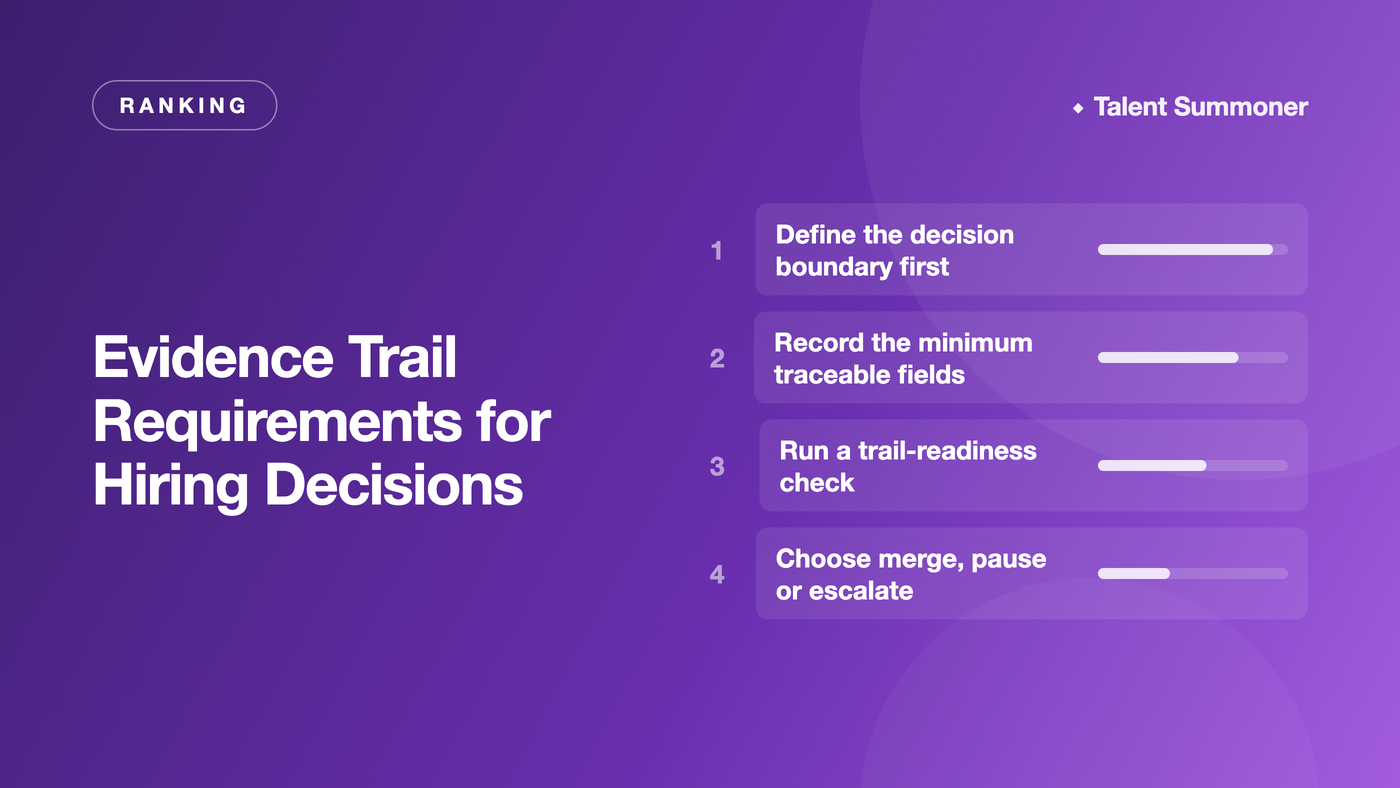
1. Confirm role brief version, criteria and finalists in scope.
2. Define the evidence standard for every material row.
3. Add one source trace and one interpretation per finalist cell.
4. Label supported, adjacent, unknown or contradicted status.
5. Compare each row with the same question for every finalist.
6. Assign an owner, check and stop condition for each material gap.
7. Record the proposed action, reason, reviewer and date.
8. Preserve the matrix version and source history before sharing.
This is a review aid, not a downloadable file or automatic decision rule. Limit access to people involved and retain only information your process requires.
Where Talent Summoner fits
Talent Summoner is our product. Its current Candidate Ranking tool, checked on 2 September 2026, accepts a pasted or uploaded job description and up to 50 CVs in PDF, DOCX, MD or TXT format. It returns a ranked shortlist with plain-English reasoning; the report can be shared by link or downloaded as a PDF without an account. Use it as matrix input, then inspect sources and record your criteria, unknowns and next actions separately.
When the supplied pool is too small, candidate sourcing, checked 2 September 2026, is the separate discovery route. See pricing for current options. Talent Summoner organises ranking and discovery; your team verifies evidence, conducts follow-up and owns the decision.
What should go in an evidence matrix?
Include approved criteria, each finalist, source traces, interpretations, status labels, unknowns, verification owners and the next action. Keep the brief version and review date visible.
Should an evidence matrix have one total score?
Not by default. A total can hide an unknown must-have or let a preference compensate for a material gap. Compare criteria directly and document any scoring method separately.
Is unknown the same as a failed requirement?
No. Unknown means the material does not answer the question. Record what needs checking and apply a comparable verification step.
How do I handle conflicting evidence?
Keep both traces, note relevant dates and assign a reviewer. Do not average contradictory evidence or close a finalist automatically.
Can Talent Summoner create the evidence matrix?
The current product provides ranking output and shareable reports. Your team builds the criterion-level comparison, verifies source context and owns follow-up and hiring decisions.
For the next finalist review, freeze the brief, copy its criteria into rows and complete one source-backed cell per person. Name an owner and stop condition for every material unknown before choosing whether to progress, verify, hold, revise or close.