Talent Summoner
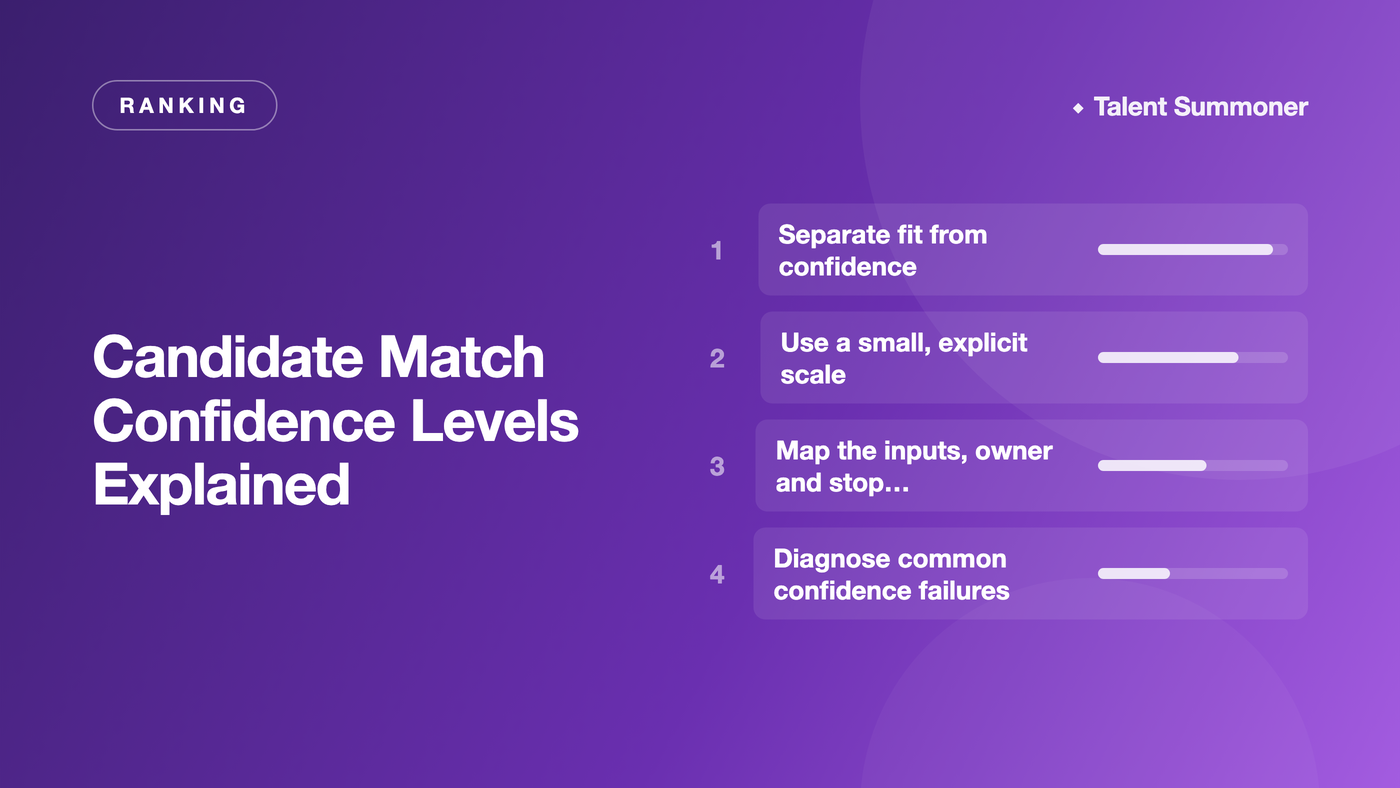
Candidate Match Confidence Levels Explained
A practical guide to candidate match confidence levels: separate evidence strength from fit, assign review owners and set stop conditions.
Candidate match confidence describes how strongly available evidence supports an interpretation of a candidate against one role requirement. It is a review signal, not a probability of hiring success.
The distinction matters because a candidate can match one criterion strongly and have weak evidence for another. Use confidence to organise verification, while keeping the final decision with the people responsible for the role.
Separate fit from confidence
Fit asks, "How closely does the evidence relate to this requirement?" Confidence asks, "How securely can we support that reading from the source we have?" They are related but not interchangeable.
For example, a CV saying that a candidate owned a production API migration may be a strong match with high confidence if scope and context are clear. A statement that a candidate "worked with modern systems" may be relevant to a broad preference, but confidence in the precise interpretation is low. Neither is a measurement of job performance, motivation or likely acceptance.
Do not treat a confidence label as a universal vendor metric. Define each level, record the reason and apply the same definitions to comparable candidates. Confidence describes the evidence-to-criterion reading, not the worth of a person.
Use a small, explicit scale
A four-level scale is enough for many shortlist reviews. The labels below are a team framework, not a claim that every matching product uses them.
| Level | What the evidence supports | Appropriate next action |
|---|---|---|
| High | A specific, relevant source clearly addresses the criterion, with enough context and ownership to explain the match. | Treat the criterion as supported; confirm an ordinary detail if needed and keep the source visible. |
| Medium | The source is relevant, but one material detail is unclear, or the evidence is adjacent rather than direct. | Assign a targeted verification question to an owner. |
| Low | The interpretation depends on vague wording, stale context, an indirect signal or several inferences. | Hold the criterion open; inspect the source or seek clarification before relying on it. |
| Unknown | No usable evidence answers the criterion, or the source cannot currently be checked. | Record the gap as unknown and assign a way to verify it. |
No universal date makes a source current, and detail alone does not justify a high label. Consider specificity, relevance, context, ownership, role-appropriate recency and contradictions. Record one reason so another reviewer can challenge it.
Map the inputs, owner and stop condition
Attach confidence to a repeatable record. For each material requirement, capture:
- The requirement: quote the approved role brief and label it must-have, nice-to-have or boundary.
- The source: preserve the CV passage, project description or permitted professional-profile detail, with its source and date where relevant.
- The interpretation: explain what the source establishes and what it merely suggests.
- The status: use a precise label such as supported, adjacent, contradicted or unknown.
- The confidence and reason: state the level and the evidence limitation that led to it.
- The next action: name the question, owner and stop condition for resolving the uncertainty.
The owner might be the recruiter, role owner or another designated reviewer. A stop condition prevents an open-ended search for reassurance. For example: "Recruiter asks both finalists for the same production-ownership example; role owner reviews the answers before progression." If the source is inaccessible, mark the criterion unknown until evidence is available. Do not convert an unresolved gap into a lower score or rejection.
Diagnose common confidence failures
High confidence from a thin source means the interpretation has outrun the evidence. Remove assumptions about scale, seniority, results or ownership, then relabel the criterion. A strong verb is not enough to establish every detail.
Low confidence caused by wording variation may be a search or reading problem. Check equivalent terms, adjacent responsibilities and project context using the same standard elsewhere. Do not demand one preferred job title when the requirement is observable work.
One broad confidence label hiding mixed evidence makes a close shortlist difficult to compare. Split the role into material criteria and label each one. A candidate may be supported for a core capability, adjacent for an industry preference and unknown for a working-pattern boundary. Address the decision-changing item, not the average impression.
Apply it when scores are close
Freeze the brief before comparing names. Review each candidate against the same criteria, inspect the source and keep unknowns visible. Compare confidence reasons, not just report order.
If two candidates are close, preserve the tie when evidence does not justify a distinction. Offer the same focused question or work sample to both when relevant. If one criterion is decisive, record why it is required and who approved that boundary. A narrow numeric difference is not certainty.
Where Talent Summoner fits
Talent Summoner is our product. Its current Candidate Ranking tool, checked on 2 September 2026, accepts a job description and up to 50 CVs in PDF, DOCX, MD or TXT format, requires no account and produces a ranked shortlist with plain-English reasoning and a shareable report. The page describes candidates as scored against supplied requirements, but does not document a universal confidence scale or dedicated confidence field. Record your team's confidence reason separately.
When the CV pool is too small, candidate sourcing starts from a role brief and searches LinkedIn, GitHub and other public professional sources. It returns a ranked shortlist with must-haves, nice-to-haves and reasoning. Your team checks evidence, asks the follow-up question and owns the decision.
Is confidence the same as a candidate fit score?
No. Fit describes how the available evidence relates to a requirement; confidence describes how securely that interpretation is supported. A close match can still have low confidence when context or ownership is missing.
Does high confidence mean the candidate will perform well?
No. It means the supplied source clearly supports the interpretation recorded for that criterion. It does not predict performance, motivation, interview results or hiring success.
How many confidence levels should a team use?
There is no required number. Use a small scale reviewers can apply consistently, define each label and record the reason. Four levels, including unknown, are a practical starting point.
Should an unknown criterion automatically lower a candidate's rank?
Not automatically. Judge materiality, apply the same check to comparable candidates and assign an owner. Unknown evidence is not proof that the candidate lacks the capability.
Does Talent Summoner show candidate match confidence levels?
Its current ranking page documents scored requirements, plain-English reasoning and shareable reports. It does not publicly document a universal confidence scale, so do not infer one from rank or wording. Keep your definition in the review record.
For the next close shortlist, copy the role requirements into a criterion-level table, label each match and confidence reason, then assign one owner and stop condition before choosing the next human-owned action.