Talent Summoner
Separating Eligibility from Job Fit
A worked guide for internal-mobility reviews that separates eligibility gates from job-fit evidence and assigns a clear next action.
Eligibility and job fit answer different questions. Eligibility asks whether a person may be considered under an approved rule or operating boundary. Job fit asks how the available evidence relates to the work the role requires. Combining them into one impression makes internal-mobility reviews difficult to explain: a candidate may be eligible but need more evidence of a capability, or show relevant capability while an eligibility question remains unresolved.
For an internal-mobility lead, the practical goal is to keep these lanes separate until a human decision owner can bring them together. Eligibility is not a measure of merit, and fit is not permission to bypass an approved prerequisite. This guide uses an illustrative review record, not a universal policy or a benchmark.
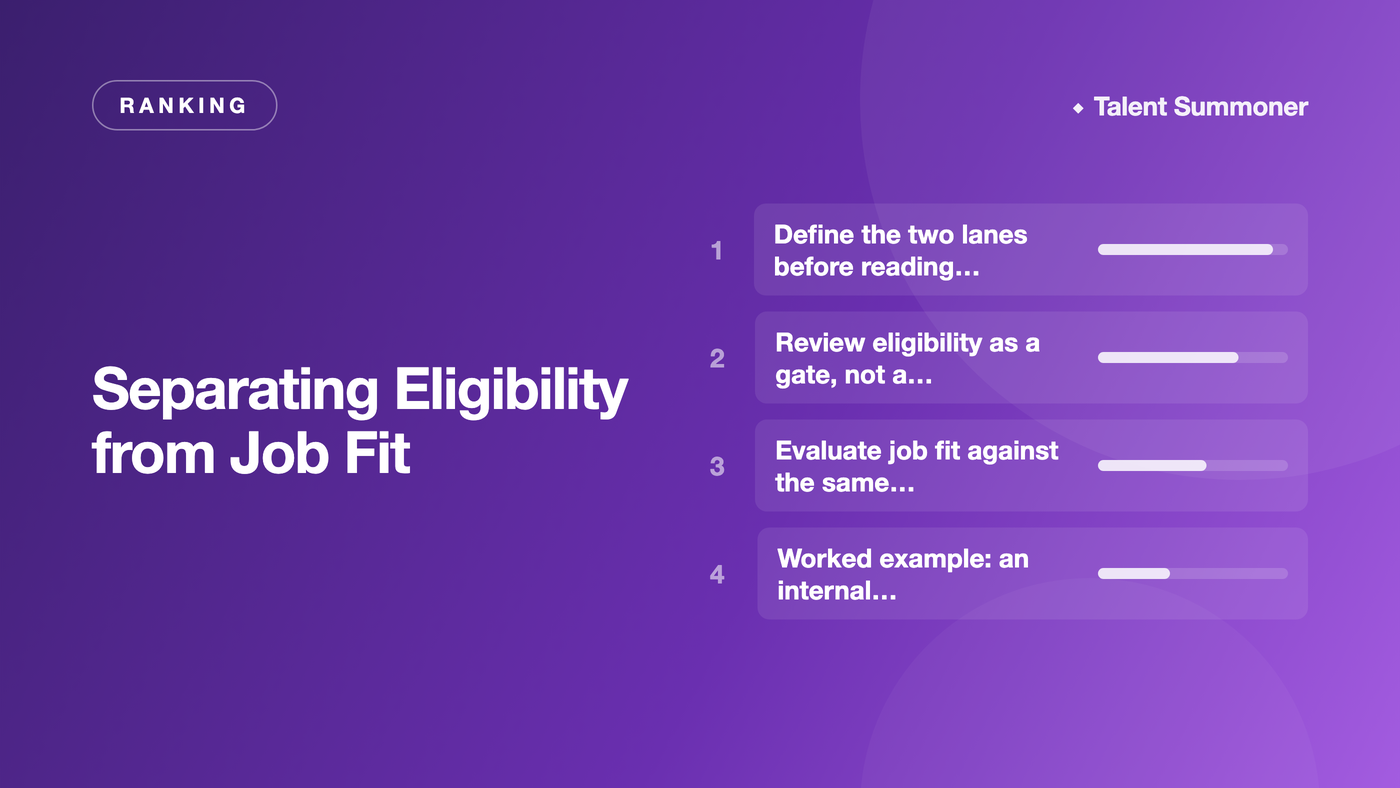
Define the two lanes before reading names
Write the eligibility rule and its owner first. The rule might come from an internal mobility policy, an approved working arrangement or another documented condition for the role. Use the exact policy language and record its version or review date. Do not infer eligibility from tenure, a reporting line, a profile, a job title or a manager's informal comment. If the question concerns employment status, work authorisation, location or another regulated condition, route it to the responsible HR, legal or qualified local adviser. This is general process guidance, not legal advice.
Then write the fit criteria in terms of work. Separate must-haves, nice-to-haves and genuine job-related boundaries. For each criterion, state what evidence could support it and what remains unknown. "Already knows the company" is not a fit criterion. "Can coordinate a cross-team implementation and explain trade-offs to affected users" is reviewable if the role actually requires that work.
Do not let the fit discussion silently rewrite eligibility. Likewise, do not use a failed or unverified eligibility gate as a reason to describe someone as a poor fit. Keep one record for each lane and a named owner for any hand-off.
Review eligibility as a gate, not a score
Start with the smallest check that can establish the approved condition. Mark the result confirmed, not confirmed, not met or not applicable only when those labels have been defined by the policy owner. If the source is missing or the rule is ambiguous, use unknown and assign the owner; do not turn silence into a negative finding.
Eligibility records should contain the rule, the permitted source, the date checked, the result and the next action. A CV may identify the person and describe work, but it is not automatically the authoritative source for an internal policy or authorisation decision. Limit access to sensitive material according to your organisation's process, and do not circulate more personal information than the check needs.
The gate can be decisive for process progression, but it should not change the fit description. "Fit evidence supported; eligibility verification pending" is more useful than a blended label such as "medium potential". It tells the decision owner exactly what is known and what must happen next.
Evaluate job fit against the same brief
Once the criteria are frozen, review the candidate's work evidence criterion by criterion. Record the source, its narrow interpretation and the status supported, adjacent, unknown or contradicted, using definitions your team can apply consistently. A current internal title can help locate an example, but it does not establish ownership, scope, quality or readiness for a different role.
Keep development potential separate from present evidence. An internal candidate may be eligible to apply and have adjacent experience that could be developed. That can justify a focused conversation, work sample or training plan; it should not be silently counted as proof of a must-have. Apply the same evidence standard to external candidates when they are in the same selection process.
Worked example: an internal implementation move
The following is an illustrative record for an operations coordinator applying to an implementation lead role. The organisation's policy owner has defined eligibility separately from the role brief.
| Review item | Lane | Available evidence | Status and next action |
|---|---|---|---|
| The person may enter this internal-mobility process under the current policy. | Eligibility | The policy owner's application record, not the CV. | Unknown until the owner checks the current rule; do not ask the hiring panel to infer it. |
| Coordinate a customer-facing implementation across teams. | Fit, must-have | A project description names coordination and a launch, but does not state the person’s decisions or scope. | Adjacent; ask the same focused ownership question used for comparable candidates. |
| Explain operational trade-offs and manage follow-up work. | Fit, must-have | A documented process change describes stakeholders and follow-up tasks, with the candidate’s contribution identified. | Supported for the described activity; verify the context that matters to this role. |
| Familiarity with the company's implementation software. | Fit, nice-to-have | The candidate uses a related internal tool. | Adjacent; keep it out of the must-have gate unless the role owner approves a change. |
The record produces two different next actions. The policy owner checks eligibility. The role owner reviews the ownership question and decides whether a comparable work sample is needed. Neither action changes the other lane’s labels. If eligibility is confirmed and the fit gap remains material, the candidate can be marked verify rather than rejected for an untested assumption. If eligibility is not met under the approved rule, record that process outcome without rewriting the fit evidence.
Close the review with a bounded hand-off
Before discussing overall order, read back the eligibility result, fit statuses, unresolved contradictions and decision owner. Use one current disposition: progress, verify, hold, revise or close. A close action should state the approved gate or job-related evidence supporting it. A hold should name the dependency and owner. A revise action should create a new brief or policy version rather than changing the standard mid-review.
Preserve the original evidence and the reason for every status change. If an internal policy changes, keep the previous review tied to its earlier version. This makes a later mobility decision auditable without treating an internal move as a prediction of future performance.
Where Talent Summoner fits
Talent Summoner is our product. Its current Candidate Ranking tool, checked on 2 September 2026, accepts a job description and up to 50 CVs in PDF, DOCX, MD or TXT format, requires no account and returns a ranked shortlist with plain-English reasoning and a shareable report. Use it to organise fit evidence from supplied CVs; it does not verify internal policy eligibility, work authorisation or readiness for an internal move.
When the approved pool is too small, candidate sourcing, also checked on 2 September 2026, starts from a role brief and searches LinkedIn, GitHub and other public professional sources across 200M+ profiles. Its ranked results can support discovery, but public-source information is a lead to verify, not proof of eligibility, current availability or interest. Keep the two lanes in your own review record.
Is eligibility the same as job fit?
No. Eligibility is an approved prerequisite or operating boundary. Job fit is the relationship between role criteria and available work evidence. Record them separately so an unresolved gate is not described as weak capability.
Should an unknown eligibility check automatically reject an internal candidate?
No. Follow the policy owner's defined process. Mark the check unknown, name the authorised source and assign an owner. Do not use a missing record as proof that a condition is not met.
Can strong fit evidence override an eligibility rule?
No. Fit evidence cannot authorise an exception to an approved rule. If the rule may be wrong or has changed, ask its owner to revise or clarify the policy and retain the version used for the review.
Can Talent Summoner decide whether an internal candidate is eligible?
No. Our product can organise submitted CVs against a job description and explain ranking signals. Your organisation still verifies policy conditions, evaluates role evidence and owns the internal-mobility decision.
For the next internal-mobility review, copy the approved eligibility rule and role criteria into two separate sections, assign one owner to each unresolved item and record a bounded disposition. Then use candidate ranking for supplied CVs or candidate sourcing when the discovery gap is real.