 Talent Summoner
How to Hire Your First Employee as a Startup Founder
A practical first-employee hiring guide for founders, from role readiness and employment model to evidence, offer handoff and onboarding ownership.
 By Kevin Wong · Published · Updated · in Hiring Process
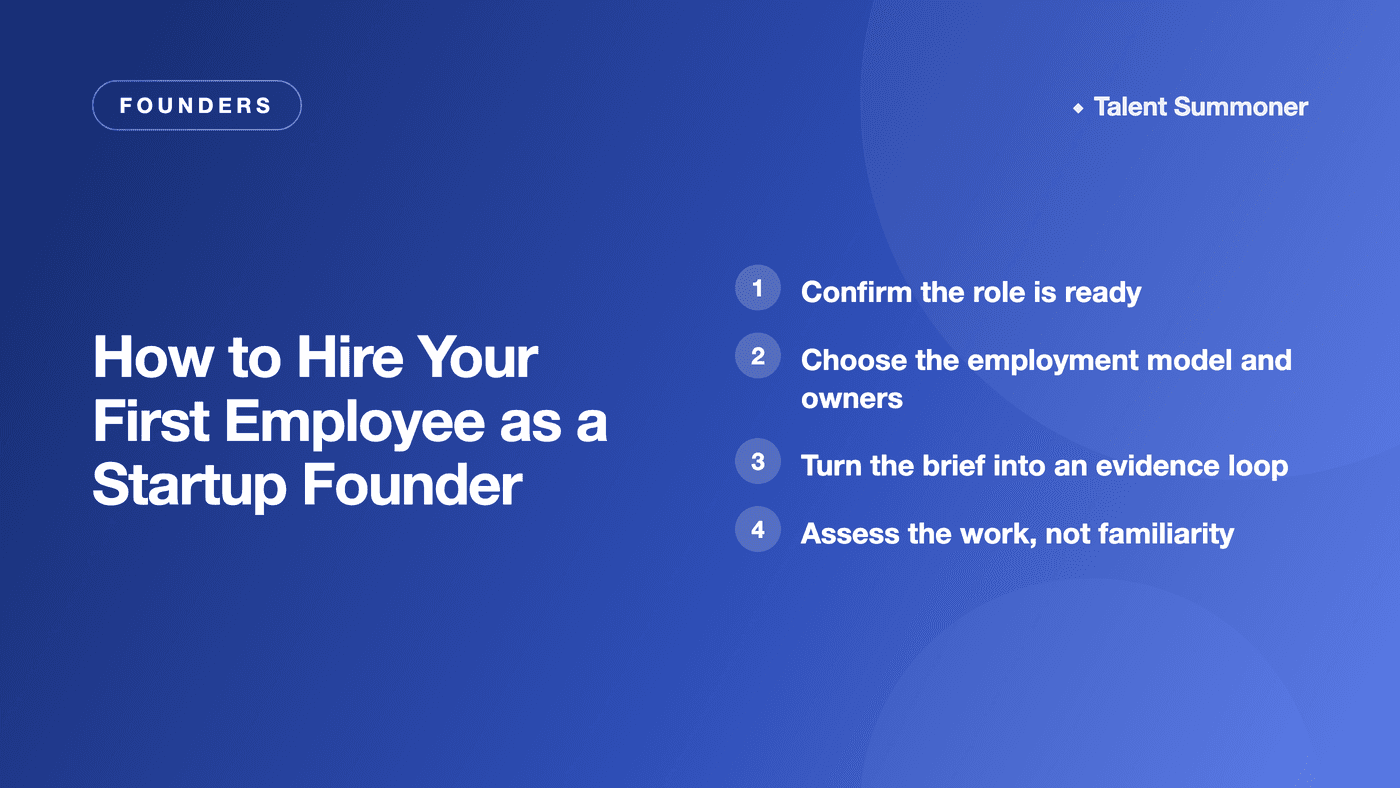
Hiring your first employee as a startup founder is a chain of decisions: what work the business needs, what engagement model fits, how evidence will be assessed, who approves the offer and who owns the new person's start. If any link is vague, the founder becomes the bottleneck.
The aim is a small process with named owners and a clear handoff. Keep sourcing, assessment, employment administration and onboarding distinct.
Confirm the role is ready
Start with the business problem, not a title. Write the outcome this person should own, the work the founder or team can no longer absorb, and the decisions belonging to the role. Note the location, working pattern, reporting line and genuine constraints.
For each important capability, state acceptable evidence: a delivered project, work sample, technical explanation or reference conversation. Keep must-haves distinct from nice-to-haves. Do not start outreach until you can explain the outcome, decision-maker and evidence standard. Ask a subject-matter colleague or trusted adviser to challenge ambiguity before candidates are in view.
Choose the employment model and owners
Decide whether the work calls for a direct employee, independent contractor, agency arrangement, employer-of-record service or another model. The right answer depends on the facts, locations and applicable rules; a label alone does not settle classification or obligations.
Record where the work will be performed, who directs it, the intended duration, confidentiality and intellectual-property needs, and who approves the arrangement. Before committing, ask a local employment lawyer, HR specialist, accountant, payroll provider or responsible government authority to confirm the setup. Contracts, payroll, eligibility, benefits, leave, working-time rules and records may need specialist guidance. This is general process information, not legal, tax or employment advice.
The founder owns the business case and final decision; a named manager owns day-to-day work; an operations or finance owner knows what happens after acceptance.
Turn the brief into an evidence loop
Use the approved brief consistently through discovery, review and interviews. Record what is known, unknown or contradicted; an exact title, prestigious employer or polished profile is not proof of capability.
Talent Summoner is our product for discovery. Its candidate-sourcing workflow, checked on 3 October 2026, starts from a role brief and searches LinkedIn, GitHub and other public professional sources across 200M+ profiles. It returns a ranked shortlist with must-haves, nice-to-haves and plain-English reasoning; feedback can adjust a later search and weighting. See current pricing for Role and monthly options.
For existing CVs, the separate candidate-ranking tool accepts up to 50 CVs in PDF, DOCX, MD or TXT format, requires no account and creates a shareable report. The team still verifies evidence, chooses contact and owns selection.
Assess the work, not familiarity
Use a consistent interview structure. Ask questions tied to role outcomes, request comparable evidence and record answers separately from impressions. For a work sample, mirror a real task, set scope and explain evaluation; avoid unpaid production work or irrelevant personal information.
Review gaps without turning uncertainty into automatic rejection. Record what would resolve each material unknown and who will verify it. A ranking orders attention; it cannot establish motivation, availability, performance or future success. Before deciding, document supporting evidence, remaining questions and accountable owners.
Talent Summoner supports sourcing and CV ranking; it is not an ATS, does not manage an application pipeline, does not automatically reject candidates and has no ATS integration today.
Make the offer handoff explicit
Once the founder chooses a candidate, prepare a handoff rather than forwarding a name. Include role scope, reporting line, evidence reviewed, unresolved questions, decision owners, working arrangement and conditions to check. The offer owner should know who approves terms and answers candidate questions.
Before presenting a binding commitment, send the facts to the local specialist or authority identified earlier. They can confirm contract form, classification, payroll treatment, eligibility checks and other obligations. Keep promises aligned with approved terms; do not improvise legal, tax or employment wording from a generic template.
Assign onboarding ownership before acceptance
Onboarding is not finished when the offer is accepted. The manager owns priorities, feedback and access to work. The founder owns context and decisions. Operations or finance coordinates accounts, equipment, payroll administration and documents; a teammate can own introductions.
Before the start date, confirm the role brief, initial priorities, introductions, systems and route for questions. Set check-ins around the role and person's context rather than a universal timeline, and update the plan when the work changes.
The practical next step
Write one role brief with its outcome, evidence rules, employment-model questions and named owners. Then start one focused sourcing search or review existing CVs with candidate ranking. Keep sourcing, assessment, offer and onboarding records distinct. Once you hire more than one role, our talent acquisition strategy guide sets a budget for each.
FAQ
How do I know whether my startup is ready to hire its first employee?
You are closer when you can state the business outcome, role ownership, evidence standard, manager and approval path. If those answers change with every candidate, refine the brief first.
Should my first hire be an employee or a contractor?
There is no universal answer. Consider the actual arrangement, locations, control, duration and obligations, then ask a local employment or HR specialist, payroll professional or responsible authority to confirm the model. Do not treat a label as legal advice.
Can Talent Summoner manage my first-employee hiring process?
No. Talent Summoner is our sourcing and candidate-ranking product. It can discover candidates from a role brief or organise CV review, but it does not manage an application pipeline, replace an ATS, automatically reject candidates, run interviews, prepare offers or own onboarding.
What should happen after a candidate accepts?
Use a written handoff to the manager and operations or finance owner. Confirm the specialist-approved setup, documents, access, priorities, introductions and check-ins before the start date.
Related: How to Hire When You Do Not Have a Talent Database · How to Choose Between an Agency, Recruiter and Sourcing Tool · How to Brief a Hiring Manager Before Sourcing Starts
Talent Summoner product facts read from our live candidate sourcing, candidate ranking and pricing pages, verified 3 October 2026. We re-verify this page quarterly — tell us if something changed.