 Talent Summoner
How to Hire When You Do Not Have a Talent Database
A practical hiring process without an owned candidate database, using applications, referrals, communities and public-source discovery.
 By Kevin Wong · Published · Updated · in Candidate Sourcing
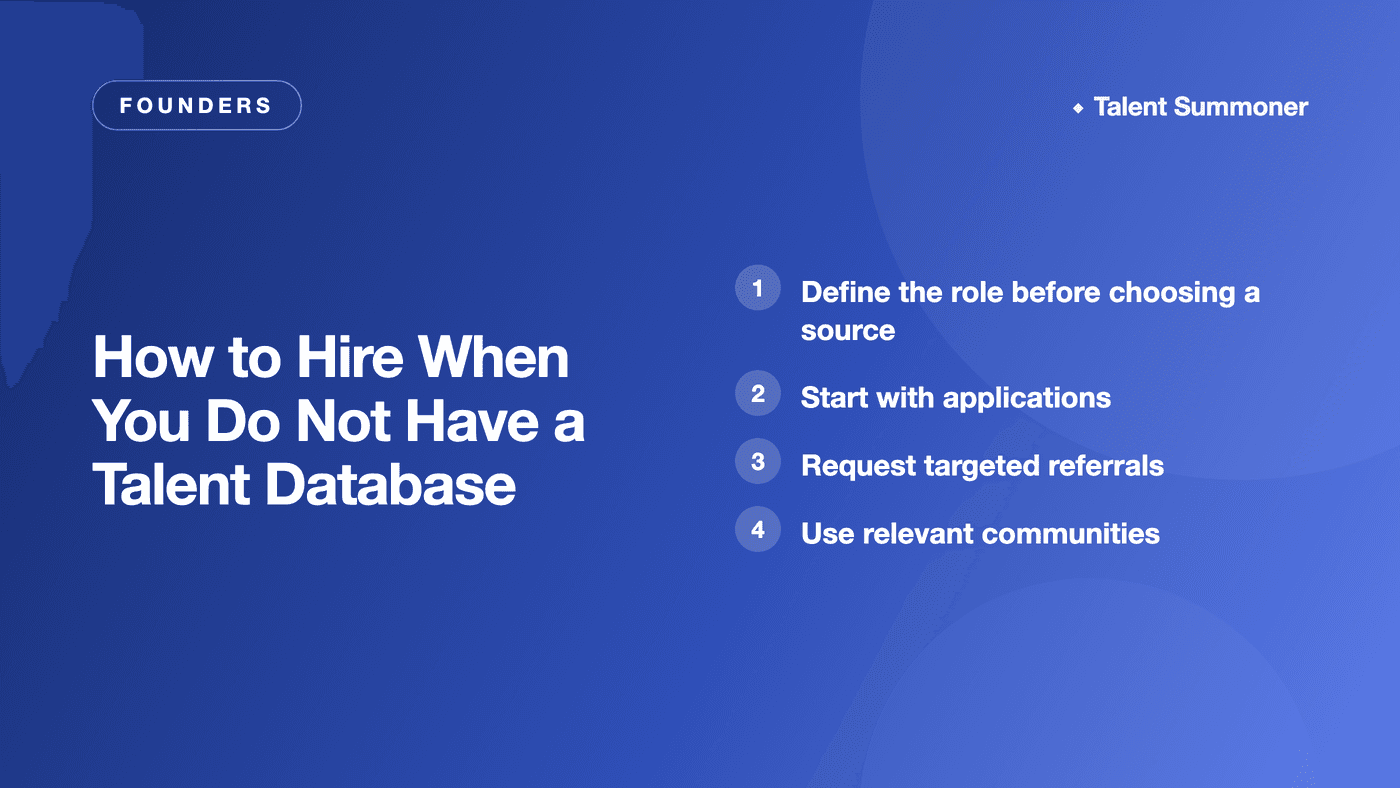
You do not need a stored pool of past candidates to begin hiring. Use a clear role brief, several deliberate ways to find people and a small record of what happened. The aim is to make one decision traceable, then keep the useful process for the next role.
1. Define the role before choosing a source
Write the outcome the person will own, must-haves, nice-to-haves, working constraints and evidence to check. Name the hiring owner and set a review date. A short brief helps you judge an application, referral or public profile against the same question.
Separate evidence from unknowns. An unmentioned skill is not disproved, and a referral is not proof. Decide which questions belong in an application, work sample or conversation.
2. Start with applications
Publish a focused job description on your careers page and relevant job boards or professional networks. Explain the work, constraints, requirements, selection stages and application route. Ask for relevant evidence rather than personal information you do not need.
Applications are a useful pool because the person chose to submit for this role. That does not establish that every detail is current or that they will accept an approach for another role. Review submissions against the brief, record a disposition and tell applicants what happens next.
3. Request targeted referrals
Ask employees, advisers, customers or trusted contacts for introductions to people who may fit a brief. Give them the outcome, two or three must-haves and constraints. A focused request beats asking for anyone interested.
Prefer an introduction that lets the person decide whether to engage. A passed name is not consent to add someone to a permanent list. Record the referral route and status, then verify experience, interest and availability directly.
4. Use relevant communities
Look at professional associations, alumni groups, meetups, conferences, open-source communities and role-specific forums. Follow each community's rules: some welcome vacancies, while others prohibit recruitment posts.
Describe the work, constraints and application route, and invite questions. Do not scrape member lists or send repeated unsolicited messages. A community mention is not evidence that every member wants contact. Record the community, post date and response path.
5. Discover people through public professional sources
Direct research can extend your reach for specialised roles. Search public information such as LinkedIn profiles, GitHub projects, conference speakers and portfolios. Compare evidence with the brief and verify material points before progressing.
A public profile is not contact consent, interest in your role or current availability. It may be outdated, incomplete or presented for another purpose. Use an appropriate route, identify yourself and the role, respect a refusal or no response, and follow applicable rules.
Talent Summoner is our product for this discovery step. Its candidate-sourcing tool, checked on 3 October 2026, starts with a role brief and searches LinkedIn, GitHub and other public professional sources across 200M+ profiles. It returns a ranked shortlist with must-haves, nice-to-haves and plain-English reasoning. Your team owns verification, contact choices and records. Talent Summoner does not provide a contact-credit database: it can find a candidate's work email for you, and it sends outreach only after you confirm each message. The free candidate-ranking tool accepts up to 50 PDF, DOCX, MD or TXT CVs.
6. Keep a minimal process record
Preserve accountability without storing every profile you see. For each role, record:
- the brief version, owner and date;
- the channel and source link, or the referral path;
- relevant evidence and unknowns;
- disposition, reason, reviewer and next action; and
- contact status and the basis for any contact, where applicable.
Limit access, keep only what you need and set a review or deletion date. Check local privacy, retention, employment and direct-marketing requirements. This is general operational information, not legal advice; ask a qualified local adviser or privacy authority about your situation. A public source does not automatically remove those obligations.
7. Reuse the method, not an unexamined pool
After the role closes or pauses, review which channels produced relevant conversations and where verification took time. Keep the brief structure and record fields. Retain information only when there is a clear, permitted reason and retention decision.
Next step
Write the brief, choose suitable channels and create one role record before searching. Then start a focused candidate-sourcing search and review results against the same must-haves.
FAQ
Can I hire without a candidate database?
Yes. Combine applications, targeted referrals, relevant communities and public-source research. Keep a small role record so decisions and follow-up do not depend on memory.
Is a public professional profile permission to contact someone?
No. A public profile does not show consent, interest or availability. Use an appropriate contact route, explain why you are reaching out, respect the person's response and check the rules that apply locally.
What does Talent Summoner do when I have no talent database?
Talent Summoner is our candidate-sourcing and ranking product. Sourcing searches public professional sources from a role brief and returns a ranked shortlist with reasoning. Your team verifies candidates, chooses the contact route and owns records, outreach and decisions.
Should I keep every profile I review?
Keep information needed for the role process and an auditable disposition. Restrict access and set a review or deletion date under local privacy and retention requirements. Do not build a permanent pool by default.
How much does Talent Summoner cost?
Your first Role is free with no card and your second is US$4, an intro price shown at checkout, not on the pricing page. After that, the pricing page lists US$29 for one Role, US$79 for three Roles, US$59 per month for 10 Roles or US$299 per month for Unlimited; unused monthly Roles do not carry over and one-time pack Roles remain valid for 24 months.
Related: How to Choose Between an Agency, Recruiter and Sourcing Tool · How to Brief a Hiring Manager Before Sourcing Starts · How Much Time Does Founder-Led Sourcing Take?
Talent Summoner product facts read from our live candidate sourcing, candidate ranking and pricing pages, verified 3 October 2026. We re-verify this page quarterly — tell us if something changed.