Talent Summoner
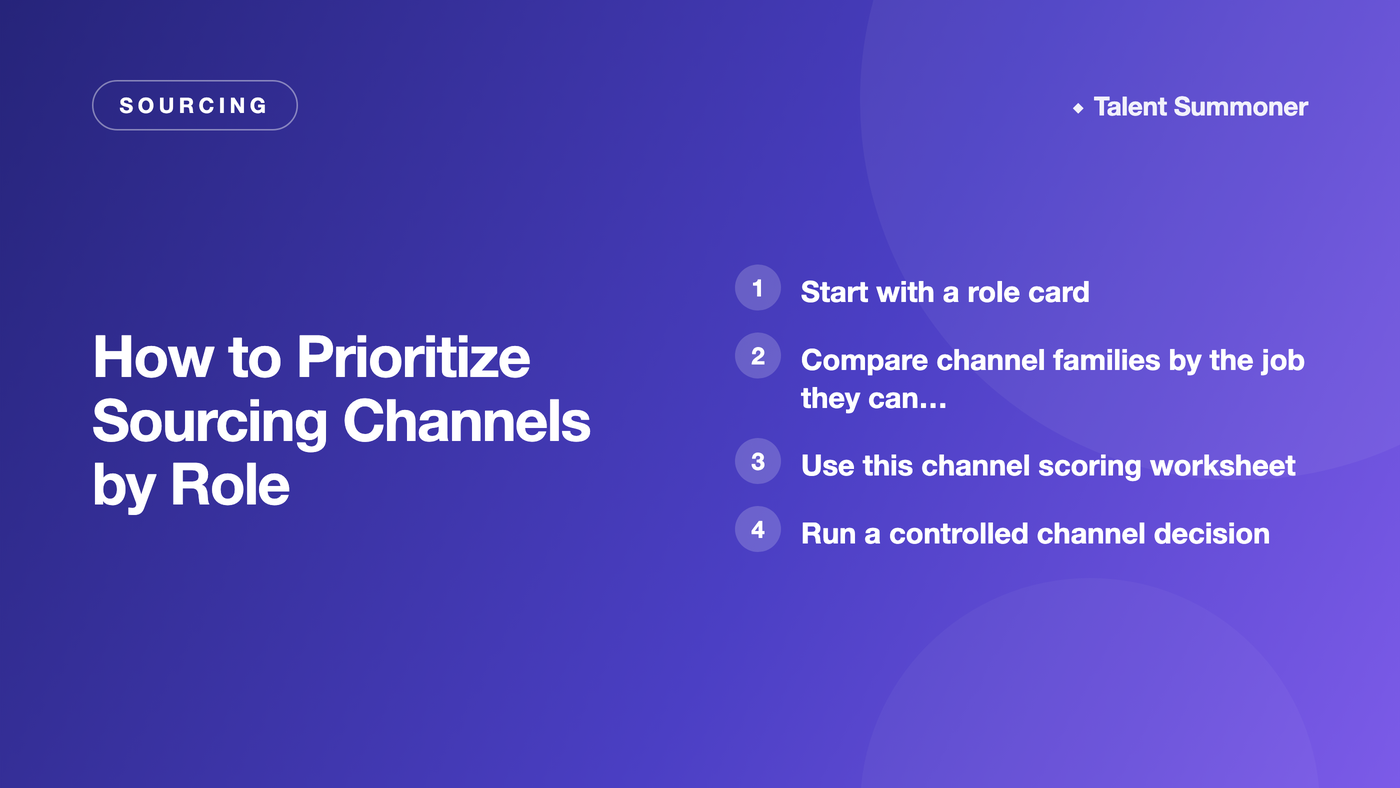
How to Prioritize Sourcing Channels by Role
A practical worksheet for choosing sourcing channels by role fit, evidence quality, reach, review capacity and clear stop rules.
When entering a new talent market, posting everywhere can produce poor role fit and more records than the team can inspect.
Prioritising sourcing channels by role means choosing a route that can expose the evidence the role needs at a review load the team can handle. The scores below are planning judgements, not market benchmarks.
Start with a role card
Write a role card before naming a channel:
- Role signal: what work or context must be visible for a profile to merit review?
- Audience: who could plausibly be reached, including acceptable adjacent backgrounds?
- Boundary: which location, working pattern and seniority constraints are genuine?
- Evidence standard: what is a lead, useful support or a human-check item?
- Review capacity: how many records can the recruiter and role owner inspect carefully?
The role signal suggests the starting channel. An artefact-led engineering role may need inspectable projects; a relationship-led search may need an explainable connection; a broad role may benefit from an opt-in route.
Compare channel families by the job they can do
Use channel families; a route can help one role and distract from another.
| Channel family | Role characteristic it can fit | Likely evidence to inspect | Reach and review trade-off |
|---|---|---|---|
| Public professional search | Specialised work, passive discovery or a narrow combination of requirements | Stated responsibilities, projects, organisations and professional context | Can reach beyond applicants, but every profile needs source and recency checks |
| Referrals | A role where trusted context or a warm introduction is genuinely useful | The referrer's reason, relevant work and a route to verify the claim | Context may be useful, but the network is bounded and referrals still need the same review standard |
| Job boards and careers pages | A role with a clear brief and a plausible active-applicant audience | Application answers, CV evidence and stated interest in the opportunity | The route is easy to explain, but the team may receive more records than it can review |
| Professional communities and associations | A recognisable domain, craft or learning community | Role-related discussions, work samples, talks or member context | The audience can be focused, but participation does not prove capability or interest |
| Work-sample or open-source ecosystems | A role where public artefacts help frame a human question | Published work samples, repositories, contributions and stated ownership | Evidence can be inspectable, but public work is partial and may not establish authorship or scope |
Do not treat a visible profile as complete. LinkedIn says its public profile is simplified, while GitHub says a profile shows work a person chooses to share. An unshown capability remains unknown. See the LinkedIn visibility guidance and GitHub profile documentation, checked 2 September 2026.
Use this channel scoring worksheet
Copy the table into the role record and score each channel from 0 to 3. Zero means unknown or implausible; three means a strong role-specific hypothesis.
| Channel | Role fit (0-3) | Evidence quality (0-3) | Reach (0-3) | Review capacity (0-3) | Total / 12 | First test | Stop rule |
|---|---|---|---|---|---|---|---|
Score role fit for whether the route exposes the work or context in the role card. Score evidence quality for a direct, traceable signal. Score reach for whether it plausibly reaches the approved audience; do not invent audience counts. Score review capacity for whether named reviewers can inspect the expected records to the agreed standard.
The total is a prompt, not a verdict. High reach with weak evidence may be a poor first test, while strong evidence with zero review capacity should wait. Write a stop rule before opening the channel.
Run a controlled channel decision
- Select a small mix. Choose one primary route and one contrasting route that answer different questions.
- Hold the role card constant. Record the channel, search wording or invitation context, date and owner.
- Review a pre-agreed amount of work. Stop at the team's capacity, and record evidence, unknowns, duplicates and the next human check.
- Make one decision. Continue when the route reveals distinct, reviewable evidence; adjust, pause or close it when the signal is too narrow or unusable.
- Carry learning forward. Keep the score and decision with the role version. A route's usefulness can change in a new market.
Stop rules worth writing down
- Stop when the channel reaches review capacity and the next records cannot be inspected carefully.
- Stop when a defined test produces no role-related evidence and repeating it adds no new hypothesis.
- Pause when a required owner, permission or source access is unavailable.
- Close a record when its material claim cannot be traced or a duplicate adds no independent evidence.
- Reopen only when the role card, audience or evidence question changes with owner approval.
These rules protect review quality. They do not say a channel has no candidates or that a person is unsuitable; they say the route is not producing usable evidence under current conditions.
Decision examples
Example: senior backend engineer. If the role needs production-service and trade-off evidence, test public professional search and an open-source route; use an explainable referral as the contrast. This is illustrative, not a performance claim.
Example: customer education manager. An association or domain community may expose talks or writing; verify ownership and scope rather than treating membership as proof.
Example: operations coordinator. A careers page or job board can test reach for a broadly described role; add direct search only for a documented evidence gap, and stop on capacity rather than an application target.
Keep data and product boundaries visible
Use only role-relevant information, preserve the source and review date, and keep assumptions separate from evidence. The UK's Information Commissioner's Office says organisations procuring AI recruitment tools should identify a lawful basis, document responsibilities, explain use, monitor fairness and accuracy, and limit collection to what is necessary. Its 6 November 2024 guidance is general information, not legal advice.
Talent Summoner is our product for role-based sourcing. Its candidate-sourcing workflow, checked 2 September 2026, starts from a role description, searches LinkedIn, GitHub and other public sources across 200M+ profiles, and returns ranked results with must-haves, nice-to-haves and plain-English reasoning. Treat it as one channel input; source inspection and selection remain with your team. It is not an ATS. The separate candidate-ranking workflow organises supplied CVs.
FAQ
What is the best sourcing channel for a role?
There is no universal best channel. Choose a route that exposes required evidence, reaches the approved audience and fits review capacity. Test it and record the stop rule.
How should I compare sourcing channels?
Score role fit, evidence quality, reach and review capacity from 0 to 3, then record the first test and stop rule. It is an internal decision aid, not a market benchmark.
Should I use several channels at once?
Use a small mix when routes answer different questions. Hold the role card and evidence standard constant so the contribution of each is visible.
Does a public profile prove a candidate is qualified?
No. Public profiles are selective and may be incomplete or out of date. Record what the source supports, then verify material claims.
Can Talent Summoner choose the channel for me?
No. Talent Summoner is our role-based sourcing product. It can provide a ranked public-source shortlist, while your team chooses the mix, verifies evidence, contacts candidates and decides.
Fill in the role card for one open position, score three channels and write a stop rule for each. Then start a candidate sourcing search for the highest-scoring hypothesis, keeping the worksheet beside the review record.