Talent Summoner
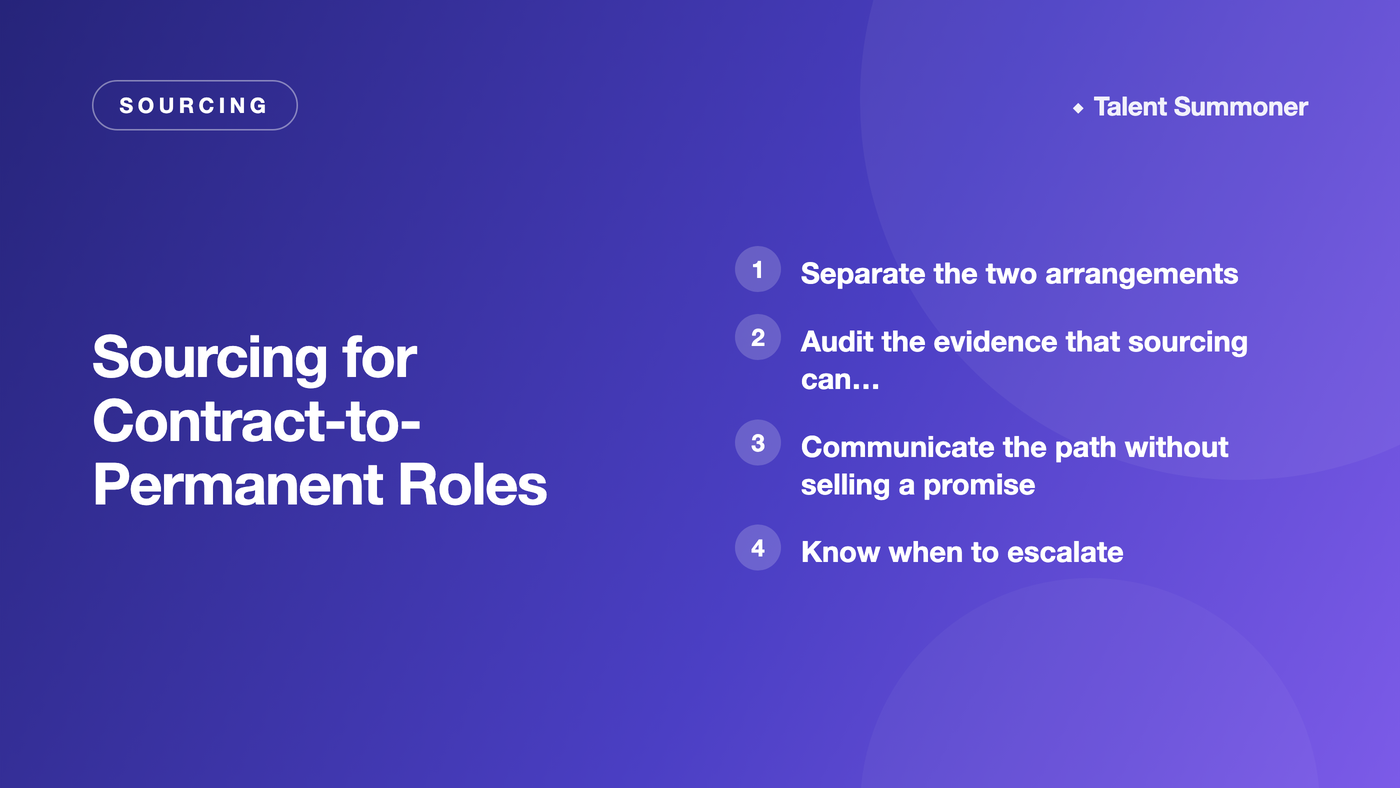
Sourcing for Contract-to-Permanent Roles
Source contract-to-permanent roles with clear status assumptions, evidence needs, candidate communication and HR or legal escalation points.
For example, a hiring manager says, "Start this person as a contractor and make them permanent if it works." A candidate hears a likely permanent job, while the agency contract names a different employer. Nobody has approved the conversion terms. That is a sourcing-quality problem before it is a search problem.
Contract-to-permanent, also called temp-to-perm or contract-to-hire, usually means a time-limited engagement with a possible permanent appointment later. The structure varies. Source against what is approved now, describe the possibility honestly and stop when employment, commercial or legal assumptions are unresolved.
Separate the two arrangements
Write the initial engagement and possible permanent appointment as separate lines. Record the initial party, duration, pay basis, pattern and deliverables; the possible employer, approval and decision timing; any role changes; and the owners for job scope, HR, commercial and legal or tax questions.
Treat conversion as an option rather than a promise unless a separate approved offer says otherwise.
Do not let "contractor" stand in for an approved worker model. The US Internal Revenue Service guidance says status depends on the whole relationship, including behavioural control, financial control and relationship type; a contract label alone is not sufficient. UK guidance likewise notes that a contractor can be self-employed, a worker or an employee employed by an agency. These are jurisdiction-specific examples, not a universal test. Apply the rules for the employing entity, work location and actual arrangement.
If the team cannot name the contracting party, approved initial terms or conversion owner, pause. If permanent headcount or compensation is not approved, describe only a possible future path.
Audit the evidence that sourcing can actually support
Source quality here means that each candidate can be presented accurately for the approved initial arrangement. It does not mean a public profile can determine worker status or predict conversion.
| Question to resolve | Evidence that may justify a conversation | What remains unknown |
|---|---|---|
| Has the person done relevant work in a time-limited engagement? | A candidate-stated role, CV or employer description names the work and period | The contractual status, personal scope, recency and current interest |
| Can the person work under the approved initial arrangement? | A direct conversation confirms the person's understanding of the proposed location, schedule and engagement | Work authorisation, tax treatment, payroll route and any required agency process |
| Is a permanent move attractive to the person? | The candidate describes their preference when asked | Whether the employer will approve conversion, and whether the eventual terms suit both sides |
| Is another supplier or employer involved? | A candidate or authorised intermediary explains the relationship | Exclusivity, ownership, transfer fees, notice and data-sharing obligations |
| Will the work remain materially the same? | The approved briefs describe overlapping outcomes and reporting | Future duties, manager, compensation, benefits and decision timing |
Treat CV wording, a job title or a source summary as a lead. Do not infer contract status, availability, willingness to convert or work authorisation from profile visibility. Keep a short note of the source, the question it supports and the human check still required. Missing information is unknown, not a negative finding.
Communicate the path without selling a promise
Candidate communication should state who offers or pays for the initial engagement, its term and conditions, whether permanence is only a possibility, who decides and what remains undecided.
For example: "This is an initial contract engagement with the approved contracting party for the approved scope and term. A permanent appointment may be considered later, subject to approval and a separate offer. Which arrangement are you seeking?" Use only approved facts. Do not promise conversion or describe tax and employment rights from memory.
Ask which arrangement the candidate is considering, recording only the job-related preference needed for the next decision. "Open to work" does not answer that question. Recontact them if a material term changes, and route questions about pay, leave, benefits, authorisation or status to the named owner.
Know when to escalate
Sourcing should pause and hand the question to the right owner when:
- the manager wants employee-like control over hours, methods, equipment or supervision while the brief calls the person an independent contractor;
- the initial arrangement, employer or payroll route is unclear;
- a staffing supplier or agency may employ the person, charge a conversion or transfer fee, or impose ownership terms;
- the role crosses borders or raises tax, work-authorisation, benefits or data-handling questions;
- "will become permanent" appears without an approved offer process, headcount or terms, contract and permanent duties differ materially, or the candidate asks for a legal, tax or rights conclusion the sourcing team cannot verify.
Record the question and pause the affected outreach or offer step until HR, procurement, legal or a qualified local adviser responds. The IRS advises documenting classification factors, but does not decide status outside its scope. Preserve the assumption, facts, owner and decision date. This is general information, not legal advice.
Contract-to-permanent sourcing checklist
- Split the initial engagement from the possible permanent appointment.
- Name each contracting or employing party, owner and decision timing.
- Record approved duration, pattern, deliverables, pay basis and material conditions.
- Mark conversion as an option unless a separate written offer says otherwise.
- Define public-source evidence and the human questions it cannot answer.
- Check agency ownership, notice, transfer and conversion terms.
- Approve candidate wording; ask the candidate's preference rather than infer it.
- Escalate status, payroll, tax, authorisation, cross-border and changed-scope questions; refresh wording when terms change.
Where Talent Summoner fits
Talent Summoner is our product for role-based candidate discovery. Its candidate-sourcing workflow, checked 2 September 2026, starts from a role description, searches LinkedIn, GitHub and other public professional sources across 200M+ profiles, and returns a ranked shortlist with must-haves, nice-to-haves and plain-English reasoning. Put approved initial terms in the brief, then ask the human questions above.
Talent Summoner does not determine employment status, act as an employer or staffing supplier, negotiate conversion terms, verify work authorisation, send outreach or provide HR and legal advice. Candidate ranking is a separate workflow for supplied CVs. Neither workflow establishes interest, availability or a permanent-employment promise.
What is a contract-to-permanent role?
It is an initial contract engagement with a possible permanent appointment later; employer, supplier, terms and rights vary, so the label is not a complete offer.
Is permanent conversion guaranteed after the contract?
Not unless a separate, approved commitment says so. Otherwise call it a possibility.
Can a contract label determine employment status?
No. The actual relationship and local rules matter; ask a qualified local adviser when unclear.
What should I do if the contract and permanent role differ?
Pause, write the differences into separate briefs and ask the role owner and HR whether the explanation or evaluation must change.
Can Talent Summoner manage contract-to-permanent hiring?
No. It supports discovery or supplied-CV ranking; your organisation owns status checks, agency terms, communication, HR/legal review, offers and the final decision.
Start with the approved arrangement, possible conversion path and one escalation owner. Then source candidates whose evidence fits what the team can explain.