Talent Summoner
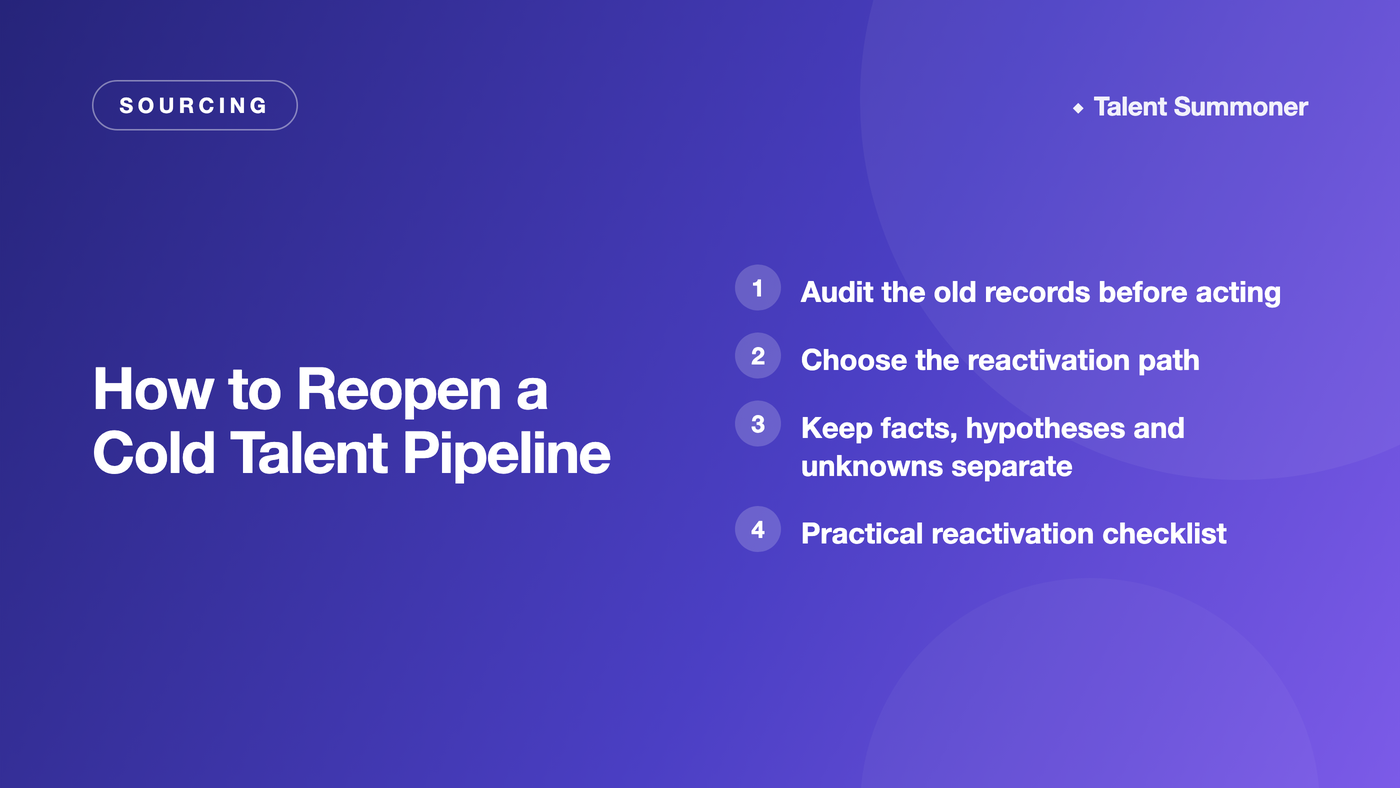
How to Reopen a Cold Talent Pipeline
A founder's runbook for classifying stale candidate records, choosing a safe reactivation path, documenting unknowns and knowing when to stop.
Six months after pausing a search, the role is open again but the spreadsheet says only "contacted" and "maybe". Some people may still be relevant; others may have changed roles or declined contact. Reopening the pipeline is a records and judgement exercise, not a reason to message everyone again.
This runbook helps a founder classify stale records, choose a reactivation path, record unknowns and close records when evidence or the contact basis is inadequate. It is not a new sourcing brief, funnel-stage guide or time-boxed search sprint.
Audit the old records before acting
Make a read-only copy or versioned export of the old list. Name one owner and the current role version. Do not silently overwrite an old status; the history explains the earlier decision.
Classify each record using its trace, status and contact history, not an invented age threshold. Age prompts verification; it does not decide deletion or contact.
| Record state | What it means | First action |
|---|---|---|
| Reviewable | The source and prior decision are traceable, with no known stop request | Refresh material facts and confirm the next path |
| Stale but recoverable | The source or role context is old, and current interest or contact permission is unknown | Recheck the source, contact record and approved channel before any message |
| Conflicted or duplicate | Two records disagree, identify the same person, or carry different outcomes | Put the record on hold and resolve the identity and history |
| Suppressed | The person declined, opted out, or a do-not-contact instruction is recorded | Do not reactivate; preserve the suppression decision in the approved system |
| Unusable | There is no reliable source, the identity cannot be established, or the purpose is no longer approved | Close or restrict the record under the organisation's process |
Do not turn a missing note into a positive signal. "No response" describes one interaction; it does not prove poor fit, continued interest or permission to switch channels.
Choose the reactivation path
Choose one path from the classification and write the reason. A clear request to reconnect later is context for a fresh, human-reviewed invitation, not ongoing permission; check the current contact basis and role facts first. It does not prove current availability.
For a previous shortlist or no-response record, start from the current role and traceable evidence. Check prior contact, suppression and duplicates, then decide whether one optional invitation is appropriate under policy. The old message may no longer fit the role or sender.
For a referral or old CV with no clear contact history, treat the source as a lead. Confirm its permitted use, then review it against the current role. Candidate Ranking can organise an existing CV set, but cannot establish recency, identity, interest or permission to contact.
For a stale public-profile record, verify the source or run a new candidate sourcing search from the current brief. New discovery is not an instruction to contact everyone in the old list.
Keep facts, hypotheses and unknowns separate
Give every reactivated record a short handoff note another teammate can understand without opening old chat threads:
Candidate record and role version:
Source URL, source date (if shown) and review date:
Prior status, contact history and suppression check:
Current job-related evidence:
Known facts / working hypothesis / unknowns:
Chosen path and reason:
Human owner, approved channel and next review point:
Outcome, closure reason or correction history:
Use "unknown" for current scope, availability, interest, authorship or any fact the record does not establish. Write one question for the owner. A ranking, old title or public activity is not a current conversation.
The UK's Information Commissioner's Office guidance, dated 6 November 2024, tells organisations to use a lawful basis, document responsibilities and collect only the minimum information needed. It also warns against indefinite retention for broad future use. Apply the rules for your organisation, channel and location; this is general information, not legal advice. NIST describes its AI Risk Management Framework as voluntary guidance, not a hiring standard.
Practical reactivation checklist
- Confirm the current role, owner, version and reason for reopening.
- Preserve the old status and source trace before changing anything.
- Classify the record as reviewable, stale, conflicted, suppressed or unusable.
- Check identity, duplicates, prior contact, replies and do-not-contact instructions.
- Recheck material role and candidate facts using an approved, current source.
- Label every important claim as fact, hypothesis or unknown.
- Choose one path and record why it is proportionate to the evidence.
- Name the human reviewer, channel and next action before drafting contact.
- Record no response, decline, opt-out, correction or progress accurately.
- Set the stop condition and close, restrict or revisit the record only through the approved process.
Decide when to stop
Stop when the person opted out, the identity is wrong, a conflict cannot be resolved, or the contact basis is unclear. Stop when the role is closed, a material condition cannot be verified, or the only support is an untraceable note. These are process decisions, not judgements about ability.
If the person does not reply, follow the organisation's approved review point, not a universal follow-up number. Record the outcome and close or suppress as required. If new evidence changes nothing, stop reopening the record just to make the list look active. Starting fresh can be the correct outcome.
Talent Summoner is our product for role-based candidate discovery and ranking. Its candidate-sourcing workflow can turn a current role description into a ranked shortlist from public professional sources, while candidate ranking can organise an existing CV set. Use either as review input, not as a historical contact record. It does not establish current interest, availability, identity or contact safety; humans own verification, communication, status and hiring decisions.
FAQ
What makes a talent pipeline cold?
A pipeline is cold when records no longer provide a reliable current status, source context or next action. There is no universal age threshold; classify uncertainty and verify what matters first.
Should I contact everyone from an old shortlist?
No. Check prior contact, opt-outs, duplicates, source quality and current role relevance. A human owner chooses any optional contact path.
Is no response a reason to close a candidate permanently?
No. No response describes one interaction, not capability or future interest. Follow the approved review and retention process, record the outcome and stop when required.
Should old CVs be deleted immediately?
Do not guess. Apply your organisation's retention, access and deletion process, use only the minimum information needed and document the review. Local requirements differ.
Can Talent Summoner reopen my pipeline automatically?
No. Our product supports new role-based discovery or review of supplied CVs. It does not establish current interest, replace contact-history controls or make reactivation and hiring decisions.
Choose one old record, run the checklist with the role owner, and write a dated classification and stop condition. Then start a focused candidate-sourcing search only for the gap that the recovered records cannot answer.