 Talent Summoner
How to Search for Adjacent Backgrounds in Recruiting
Use transferable evidence and controlled search passes to explore adjacent talent without lowering role standards or overclaiming candidate fit.
 By Derek Chau · Published · Updated · in Candidate Sourcing
Adjacent talent sourcing means looking beyond the most familiar career path for evidence of the work a role requires. It can help when the same capability appears in different functions or when a brief combines unusual requirements. It is not a shortcut around standards: a related background creates a reason to investigate, not proof that someone can perform the role.
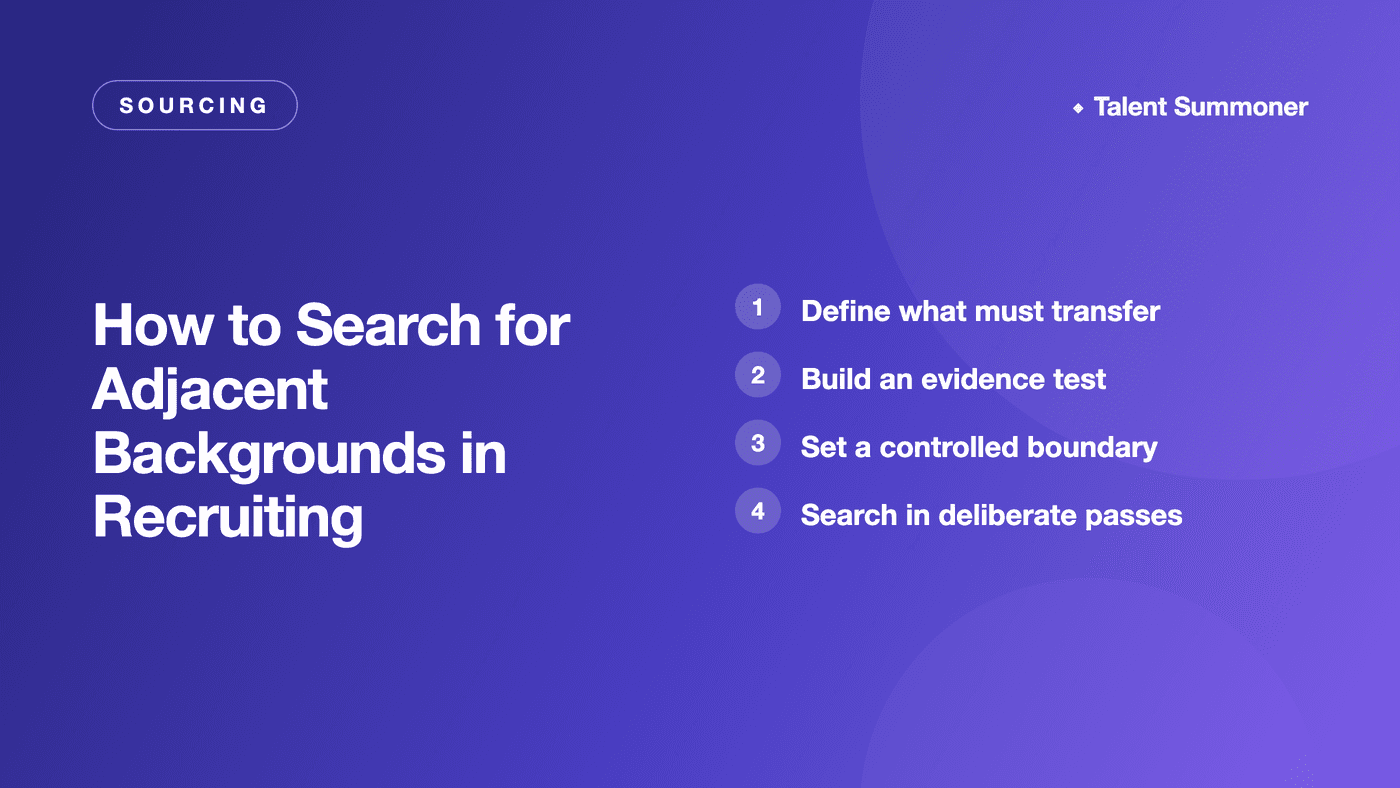
Define what must transfer
Start with the role's outputs rather than its usual career path. Write down the decisions, activities and constraints the person will handle. Separate the brief into:
- Core capability: the work that must transfer, such as diagnosing customer problems, designing reliable data flows or leading a delivery plan.
- Context: the environment that may affect transfer, such as regulated information, a particular buyer, scale or operating model.
- Boundary: a genuine non-negotiable, such as a licence, a work-related language requirement or experience with a system that cannot be learned during onboarding.
Build an evidence test
Define evidence before viewing profiles. For each core capability, record five fields:
- Capability: what the person needs to do.
- Observable signal: a project, responsibility, work sample or described outcome that could support the claim.
- Transfer distance: what context differs and why the underlying activity may still be comparable.
- Gap: what the source does not establish, such as scale, tool depth, decision authority or exposure to a constraint.
- Verification question: the focused question that would test the gap.
For an example only, a role may require investigating production incidents and improving an operational process. Direct evidence could come from reliability engineering; adjacent evidence could come from support or implementation work describing incident diagnosis. The activity, not the title, makes it worth reviewing. Missing production ownership becomes a verification question.
Label results direct, adjacent, unknown or contradicted. Adjacent describes a testable hypothesis, not a score adjustment. Unknown means the available material does not establish a fact; it is not automatically a rejection or endorsement.
Set a controlled boundary
Choose which dimension may vary while the core standard stays fixed: industry, tool, customer type, team setting or delivery method. Keep genuine boundaries unchanged. If production access is essential on day one, do not turn it into a preference simply to enlarge the pool.
Write the rule in plain language: "Keep incident investigation and stakeholder communication as must-haves; explore comparable work in support or implementation; verify production ownership before progressing." This gives reviewers a shared reason to include an adjacent result.
Do not infer transferability from protected characteristics or weak proxies. Age, race, sex, gender identity, disability, religion, family status, nationality and similar personal information are not evidence of ability or availability. Employer prestige, education, location and profile polish are not substitutes for job-related evidence.
Search in deliberate passes
Run bounded experiments:
- Search the approved brief for direct evidence.
- Change one context dimension to test the named adjacent background.
- Review a labelled set for evidence quality and recurring gaps.
- Record what was useful, what was a false positive and what the next pass should change.
Keep direct and adjacent results separate; an exploratory result should not look equivalent. Distinguish not found from not present because a public profile may omit relevant work or use different language. Record the source and date, then mark gaps for verification.
Change one meaningful input at a time. Add an activity, narrow context or make a boundary explicit. Do not use an unexplained preference such as "more like this"; record the evidence pattern to repeat or exclude.
Verify before progressing
For each adjacent profile, ask about responsibility, constraints, decisions and what the new environment would require them to learn. A structured work sample or interview question can test those points better than another keyword search.
Adjacent experience is not proof of performance, and a shortlist score cannot answer what the evidence does not establish. The hiring team should decide whether the remaining gap is acceptable for this role, using the same job-related standard for every candidate.
Where Talent Summoner fits
Talent Summoner is our product for AI candidate sourcing, CV ranking and outreach you confirm before it sends. Its candidate-sourcing workflow, checked on 3 October 2026, starts with a role brief and searches LinkedIn, GitHub and other public professional sources across 200M+ profiles. It returns a ranked shortlist with must-haves, nice-to-haves and plain-English reasoning. Name the capability and boundary in the brief; treat reasoning as discovery evidence, not a verdict. Feedback can adjust a later search and its weighting.
If you already have CVs, the candidate-ranking tool accepts up to 50 PDF, DOCX, MD or TXT files, requires no account and creates a shareable report. Sourcing is free to start with no credit card; see pricing, checked on 3 October 2026, for current Role options.
Bottom line
Search adjacent backgrounds when you can state the capability, evidence and remaining gap. Keep the core standard fixed and give a person a focused verification task before treating a profile as viable.
FAQ
What is an adjacent background in recruiting?
It is a career or project context that differs from the usual path but may contain evidence of a needed capability. Describe the difference and verify the capability; adjacent is not automatically equivalent to direct experience.
How do I assess transferable skills without lowering standards?
Define the capability and boundaries first. Record each adjacent result's evidence, context difference, missing information and verification question. Keep non-negotiable requirements unchanged; the hiring team decides whether a gap is acceptable.
Can an AI sourcing tool identify adjacent candidates?
It can organise a role-brief search and surface evidence for review. People must define the test, check sources, question uncertainty and decide. A ranked shortlist does not prove ability, availability or performance.
Next step
Choose one open role and write a five-line transferability test for its hardest must-have: capability, signal, context difference, gap and verification question. Then run a focused candidate-sourcing search with one approved adjacent dimension and label every result direct, adjacent or unknown.
Related: How to Compare Candidate Sourcing Platforms · How to Build a Shortlist Without Searching Every Profile Manually · How Small Hiring Teams Choose Between Sourcing Options
Talent Summoner product facts read from our live candidate sourcing, candidate ranking and pricing pages, verified 3 October 2026. We re-verify this page quarterly — tell us if something changed.