 Talent Summoner
How to Compare Candidate Sourcing Platforms
A practical framework for comparing candidate sourcing platforms by workflow, evidence, human review, data controls and pricing.
 By Derek Chau · Published · Updated · in Tools & Pricing
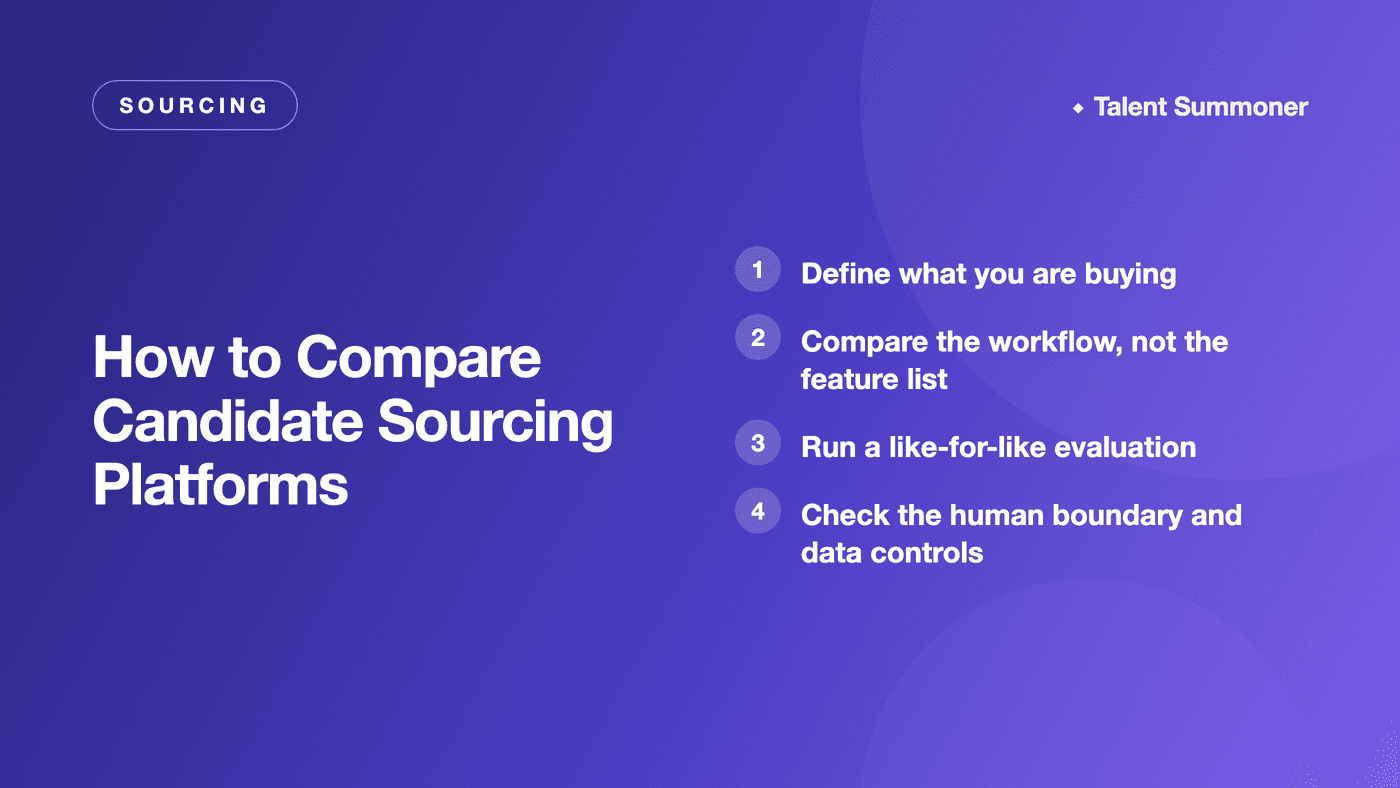
Candidate sourcing platforms can look similar in a demo while leaving different work with your hiring team. Compare the path from role brief to reviewable shortlist, not just the claimed talent-pool size. Look for inspectable evidence and a process your team can own.
Define what you are buying
Separate three jobs that are often bundled together. Sourcing discovers people beyond your applicant pool, whether a recruiter searches by hand or uses AI candidate sourcing. Candidate ranking compares CVs you already have; Talent Summoner's separate candidate-ranking tool accepts up to 50 CVs and produces a shareable report. An applicant tracking system manages applications, stages, communication and records. A sourcing platform may complement an ATS, but is not automatically a replacement.
Write down the role, evidence to inspect, expected sources, and the hand-off after discovery. Include must-haves, nice-to-haves, location or working-pattern constraints, and acceptable adjacent backgrounds. This gives every vendor the same test.
Compare the workflow, not the feature list
Use a scorecard before a trial. The Talent Summoner column describes our product; verify the final column elsewhere.
| Buying criterion | Talent Summoner (our product) | What to verify elsewhere |
|---|---|---|
| Role input | Starts from a plain-language role brief | Can the hiring manager create a useful search without specialist query syntax? |
| Source coverage | Searches LinkedIn, GitHub and other public professional sources across 200M+ profiles | Which sources are included, and can the supplier explain what the reviewer can inspect? |
| Shortlist explanation | Ranks against must-haves and nice-to-haves with plain-English reasoning | Does each result show supporting evidence, gaps and uncertainty rather than only a score? |
| Feedback loop | Yes/no feedback and preference edits adjust a later search and weighting | Can one deliberate correction change the next result set? |
| Review hand-off | The team reviews the ranked shortlist and decides what to verify or do next | Can the hiring manager share, export or record a decision without rebuilding the search? |
| Commercial fit | Role packs or a monthly Role budget | Is the bill based on roles, seats, credits, usage, or a managed service? |
Do not treat a bigger database or higher score as proof of better candidates. Ask what the platform can show, cannot verify, and how a reviewer can challenge a result. A useful comparison exposes uncertainty instead of hiding it behind a ranking label.
Run a like-for-like evaluation
Use one approved brief for every platform: three real must-haves, two preferences, an explicit exclusion, and one adjacent background you would consider. Keep wording and date fixed. Record any supplier-specific input as a workflow difference.
For each result set, record:
- time from brief to the first reviewable shortlist;
- the number of profiles the role owner would investigate further;
- whether material fit claims have visible supporting evidence;
- missing, stale or ambiguous information;
- duplicate results and manual clean-up; and
- the software cost plus the operator time required for this role.
Then make one controlled correction: mark a false positive, change a preference to a must-have, or add an acceptable adjacent background. Run the search again and check whether the result reflects it. This tests a review loop rather than an impressive first screen.
Check the human boundary and data controls
Candidate profiles are research evidence, not a complete account of ability, motivation, availability or current circumstances. Ask how the platform distinguishes observation from inference, handles missing evidence, and lets a person review a result before outreach or rejection. Keep requirements, verification, outreach, interviews, accommodations and selection with accountable people.
Ask what is stored, how long results remain available, who can access a shortlist, and whether reports can be shared or deleted. Public professional information can be incomplete or out of date. Do not accept claims that AI removes bias, guarantees accuracy or predicts performance. Consistent review helps inspection but does not remove responsibility.
Compare the total commercial commitment
A platform's price only makes sense against your hiring cadence. Compare one active role, a burst of roles and a quiet period. Seat or annual contracts may fit continuous sourcing; per-role packs may fit an uneven calendar. With credit pricing, identify which actions consume credits. Agency or managed-service fees include more human work, so compare hand-offs as well as the invoice.
Talent Summoner is our product, and sourcing is free to start with no credit card. Its pricing page, checked 3 October 2026, lists US$29 for one Role, US$79 for three Roles, or US$59 per month for 10 Roles. Unused monthly Roles do not carry over, extra Roles cost US$15, and one-time pack Roles remain valid for 24 months. Verify live terms before purchase because commercial details can change.
Where Talent Summoner fits
Talent Summoner is a role-based sourcing and shortlist-review product, not an ATS. Its candidate-sourcing workflow starts with a role brief, searches LinkedIn, GitHub and other public professional sources across 200M+ profiles, and returns a ranked shortlist with must-haves, nice-to-haves and plain-English reasoning. Feedback can adjust a later search and weighting. Your team verifies claims, chooses outreach, runs interviews and decides; Talent Summoner does not automatically reject candidates or manage an application pipeline.
Choose it when you want to test a real role brief, inspect why candidates appear, and refine the search without a permanent recruiter seat. If you need application tracking or a maintained candidate relationship database, include those requirements and keep the appropriate system of record.
Make the decision explicit
Give each platform a score for role input, source evidence, explanation, feedback, hand-off, data controls and total cost. Note unresolved questions. Choose the output your role owner can review responsibly, not the longest feature page.
FAQ
What is a candidate sourcing platform?
A candidate sourcing platform helps a team discover potential candidates from professional information and organise those possibilities for review. Some focus on search, some on ranked recommendations, and some combine sourcing with other recruiting workflows. Confirm what the product actually owns after the shortlist.
How should I compare candidate sourcing platforms?
Give each platform the same role brief, then compare source coverage, evidence, reasoning, correction controls, manual work, data handling and total cost. Test one deliberate feedback change before deciding.
Is Talent Summoner an ATS?
No. Talent Summoner is our candidate-sourcing and shortlist-review product. It does not manage an application pipeline or automatically reject candidates. Use an ATS or another documented process for applications, interviews and hiring records.
How much does Talent Summoner cost?
The options checked on 3 October 2026 are US$29 for one Role, US$79 for three Roles, or US$59 per month for 10 Roles. Unused monthly Roles do not carry over and one-time pack Roles remain valid for 24 months. See current pricing for live terms.
For a practical next step, choose one approved open role, run the same brief through the platforms you are considering, and score the evidence and hand-off. You can start a Talent Summoner sourcing search and compare the result with your current process.
Related: How to Build a Shortlist Without Searching Every Profile Manually · How Small Hiring Teams Choose Between Sourcing Options · How AI Turns a Job Description into a Sourcing Plan
Talent Summoner product facts read from our live candidate sourcing, candidate ranking and pricing pages, verified 3 October 2026. We re-verify this page quarterly — tell us if something changed.