 Talent Summoner
How to Find AI Engineers
How to define an AI engineering role, tell research from applied work, and find people whose public evidence matches what you need.
 By Nicholas Yan · Published · Updated · in Roles & Markets
Finding AI engineers in Asia is not a single regional search. Asia is not one labour market: countries and cities differ in employment rules, working hours, compensation, data obligations and job-title language. Start with one role and market, then add another only when you can make the same checks.
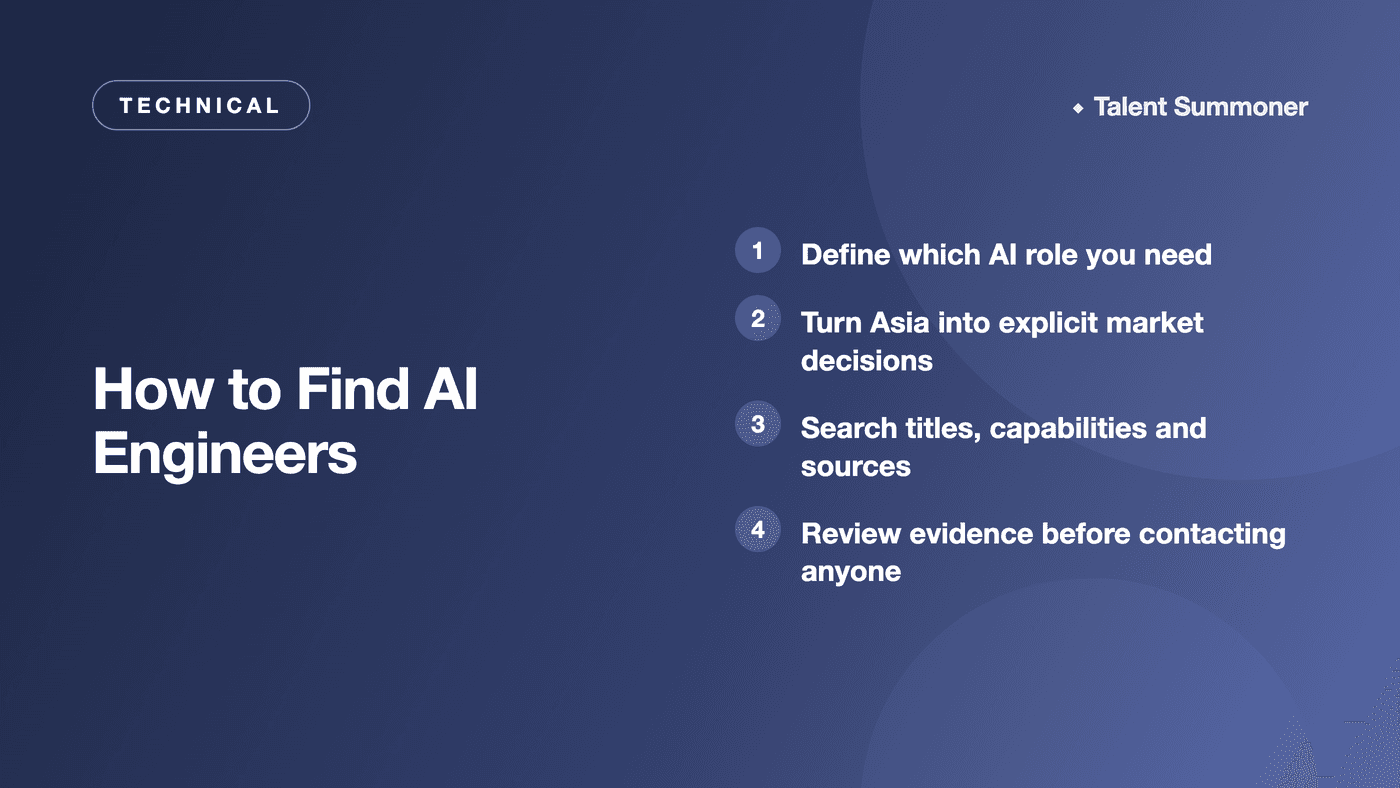
Define which AI role you need
"AI engineer" can describe materially different work. Write a role brief around ownership and evidence before choosing search terms.
- ML research: develops or evaluates models, experiments, datasets and papers. Look for a relevant problem, reproducible method or evaluation discussion, not a publication count alone.
- Applied ML: takes models into a product, including feature design, evaluation, inference and monitoring. Ask for evidence of a model or ML feature used in a real product and the trade-offs.
- MLOps or ML platform: builds pipelines, serving, orchestration, observability and governance for ML. Look for stated ownership of reliability, deployment or reproducibility.
- Data roles: may cover analytics engineering, data engineering, data science or data quality. Specify pipelines, experimentation, forecasting, analytics or another outcome; "data" is too broad.
- Product or software engineering with AI: integrates model APIs, search, evaluation, user workflows or safety controls. Define the software and product decisions the person owns.
For each must-have, write confirming evidence: a design explanation, implementation, code review, work sample or candidate account. A title, repository, paper or tool list is a signal, not proof of capability, authorship or production responsibility.
Turn Asia into explicit market decisions
Name the country or city, whether the role is local, remote or relocation-based, and working-hour overlap. Record the time zone, not "Asia time". Ask candidates to confirm location, working pattern, availability and relocation; do not infer these from country, employer, photograph or profile language.
Check work authorisation with the relevant local government authority before promising employment, sponsorship or a start date. The route depends on jurisdiction and circumstances; this is general information, not immigration or legal advice. Check payroll, tax and contractor classification locally.
Set compensation in a form candidates can understand: currency, base pay, variable pay, equity, benefits, allowances and exchange-rate assumptions. Use a current, market-specific source or adviser and date it. Do not carry a figure across countries or present an advertised range as accepted compensation.
Decide what public information is necessary, who can access it, how long it is retained and how a candidate can ask about it. Check current privacy and employment guidance in each jurisdiction. Public visibility does not mean unrestricted reuse; a sourcing tool does not replace your data process.
Search titles, capabilities and sources
Search title variants that match the brief: Machine Learning Engineer, Applied Scientist, Research Engineer, ML Platform Engineer, MLOps Engineer, Data Engineer, Data Scientist, AI Product Engineer or Software Engineer, AI. Add only relevant methods, systems and domain terms, such as model evaluation, computer vision, recommendation, LLM applications or data pipelines. Search each market separately against its location and working constraints.
Use applications, referrals, networks, LinkedIn, GitHub, personal sites and relevant papers. LinkedIn's public-profile guidance, checked 4 October 2026, says members choose what is visible. GitHub's profile documentation and contribution reference describe selected information and activity. Save each URL and date. A paper or repository supports a question; neither establishes authorship, current skill, availability, interest or permission to reuse data.
Review evidence before contacting anyone
Keep one record per person with brief version, market, source, evidence, unknowns, contact basis, owner and next action. Deduplicate by stable profile URL or candidate-provided identifier, not name alone. Review must-haves before nice-to-haves; label claims candidate-stated, publicly demonstrated, conflicting or unknown. Missing information stays unknown.
Turn signals into consistent questions: what did the person own, what constraints shaped the design, how was quality measured, and what happened when the system failed? Use a structured technical conversation or proportionate work sample. The hiring team decides; AI ranking is not a prediction of job performance or a substitute for consent and assessment.
Talent Summoner is our product for role-based discovery. Its candidate-sourcing workflow starts from a brief and searches LinkedIn, GitHub and other public professional sources across 200M+ profiles. It returns a ranked shortlist with must-haves, nice-to-haves and plain-English reasoning; feedback can adjust a later search. Verify evidence and data basis yourself. It can send outreach from your own connected Gmail, Outlook or LinkedIn account, but only after you review each message and confirm the send; it does not manage an ATS pipeline. Our free candidate-ranking tool accepts up to 50 CVs and creates shareable reports. See pricing.
Contact with a local, specific message
Before outreach, confirm location, working hours, employment model, compensation and open questions. Explain why the person's stated work is relevant and invite an optional conversation. Keep one owner, record the response and stop at a decline. A public profile is not an application; Talent Summoner can send outreach from your own connected Gmail, Outlook or LinkedIn account, but only after you review each message and confirm the send.
FAQ
Is "AI engineer" a useful search title?
It is a useful starting phrase but too broad alone. Pair it with the track, evidence and market constraints.
Should I search all of Asia at once?
No. Treat each country or city separately for location, time zone, authorisation, compensation, data handling and search terms. Expand when you can perform the same checks.
Does a paper or GitHub repository prove an AI engineer is qualified?
No. It provides a question, not proof of authorship, production ownership, current capability, availability or interest. Verify it with the candidate.
Can Talent Summoner hire AI engineers for me?
No. Talent Summoner is our product for sourcing and shortlist review. Your team handles local checks, consent, interviews and decisions, and reviews each outreach message and confirms the send before anything goes out.
Choose one AI role and one Asian market. Write three observable must-haves, add local checks and run a focused search for evidence to review.
Related: Hiring Developers in Singapore: A Founder Guide · Hiring Developers Across Borders: Operating Models Compared · Hiring a Founding Engineer: Sourcing and Evaluation Plan
Talent Summoner product facts read from our live candidate sourcing, candidate ranking and pricing pages, verified 3 October 2026. We re-verify this page quarterly — tell us if something changed.