 Talent Summoner
How to Find Backend Engineers
Where backend engineers are visible, what evidence to read in their public work, and how to run a Hong Kong search without a recruiter.
 By Nicholas Yan · Published · Updated · in Roles & Markets
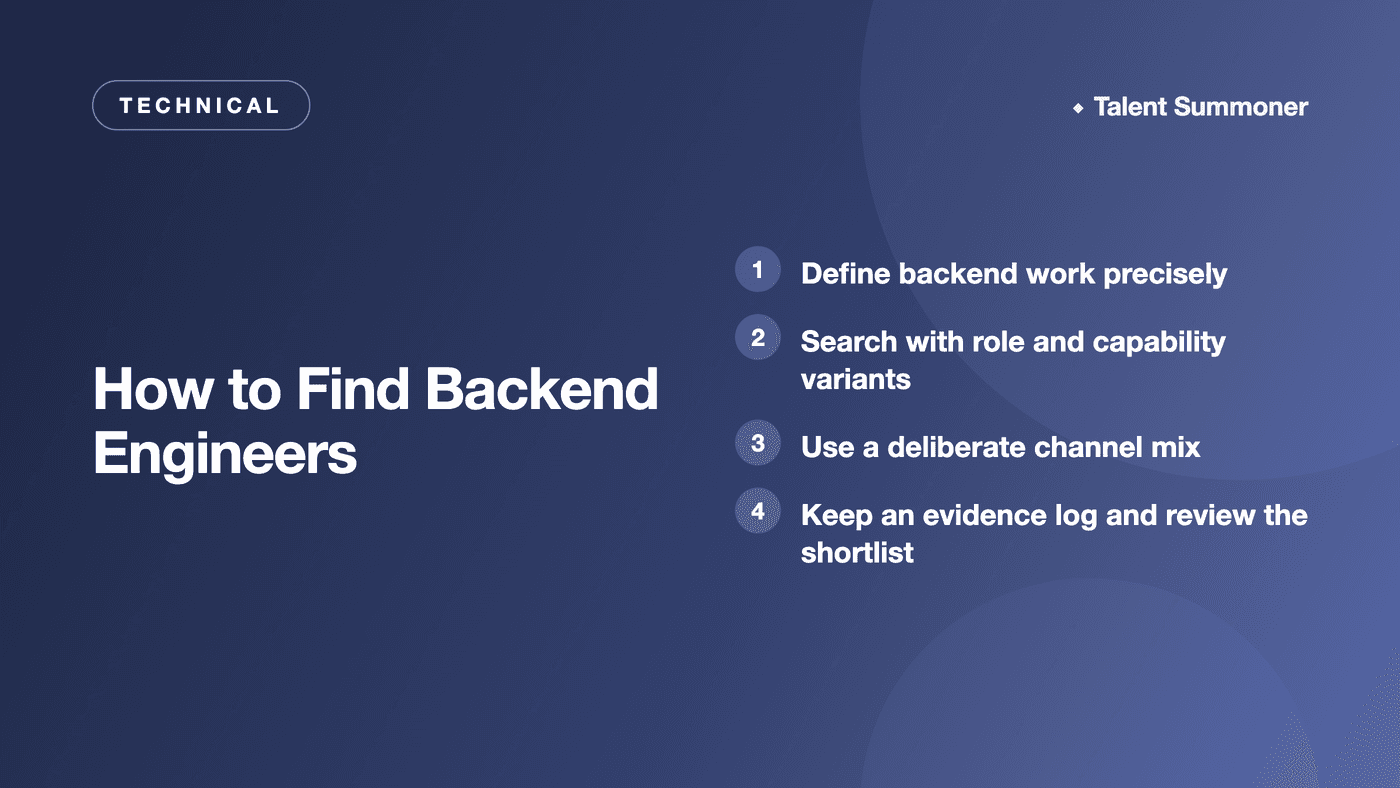
Finding backend engineers in Hong Kong starts with defining the systems work you need, not copying a job title into a search box. Connect role scope, evidence, channels and a clear hand-off to the person who will make contact.
Define backend work precisely
Write the operating context before searching. Is the engineer building APIs, internal services, data-intensive systems, event-driven workflows or platform tooling? State ownership, incident responsibilities, security requirements, team structure and whether the job is office-based, hybrid or remote from Hong Kong. Separate immediate requirements from learnable skills.
Turn each must-have into observable evidence. A backend brief might ask for:
- designing and operating an API, including failure and versioning trade-offs;
- choosing data models, indexes and consistency approaches for a real workload;
- debugging a queue, batch job or distributed service in production; and
- using observability, authentication, authorisation and safe data access practices.
These prompts support verification, not assumptions. Titles, years, GitHub stars or a long tool list do not prove ownership or reliability work.
Search with role and capability variants
Use several title variants so a narrow label does not decide who is discoverable: Backend Engineer, Backend Developer, Software Engineer (Backend), API Engineer, Platform Engineer, Distributed Systems Engineer or Site Reliability Engineer when reliability is in scope. Add capability terms such as APIs, SQL, event streaming, queues, Kubernetes, observability or application security. Include only languages the team will use.
Search Hong Kong as a working constraint, then state what counts as a match. A profile may not clarify current location or availability. Keep those as questions for the candidate. Do not infer language ability, work authorisation, relocation willingness or interest from a name, photograph, employer or profile wording.
Use a deliberate channel mix
Combine inbound applications, referrals, professional networks, LinkedIn, GitHub and other public professional sources according to the evidence each route can provide. An application shows a response; a referral can add context; a public profile can help discover relevant work. None replaces a technical conversation.
For public sources, record the exact URL and review date. LinkedIn explains that a public profile is simplified and selected by the member. GitHub's profile documentation and contribution reference describe selected information and activity, not a complete work history. A repository or graph is a question prompt, not proof of authorship, impact or interest.
Public availability also calls for restraint. This is general information, not legal advice. The Hong Kong Privacy Commissioner for Personal Data's Code of Practice on Human Resource Management, checked 19 August 2026, advises explaining purpose and potential transferees when collecting applicant data, keeping it relevant and protecting access. Apply your organisation's privacy process; public visibility does not remove those responsibilities.
Keep an evidence log and review the shortlist
Use one record per person with the brief version, source URL or referral path, review date, relevant claim, evidence, unknowns, contact basis, owner and next action. Deduplicate by stable profile URL or candidate-provided identifier, not name alone. Mark evidence as candidate-stated, publicly demonstrated, conflicting or unknown. Missing information is unknown, not a rejection reason.
Review must-haves first, then nice-to-haves. Turn each promising signal into a focused question: what did the person own, what constraints shaped the design, how was failure detected, and what changed? A design discussion, debugging conversation or small work sample can test reasoning. Use consistent criteria, record uncertainty and let the team decide.
Talent Summoner is our product for role-based discovery. Its candidate-sourcing workflow starts from a brief and searches LinkedIn, GitHub and other public professional sources across 200M+ profiles. It returns a ranked shortlist with must-haves, nice-to-haves and plain-English reasoning; feedback can adjust a later search. Treat it as a review aid, not proof of ability or an automatic decision. It sends outreach email only after you review and confirm it, and does not manage an ATS pipeline. See current pricing; sourcing is free to start.
Hand off contact responsibly
Before messaging a shortlisted person, agree on one owner, the evidence that made the profile relevant, open questions and the working pattern. Send a specific, optional invitation identifying the role and why the experience appears relevant. Ask the candidate to confirm location, interest, timing and constraints. Record the response, avoid duplicate approaches and stop when the person declines.
For compensation, use the dated Hong Kong software engineer salary guide and its Jobsdb backend developer source, checked 19 August 2026. Jobsdb reports advertised, not accepted, compensation. Recheck the source and define package assumptions before setting a range.
FAQ
What should a backend engineer search include?
Start with the work: APIs, data modelling, services, queues, reliability, observability and security. Use title variants such as Backend Engineer and Platform Engineer, then add only needed languages and systems.
Does GitHub prove that someone is a strong backend engineer?
No. Public repositories and qualifying activity create follow-up questions, but do not prove ownership, production responsibility, quality, availability or interest. Verify the work with the candidate.
How should I handle an incomplete Hong Kong profile?
Record the missing detail as unknown. Ask directly about current location, working pattern, timing and any work-authorisation question. Do not infer those facts from a profile, name or employer.
Can Talent Summoner contact candidates for me?
It can send a message through your connected Gmail, Outlook or LinkedIn account, but only after you review and confirm each message — it never contacts anyone on its own. Your team still reviews evidence, chooses the contact route, handles replies and makes the decision.
Start with one backend role, write three evidence-based must-haves and prepare the review log. Then run a focused candidate search, review the evidence and assign one contact owner.
Related: How to Find AI Engineers · Hiring Developers in Singapore: A Founder Guide · Hiring Developers Across Borders: Operating Models Compared
Talent Summoner product facts read from our live candidate sourcing, candidate ranking and pricing pages, verified 3 October 2026. We re-verify this page quarterly — tell us if something changed.